 EN
EN  Romana
 Magyar
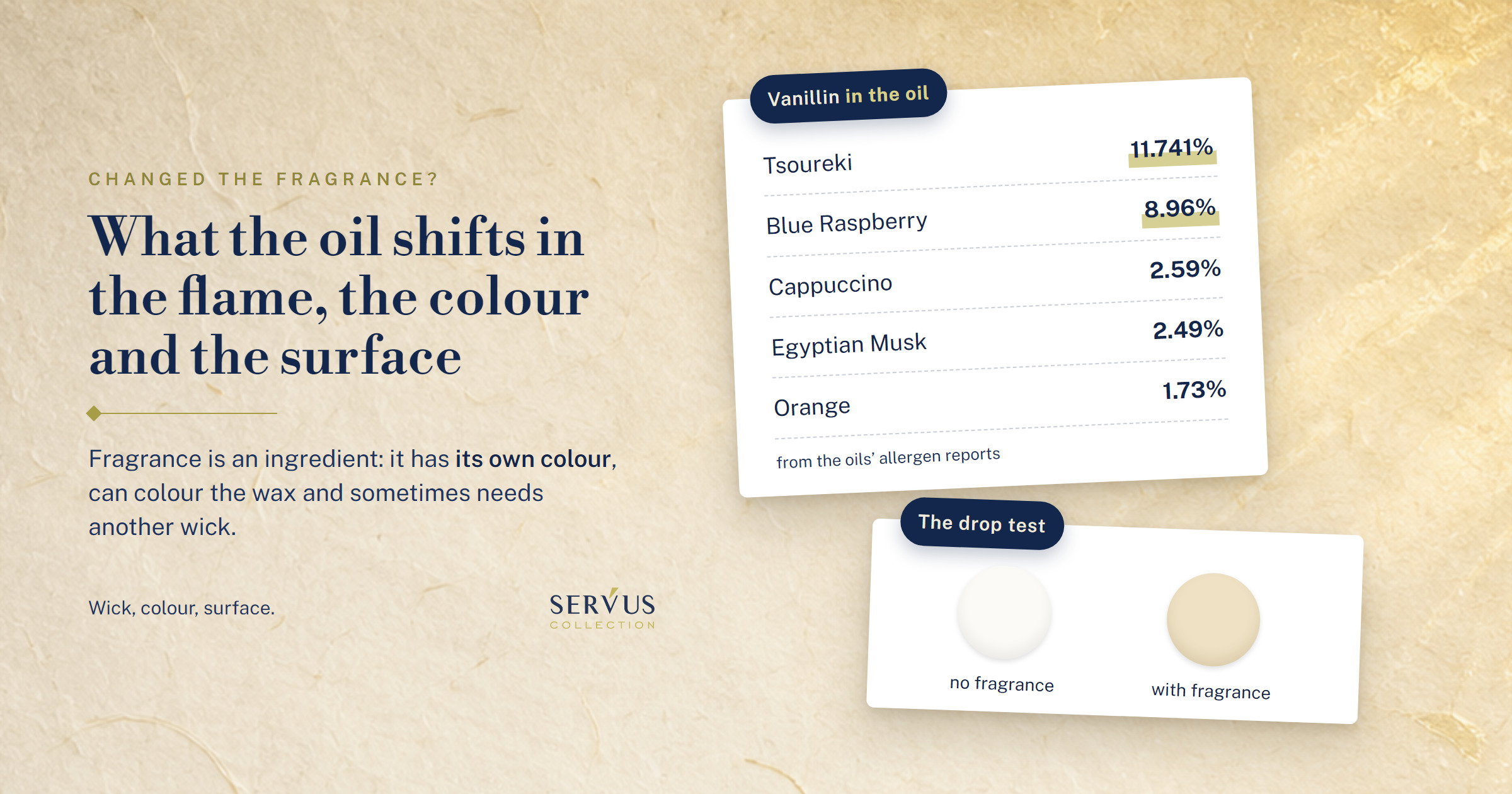
Same wax, same wick, same glass, and you changed one thing: the fragrance. The new candle burns differently, comes out cream instead of white, or has an oily film on top. The batch hasn't gone wrong. Fragrance isn't just scent, it's an ingredient: it has its own colour, a composition that colours the wax, and a weight the wick feels.
A new fragrance can shift three things: the flame, the colour and the surface. You can read all three if you pour the old recipe and the recipe with the new fragrance side by side, under the same conditions.
I'm Sînziana. In our workshop in Maramureș, Romania, we've been pouring candles since 2010, and we sell on the fragrances, waxes and wicks we work with ourselves. The figures below come from the safety data sheets and allergen reports of our oils, as we've written them on the product pages.
Below you'll find what fragrance changes in a candle, how to find out what exactly changed without redoing the whole recipe, the table of vanillin in our fragrances, and what to prepare before your first batch with a new scent.
What does fragrance change in a candle, apart from the scent?
Fragrance can change how the wick burns, the colour of the wax and the surface of the candle. All three come from the same fact: the fragrance oil stays in the wax as an ingredient, with its composition and its colour, and reaches the flame along with it.
The data sheets of the waxes we sell say this in almost the same words for KeraSoy Container 4130, EcoCoco and EcoOlive: the fragrance, the colour and the shape of the candle change the wick it needs, and every combination of wax, dye, fragrance and wick has to be burn-tested. No data sheet gives you a recipe that works with any fragrance.
Why can a new fragrance need a different wick?
Because fragrance can change the burn, and two fragrances don't change it the same way. The data sheet of the 4130 soy wax says that some fragrances react badly with the wax and can give a weak flame, especially those made for paraffin candles. It also recommends fragrances developed for natural waxes.
That doesn't mean you change the wick with every fragrance. It means the wick chosen for the old fragrance is a hypothesis for the new one, not a certainty. If the candle with the new scent tunnels, goes out or blackens the glass, the first suspect is the change you made: the fragrance. The signs and what to read from them are in our article on the wick that goes out and in the one on soot.
Why does a vanilla-scented candle turn yellow?
Because vanillin and other components of the scent colour the wax. On the page of our Vanilla oil we write what we've seen in the workshop: at 5% in the wax, the scent shifts the wax towards cream or beige, visible especially on white wax and on pastel shades. We saw it on the drop test, on a white worktop, before pouring the batch.
Vanilla isn't the only one. Ginger Cookie came out creamy yellow in the workshop, and it's not a batch defect. And there's something simpler: the oil itself has colour. Of the 32 fragrance oils active on our site, for 24 the safety data sheet gives the liquid as "light yellow to amber". For another 7 the data sheet doesn't state the colour of the liquid, and for the last one we don't have the property table yet. The colour of the oil can change the shade of white wax. How much, at your percentage, you find out from the test: the drop shows you the colour at the start, and the candle kept for a few days shows whether it moves further.
The surface: the oily film above the wax's limit
When you put in more fragrance than the wax can hold, the oil comes up to the surface. The data sheets give the limit: KeraSoy Container 4130 takes fragrance up to 10–12%, KeraSoy Pillar 4120 between 5 and 10%, and above 10% the fragrance can separate. On the Ginger Cookie page we also write the second cause: oil on the surface means wax that was too cold or a percentage that was too high.
A new fragrance pushes you towards the limit without you noticing, especially when the new scent seems weaker cold and you raise the dose to smell it. In our formulas we stay at 6–8% in containers and 5–6% in moulds, and how to work out the percentage per kilogram is in our article on how much fragrance you need.
How do you find out what the fragrance changed without redoing the whole recipe?
Pour two pieces: the old recipe, with the fragrance you've used so far, and the recipe with the new fragrance, at the same percentage, with the same wick, in the same type of container. If the difference between them repeats under the same conditions, the fragrance change is the main clue. That way you're no longer guessing between five causes.
The rule is the one from any workshop test: change one thing at a time. If you put a new fragrance, a new dye and a different wax into the same batch, and the candle came out differently, you have no way of knowing which of them did it.
The control candle: the old recipe, poured next to the new one
The control is the recipe you know: same percentage, same wick, the fragrance you've used so far. Split the melted wax into weighed portions, put each portion's fragrance in and pour both at the same temperature, at the same time. If you also want to see how your wax burns on its own, pour a third portion without fragrance, from the same pot.
Put a drop from each portion on a white worktop too. Read them once they've set completely, not warm, as we wrote in the article on liquid and solid dye. If the recipe also has dye, leave it for the next pour, once you know what the new fragrance does.
What do you note at the first burn and after two days?
For our KeraSoy soy waxes, for moulds and for containers, the data sheets give 48 hours from pouring to the burn test. With another wax, follow the interval in its data sheet. What matters is that the pieces you compare are the same age. You judge the cold scent, the hot scent and the colour. When burning, watch the same things on both pieces: how quickly the melt pool forms, whether it reaches the edge, the height of the flame and whether the glass blackens.
Write the fragrance, the percentage, the wax, the wick and the temperature at which you added the fragrance on the same sheet. The test sheet we use ourselves is in the article on the burn test. Without notes, today's test won't help you with next month's batch.
When do you change the wick and when do you change the fragrance?
Think about the wick only after the difference has repeated and you want to keep the new fragrance. If the old recipe burns well and the new one burns weakly, with the same wick, the new combination of fragrance, dose, wax and wick needs adjusting. You have three options to test: a different dose, a different fragrance or a different wick. The wick one size up is one of them, not the sure fix.
What you don't do is raise the dose when the candle smells weak and burns too hot. On the page of the waxed wick we write that a melt pool deeper than half a centimetre is the sign to check the wick first, not the dose, and that more fragrance in an overheated candle makes the result worse.
Vanillin in our fragrances: where you see it on the data sheet
For 12 of the 32 fragrances active on our site, vanillin or ethyl vanillin appears in the composition written on the product page. For 8 of them we have the vanillin percentage from the scent's allergen report, which you'll find under Download on each fragrance's page. For Vanilla we have a range of ethyl vanillin, from the safety data sheet. For the other three, the composition names it without a percentage.
The percentage isn't a colour forecast. The allergen report tells you how much is in the oil, not how much shows in your wax, at your percentage. But it tells you where to look first.
Which Servus fragrances have vanillin on their safety data sheet?
The table below is taken from the product pages. For Vanilla the percentage is from the safety data sheet, for the others from the allergen report.
| Fragrance | Vanillin / ethyl vanillin in the oil | Colour of the liquid, from the data sheet |
|---|---|---|
| Tsoureki | 11.741% | light yellow to amber |
| Blue Raspberry | 8.96% | not given on the data sheet |
| Cappuccino | 2.59% | light yellow to amber |
| Egyptian Musk | 2.49% | light yellow to amber |
| Orange | 1.73% | light yellow to amber |
| Cashmere Kush | 1.24% | light yellow to amber |
| Opium | 0.597% | light yellow to amber |
| Fresh Linen | 0.396% | light yellow to amber |
| Vanilla | ethyl vanillin 1.81–3.72% | not given on the data sheet |
| Ginger Cookie | in the composition, no percentage | light yellow to amber |
| Strawberry Slush | in the composition, no percentage | light yellow to amber |
| Weed Out – Smoke Out | in the composition, no percentage | light yellow to amber |
For Vanilla and Ginger Cookie we've seen the colour in the wax, and it's written on their pages. For the other ten, the table only says what's in the oil. How much it changes the shade in your wax you find out from the drop test. And if a fragrance isn't in the table, that doesn't mean it leaves the wax white: the manufacturer's documents only list the components it's required to declare, and the oil has its own colour anyway.
What do you do when you want a white candle with a gourmand scent?
Do the drop test with the chosen fragrance, at the final percentage, before you promise anyone a white candle. If the set drop comes out cream, you have two honest options: choose another scent and test it the same way, or keep the scent and sell the candle as cream.
On the Ginger Cookie page we say plainly that this scent won't give you clean white. And if the batch is already poured and came out cream, the only honest thing is to sell it as the shade that came out, not the one in the photo.
Where to start
Start with the documents of the new fragrance, before the scale. From them you take three things: the colour of the liquid, the flash point and, from the allergen report, whether it contains vanillin. Then pour the old recipe and the new one from the same pot.
What do you prepare before the first batch with a new fragrance?
Take the temperature at which you add the fragrance from the wax's data sheet, not the fragrance's: for our container soy wax, 60–65 °C, with the pot off the heat. The flash point on the fragrance's safety data sheet is safety information for handling, not the fragrance-adding temperature. It differs a lot from one scent to another: on our pages, Strawberry Slush has it at 62 °C, Orange at 75 °C and Lavender at 92 °C. That's why you read it for every new fragrance and don't carry it over from the old one.
Then prepare the weighed portions, one container for each, the same wick for all of them and a sheet for notes. Pour, wait for the interval in the wax's data sheet, and light the pieces under the same conditions. Pour the batch only after the piece with the new fragrance has burned well almost to the end.