
 EN
EN  Romana
 Magyar
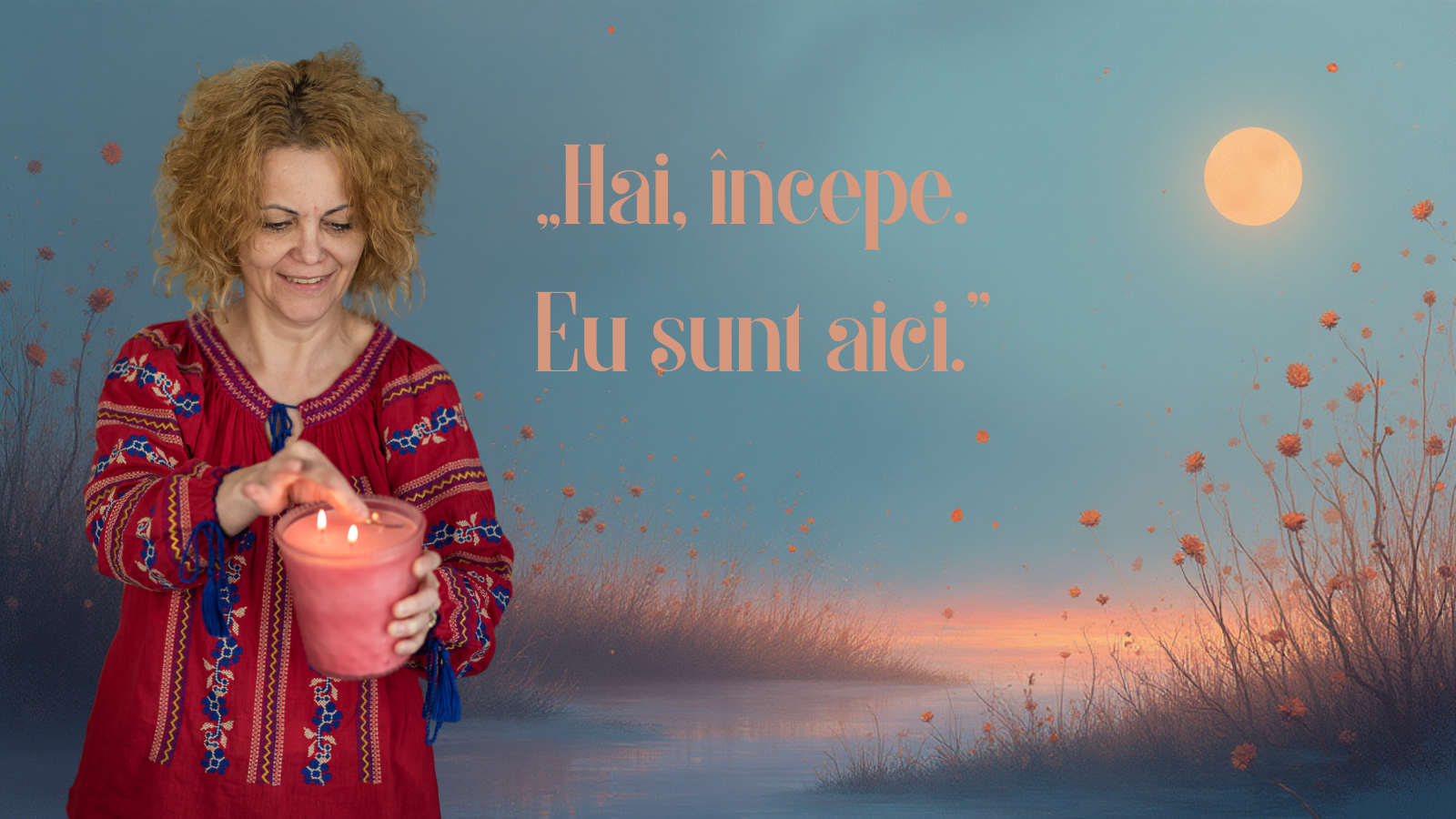
There is a certain kind of light that never comes when you call it, nor when you wait for it, nor when you feel you’ve done “everything right”, but appears only when tiredness, doubt and honesty settle together, like fine layers of the same truth. It is a light that doesn’t fall on objects, but unfolds you from within, a light that creeps slowly across the surface of things, slips into the creases of your palms, smooths your thoughts and, without asking you anything, leaves you in reply a quiet that only true beginnings know.
That is how every Sunday begins in my workshop: not with noise, not with plans, not with lists, but with this warm, round light that slips between the shelves, settles over the stainless steel pots, strokes the edges of the workbench and wraps me like a thin cloak, alive and see-through.
I let it come.
I let it look at me.
I let it tell me who I am.
And every Sunday, before I touch the wax, before I switch on the hob, before I choose the wick or reach for a fragrance, the truth rises to the surface on its own, clear, whole, without a mask:
Servus, I’m Sînziana.
And this isn’t just a workshop. It is a road. A confession. A growing. A light that chose me, not the other way round.
Here we don’t make candles — here stories heal.
Here it isn’t wax that melts — here fears melt, patience is moulded, destinies small and large are lit.
Here every step has its memory, and every memory has a person behind it.
And if I go back in time, to find where the Servus story really began, the light inevitably leads me to a place I wouldn’t have chosen, but which chose me.
The Netherlands – the chapter where I learnt that light has a family
It was a cold morning in the Netherlands, with a milky-white light trickling over the orderly buildings and the calm streets, almost too calm for the restlessness I carried inside me.
I walked into the workshop room as into a cathedral of candles: a large space, clean, immaculate, with tables set out like altars of light; people from countries with other languages, other scents, other silences, but with those grateful, tired eyes of people who have understood that beauty asks for everything.
I felt, from the very first glance, that I wasn’t alone.
That the world of candles is an invisible continent, with borders made of passion and roads paved with trials.
I sat down at the table, and my hands touched for the first time waxes so fine they seemed alive, fragrances so complex they had a story before you touched them, tools I had only ever seen in photographs, and I felt a deep, almost childlike emotion:
my workshop in Maramureș was part of this world.
I wasn’t a spectator.
I was a participant.
I was in a place where light wasn’t a hobby, but a universal language.
On the second day, while I was testing a dense, perfectly translucent wax, I felt my chest tighten and let go at the same time.
I understood that I don’t make candles “because that’s how it was meant to be”, but because somewhere along my road, the light chose me before I chose it.
And that evening, in the hotel room, with my hands smelling of warm wax and my mind still caught between cultures, methods, temperatures and destinies, I silently told myself a truth I had denied for years:
“Sînziana, you didn’t come here to learn, but to remember.”
It was the first great beginning of Servus.
Greece – the candles that lit up the waves
Then came Greece.
And with it, a short call, full of the emotion of people who know they’ve placed their hope in a stranger:
“We’re having a wedding on the beach, at sunset… and we need candles that won’t go out.
That won’t give in to the wind.
That smell warm, but not heavy.
That stay beautiful even when the sea breathes harder.”
A request like that isn’t an order.
It is trust.
And that trust suddenly made me feel a responsibility inside me, beautiful and heavy at once.
I worked for three days without stopping, with the kind of focus that doesn’t tire you but fills you with energy.
Wicks tested in ways I had never tested them before.
Colours adjusted with fine, perfectly transparent shades.
Fragrance left to rise slowly, not to attack, not to dominate, but to embrace the atmosphere.
Wax cooled slowly, with long breaths, like a ritual older than me.
When the candles were ready, I packed them like fragile souls and sent them by plane, without knowing exactly what road they would take.
But they knew.
And that evening, as the sea moved slowly and the warm air of Greece floated like a sleeping story between the waves, the Servus candles lit up the beach.
All I received was a photograph, a sunset and a few words:
“They held. They shone. They were more than we hoped for.”
And I hung up with a lump in my throat, feeling something deep:
that the Servus light finds its way even when I can’t see it.
Sinaia – the night time stood still so the light could arrive on time
Then came that night which seems lifted from a film where you don’t know if you’ll make it, but you carry on anyway, because someone else is depending on you.
It was Thursday into Friday, late.
The workshop was in that half-silence where only the objects hold their breath.
When the phone rang, the voice at the other end was full of hope and fear in equal measure:
“We’re getting married on Saturday morning, in Sinaia.
I know it’s impossible… but could we have two candles?”
“Impossible” is a word that switches me on.
It doesn’t scare me.
It doesn’t annoy me.
It wakes me up.
The children were asleep.
The house was quiet.
In the workshop the light was warm, tired, but alive, like a friend who doesn’t go home even though it’s past midnight.
I melted the wax at 23:30, with a ritual calm.
The fragrance began to rise, almost like a sacred steam.
I poured slowly, with an attention that made me forget time, sleep, limits.
And that night, with the world asleep around me, I felt that it wasn’t only the candles taking shape, but a kind of destiny too, small, round, secret.
On Friday morning, the candles left.
On Saturday, first thing, the message came:
“They’ve arrived. They’re perfect.”
And I closed my eyes, took a deep breath and felt that truth only makers know:
light always reaches the place where it is needed.
Aurelian Temișan & Monica Davidescu – the night we invented the impossible
Then came the request that changed forever the way I look at candles.
“We want the message to be in the candle.
Not stuck on.
Not written on.
Part of it.”
Aurelian Temișan and Monica Davidescu didn’t ask for a product.
They asked for a vision.
They asked for a symbol.
They asked for something that didn’t exist.
And in that long night in the workshop — a dense night, full of attempts, of beautiful mistakes, of courage, of stubbornness, of tenderness and of a light that didn’t tire — I found myself working with a kind of devotion you don’t know until you live it.
I tested.
I got it wrong.
I tested again.
I found it.
I lost it.
I adjusted.
And in the end, before the sun came into the workshop, I made it:
the message lived in the candle, as if it had been born there.
For me it was a moment of spiritual recognition:
candles aren’t simple shapes of wax — they are the imprints of the people they serve.
Their whole story is here, if you’d like to see it:
https://www.lumanariservus.ro/en/blog/wedding-and-baptism-in-paradise-with-our-candles.html
And that night, in the quiet of the workshop, I told myself:
“Sînziana, this isn’t a trade any more.
This is destiny.”
There are moments in life — few, perhaps only a handful along the whole road — when the universe shows you, without sparing you, what it means to be fragile, to be vulnerable, to be human before matter.
Not through big, loud tragedies, but through those moments when a truth so simple and so devastating hits you that it takes your breath away.
For me, that moment came one afternoon when I opened the workshop door and found myself facing a sight I will never forget.
The burnt pot – the darkness that woke me up
Wax, when it burns, doesn’t scream.
It doesn’t blink.
It gives you no sign.
It doesn’t ask for help.
It evaporates.
It disappears.
And it leaves behind a dense, black smoke, like a thick, heavy silence that swallows everything without leaving you time to understand.
When I walked into the workshop, I first felt the smell — that bitter, heavy smell of burnt wax, something between damp wood smoke and the breath of hot metal.
Then I saw.
Everything, absolutely everything, was covered in soot: the shelves, the jars, the tools, the finished candles, the walls, the floor, even the air had a dark density, as if time had stopped in a moonless night.
For a few seconds I stayed in the doorway, my hand on the handle, unable to breathe, unable to think.
And then, from somewhere deep and unknown, an impulse came:
“Don’t cry.”
But tears don’t take orders.
They ran.
And they fell on the soot-covered floor, drawing small, round dots, like stars in a dirty universe.
In that instant I felt all my limits, all my fears, all the tiredness gathered over the years.
I felt my helplessness, my responsibility, my shame, my guilt, all mixed into a single thought:
“What if there had been a fire?”
What if someone had called me too late?
What if I had lost the workshop?
What if I had lost everything?
What if…?
I felt a cold shiver down my spine, a kind of memory of a danger that hadn’t happened, but could have.
And in that instant, in the middle of the chaos, I understood that sometimes darkness doesn’t come to burn you, but to wake you up.
I closed my eyes.
I breathed.
And I said:
“Right. Let’s go.”
Seven days – the rebirth of a workshop and my own
Seven days followed in which I carried everything outside.
Seven days in which I washed until my palms began to hurt.
Seven days in which I scrubbed the walls with a kind of calm desperation, as if the soot wasn’t only on the surfaces, but in me too.
Seven days in which I felt every gesture was a form of penance, but also a form of healing.
I threw things away.
I saved others at the very last moment.
I found out how heavy a shelf full of jars is when you carry it up the stairs on your own.
I smelled the warm water mixing with the soot like a paste of forgetting.
I felt the pain in my shoulders, my neck, my back, pains you only recognise when there’s no one left to share them with.
But with every piece of soot I took off the wall, I felt I was starting myself over too.
That something was being cleaned inside, not just in the workshop.
That I was letting myself leave an older version of me behind, to make room for a new beginning, unexpected, but necessary.
On the last evening, when the workshop was white again, bright, breathable, I sat down on the floor, between the shelves, my back against the still-damp wood, and felt a clean, round, deep quiet.
Not triumph.
Not pride.
Not ecstasy.
Gratitude.
Because there was no fire.
Because it wasn’t the end.
Because I had been given a painful lesson, but not a devastating one.
Because sometimes life knocks on your door not to frighten you, but to set you back on your feet.
And there, on the freshly washed floor, in the workshop brought back to life, I felt something I will never forget:
“Sînziana, this light wants you alive.”
Recognition – the way makers find each other in the world
There is a secret way in which people who create with their hands look at one another.
Not as rivals.
Not as strangers.
But as members of the same unseen family.
People who knead bread, who carve wood, who paint icons, who sew beads, who mix soap, who pour candles — recognise each other without words.
It’s a light in the eyes.
A warm silence.
A way of breathing together.
And often, deep inside, without saying it out loud, without anyone needing to say a thing, I feel in my chest that old, simple phrase, which carries more weight than it seems:
“Brother, I recognise you for what you are.
You’re one of mine.”
Not as status.
Not as merit.
But as light.
Because people who create aren’t bound together by titles or diplomas, but by something much deeper:
by the way they carry the light in their palms.
What is Servus?
Servus isn’t a brand.
It isn’t a workshop.
It isn’t a business.
It isn’t a place.
It isn’t a shop.
It isn’t a label.
Servus is a living, warm, vulnerable space — like a heart lit slowly, beating through every candle, every story, every person who has passed through here.
Servus is the place where light is made of people.
Servus is the place where mistakes become lessons, lessons become roads, roads become light.
Servus is the place where there is no “too late”, “too hard”, “too big”, only the question:
“What is the light trying to tell you now?”
And if you too make something with your hands — anything —
if you shape something, if you create something, if you leave behind an object that wouldn’t have existed without you, then, in a deep and real way, you are part of this story.
Because light binds us.
And light recognises us.
And light holds us.
The end of the manifesto – the light that is waiting for you
On a Sunday morning, like this one, in my workshop, which has seen enough to be a witness, not just a space, the light settles on the cold table and whispers to me, unhurried, without false promises, without drama:
“Go ahead, start.
I am here.”
And in that moment, I understand.
That the light never ends.
That it only waits.
And that when you welcome it with an open heart, it takes you exactly where you need to be.