
 EN
EN  Romana
 Magyar
CLP label calculator for candles, diffusers and room sprays
The safety (CLP) label of your candle
Choose the oil and how much you use. See what our oil requires on your candle's label, and why.
1 Your recipe
2 The details on your label
3 Your label, 74 × 52 mm
Why does the pictogram appear on some candles and not on others?
On the IFRA certificate, candles (category 12) usually have no limit. It looks as if a candle needs no warning, but these are two different questions.
IFRA tells you how much fragrance you may use. The safety label (the rule is called CLP) tells you what you write on the candle. For allergies, what counts is not the whole oil but each substance in it: how much of it ends up in the finished candle.
Each allergen has a threshold in the candle: 1% for most, 0.1% for the strong ones, or a lower one written in the safety data sheet. Below one tenth of the threshold, it does not appear on the label; from one tenth, it goes on the “Contains” line; from the threshold, it brings the exclamation mark pictogram, “Warning” and statement H317, “May cause an allergic skin reaction”.
The Lavender example. The oil's data sheet gives 7.5–15% lavandin (a hybrid lavender), an allergen with a 1% threshold. We calculate cautiously, with 15%. In 100 g of candle, 8% oil means 8 g, of which 1.2 g is lavandin: 1.2%, above 1%. So: pictogram and “Warning”. Along the percentage scale:
- up to 0.6% oil: nothing about allergy;
- from 0.7% to 6.6%: only the line “Contains … May produce an allergic reaction.” (at 6%: 0.9 g lavandin, below 1%);
- from 6.7% (6.7 g × 15% = 1.005 g, above 1%): the pictogram, “Warning” and H317.
This is not a rule we made up. Craftovator and The Soap Kitchen, UK suppliers, publish the same for their lavender at 10% oil: the pictogram, “Warning” and H317.
The exclamation mark can also come from another hazard, with its own statement on the label. For the environment (water), H412 comes as text only; H411 comes with the fish-and-tree pictogram, without “Warning”.
The label carries the name, address, phone number and e-mail of whoever places the candle on the market: yours or your company's, not Servus's.
The configurator guides you, but the label is yours: you make the candle, you are responsible for what it says. Another oil with the same name may give a different result.
















FAQ
What does the CLP label calculator do?
Choose the product (candle, reed diffuser or room spray), our fragrance oil and how much of it you use. The calculator shows what you need to write on the label: the pictogram, the word “Warning”, the H and P statements and the “Contains” line. It also tells you why each one appears. You print the label straight from the page.
Which oils and products does it work for?
For the French Color & Fragrance oils in our shop, because we have their safety data sheets. It calculates the label for candles, for reed diffusers and for pump room sprays, both on the Diffusol M base. It does not calculate soap, creams or other cosmetics: a different regulation applies there.
How do I work out the oil percentage?
From the weight of the finished product. For a candle, 8 g of oil in a 100 g candle is 8%. If you calculate on the wax, convert: 7 g of oil per 100 g of wax gives 7 ÷ 107 = 6.5%. For a diffuser, 20 g of oil and 80 g of Diffusol M make 20%. If you enter the percentage on wax directly, the result is stricter than needed.
Why does the diffuser always have “Warning” on its label?
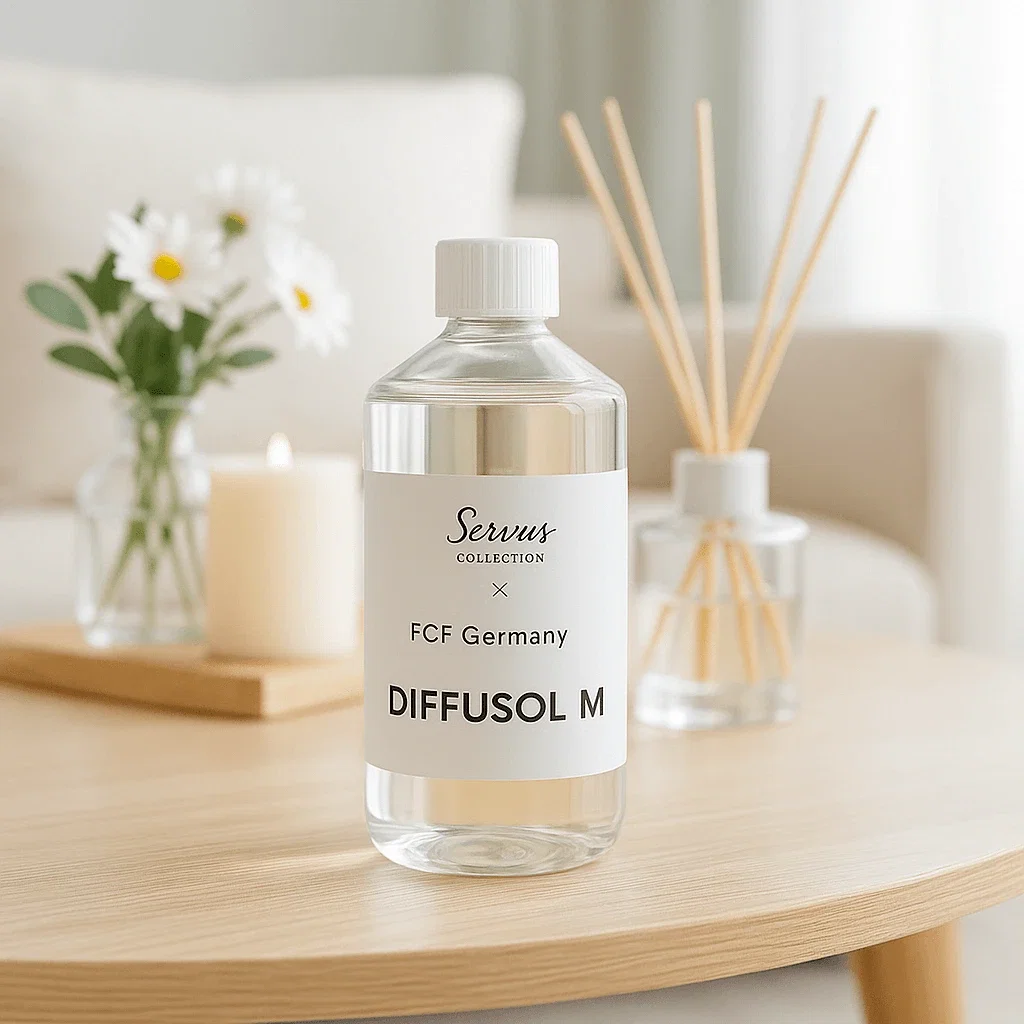
Diffusol M, the base you put the oil in, is classified as an eye irritant (statement H319). It is most of the diffuser or spray, so the exclamation mark pictogram, “Warning” and statement H319 appear on every product made with it, however little oil you use.
Why can’t I choose any percentage for diffusers and sprays?
Because the IFRA certificate of each oil sets a limit for diffusers (category 10A) and sprays (category 10B), which differs from one fragrance to another. For Opium, for example, the limit is 0.88% in a diffuser and 2.05% in a spray. The calculator does not let you go past it. Strawberry Slush and Pink Sands cannot be chosen for diffusers and sprays at all, because their flash point is below 70 °C.
Which of my details must appear on the label?
The name, address, phone number and e-mail of you or your company, that is, of whoever places the product on the market, not ours. Without them the label is not complete and the calculator does not print it. You can enter the batch on the page or write it by hand on the blank line.
How reliable is the result?
The calculation is cautious: for each substance we took the highest figure in the range given in the oil’s safety data sheet. We counted only the oil and the Diffusol M base; the wax and the colourant are assumed to have no hazards of their own. If you add anything else to the product that has a safety data sheet, check that sheet too. The calculator guides you; you are responsible for the label.
Do I have to notify my product to the poison centre?
If its label is classified for health, for example with H317 on a candle or with H319, which every diffuser and spray made on Diffusol M has, the route is this: create your product’s UFI code in the ECHA UFI generator and send the notification to the poison centre through ECHA’s notification portal (PCN). You can give the UFI code of our oil in the dossier, but your label carries your own code. The calculator shows under the label when your product is in this situation.