
 EN
EN  Romana
 Magyar
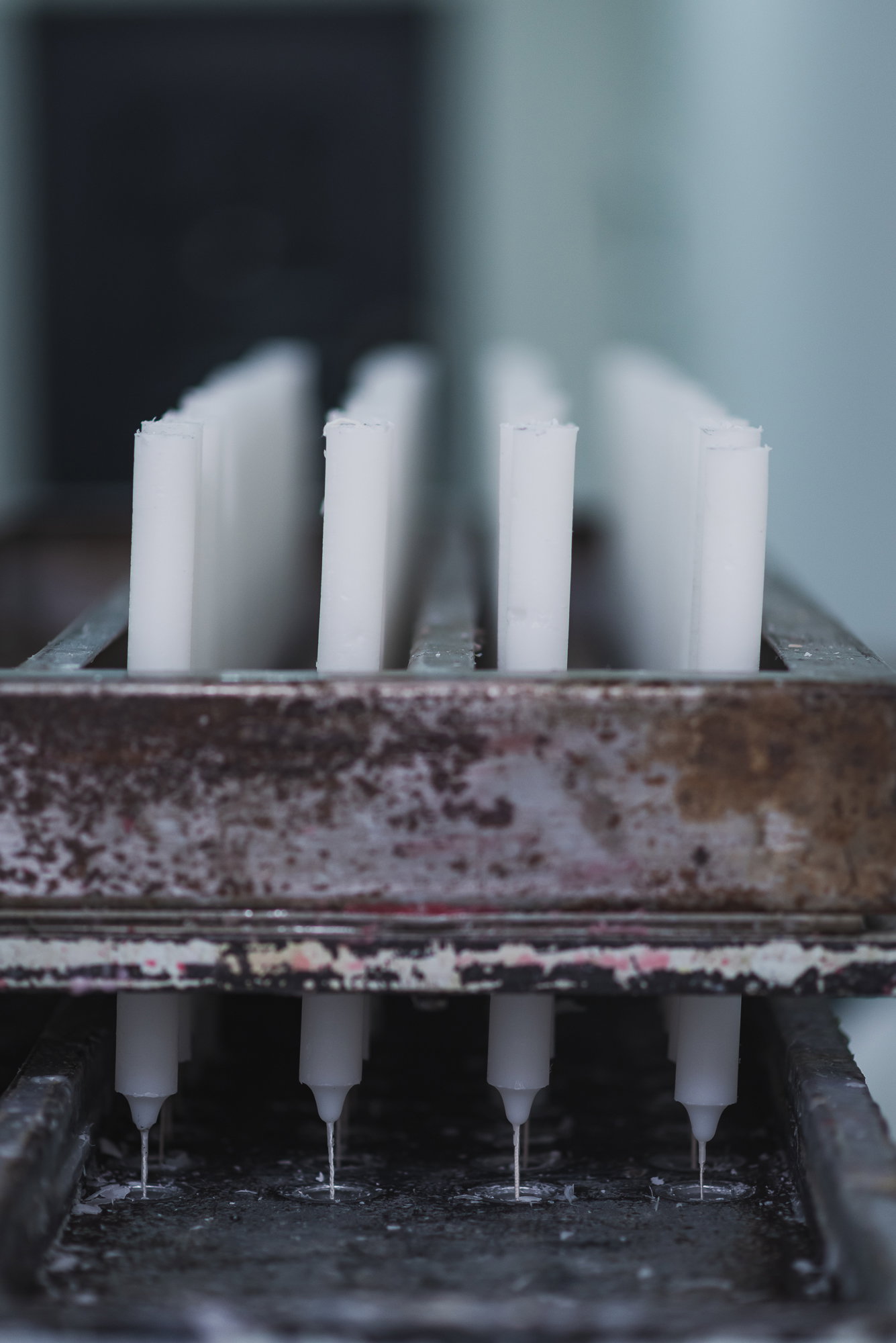
The Servus story of wedding and baptism candles, ruined batches, the first big order and the standard that was built in the workshop.
We dreamed of scented candles.
Candles made slowly, with care, with chosen scents and ingredients we could understand. Not just use. Not just buy because a recipe said so.
In the beginning, in the kitchen, we never imagined that one day we’d talk this much about wedding and baptism candles. About diameters, heights, moulds, deadlines, shipping, florists, church, venue, decorations and photographs.
We didn’t start out with this idea.
The market asked for it.
The market sometimes asks for something other than what you dreamed of
In the beginning, customers asked simply.
Do you make wedding candles too?
Have you got something white, simple, a bit taller?
Can you make them for a baptism too?
We hesitated.
Not because we didn’t want to work. But because the events market already seemed full. Between 2010 and 2015, we had the impression that everyone was making wedding and baptism candles. It looked like a crowded field: hard to get into, easy to copy and hard to take further with an identity of your own.
We came from the workshop.
From testing.
From wanting to know what we were doing.
And maybe that’s exactly why it was hard for us to say "yes" too quickly.
The first event candles came into our range shyly: simple white candles, 4.5 cm in diameter and 35 and 40 cm tall.
They weren’t spectacular products in the classic sense. They had no rich decoration. No complicated story. No big promises.
But they had to be right.
And in the workshop, "right" means more than "looks good in a photo".
An event candle doesn’t live only in the photograph
Over time we understood that an event candle isn’t just a taller candle.
It’s an object that passes through too many hands to be made any old way.
You take it out of the mould. You check it. You pack it. You send it. The florist receives it. Decorates it. The godparent holds it. The family sees it. Someone carries it into the church. It’s there in the photographs. It stays in the memory of a day that doesn’t come again.
That’s where we understood why being beautiful isn’t enough.
It has to hold.
Stand straight. Not be too soft. Not scratch at the first touch. Take decoration. Survive the journey. Not become one more worry for someone whose day is already full of emotion.
[Raw materials for candles] / [How to choose a baptism candle that doesn’t drip in church]
We ruined batches
We ruined batches.
We’re not saying it to sound poetic.
That’s how it was.
There were pours that didn’t come out as they should. Candles too soft. Surfaces we didn’t like. Different behaviour from one temperature to another. Batches that seemed fine at one moment and showed us something else after cooling, handling or storage.
That’s when we started taking notes.
Not so it would look nice in a brand story.
But because otherwise we had no way of understanding.
What we poured. How it behaved. What changed. What’s worth keeping. What has to be redone. What we don’t repeat.
That’s how the observation sheets came about. That’s how the recipes we had tried were separated from the recipes we had approved. That’s how we began to understand what it means for a candle to be made not just for the shelf, but for a real day, with real people, under real pressure.
The standard didn’t come from a nice idea.
It came from ruined batches.
The first big order
In the beginning we sold locally, in Maramureș.
A flower wholesaler trusted the product. They tested it, liked the quality, the price and the way we worked. Then came the first bigger order.
For us, back then, it was big.
We didn’t have many special moulds. We didn’t have today’s workflow. We didn’t have the logistics experience we have now.
We had the deadline we’d promised.
And few options.
We worked for three days and three nights.
In 24 hours we poured three times.
We poured, waited, unmoulded, checked, started again. It wasn’t efficient in the way we talk about efficiency today. It wasn’t scalable. It wasn’t comfortable. It wasn’t a nice story to tell back then, when we were tired and pressed for time.
But the order went out.
On time.
Maybe that’s where we understood something that seems simple today, but feels heavy in a small workshop: trust isn’t built when everything is easy. It’s built when you have few resources, but you keep your promise.
More than 10 years later
More than 10 years have passed since then.
That partnership still exists today.
In the meantime, Servus has grown. We went from local to national. We’ve worked with customers from all over Romania. We’ve also sent products elsewhere in Europe. We’ve extended our range, grown the raw materials side, tested formulas, brought in new products, and learned from the market and from the workshop.
But for us, that flower wholesaler in Maramureș is more than a long collaboration.
It’s proof.
Not proof that we were right from the start. We weren’t.
It’s proof that we stayed long enough to learn. That we listened to the market, even when it asked us for something we hadn’t planned. That we kept to the deadline when we didn’t yet have today’s systems. That we turned fear into a way of working.
[Wedding Items] / [Baptism Items]
For makers who feel the market is changing
Maybe that’s why this story isn’t only about Servus.
It’s also about the makers who, at some point, feel that the market no longer asks for exactly what they dreamed of at the start.
Maybe you started with a product you loved. Maybe you wanted to make scented candles, soaps, decorations, favours, cosmetics or small, beautiful objects, at your own pace.
Then the customers came.
And they asked for something else.
Simpler. Bigger. More urgent. More repeatable. Better suited to an event. Less "what I like" and more "what they need".
Sometimes it’s good to say no.
Not every request is worth following. Not every direction is right for your workshop. Not every new product is an opportunity. Sometimes it’s just noise.
But other times, inside the request that scares you, there’s the next level of your work.
For us, wedding and baptism candles were one of those requests.
We didn’t want them at the start. We didn’t go in relaxed. We didn’t have all the answers.
We had the workshop, our hands, the tests, the notes, and the wish not to deliver anything we don’t believe in.
The season changes. The workshop doesn’t stop
In the Servus ecosystem, the year has its own rhythm.
There are months when raw materials pick up strongly. Makers test, produce, look for wax, wicks, fragrances, dyes, recipes and solutions. The workshop is buzzing around production.
Then comes the change.
In spring and summer, part of the raw materials volume drops. It doesn’t disappear, but it changes. Many makers work differently. Weddings, baptisms, orders with deadlines and collaborations with florists come along, products that have to arrive in good shape and on time.
For someone who only looks at the numbers, it looks like a drop.
For someone who knows the workshop, it’s a change of season.
What remains after fear
After fear, what remained wasn’t courage, just like that, as a nice phrase.
What remained was a way of working.
We poured again. We took notes. We redid things. We learned to say no when we couldn’t guarantee something, and yes only when we felt the product would hold.
We learned that a beautiful candle isn’t automatically a good candle for a real event.
We didn’t plan this.
The market asked for it.
And out of what we hadn’t planned came one of the directions that built Servus.
Sînziana says:
Servus was born in the workshop. What we know is tested. What we don’t know, we say. The rest we do together.