
 EN
EN  Romana
 Magyar
In our workshop in Maramureș, Romania, the wick has been the “little big culprit” all along. You'd think it all comes down to the wax. Or the fragrance. Or the temperature. But the simple truth is this:
A good candle starts and ends with the wick.
I've seen gorgeous candles, nicely poured, that burned badly. And modest candles, with the right wick, that burned round and quiet.
That's how I came to understand something you don't learn from manuals: the wick isn't a choice, it's a conversation. One you have to hold with patience, testing and a little intuition.
I'm Sînziana. I'm the founder of Servus and the person who has tested hundreds of wicks in the workshop. And today I'm showing you our in-house method, the one we've been using since 2012. The method that has helped us answer hundreds of phone calls from makers:
“Can you tell me which wick goes with my jar?”
“Why is my candle smoking?”
“Why doesn't it melt all the way to the edges?”
The right answer is never a wick code. The right answer is: testing done intelligently.
In the workshop, wicks don't sit in boxes. They sit on the table, on the shelves, next to coffee cups, next to samples, next to our mistakes and next to today's successes. You pick them, you try them, you light them, you let them work. And one day… you see the difference between a good wick and the right wick.
That's what we want to give you today: not an answer, but the tools to reach the right answer on your own.
How to choose the right wick – the Servus Method 2025
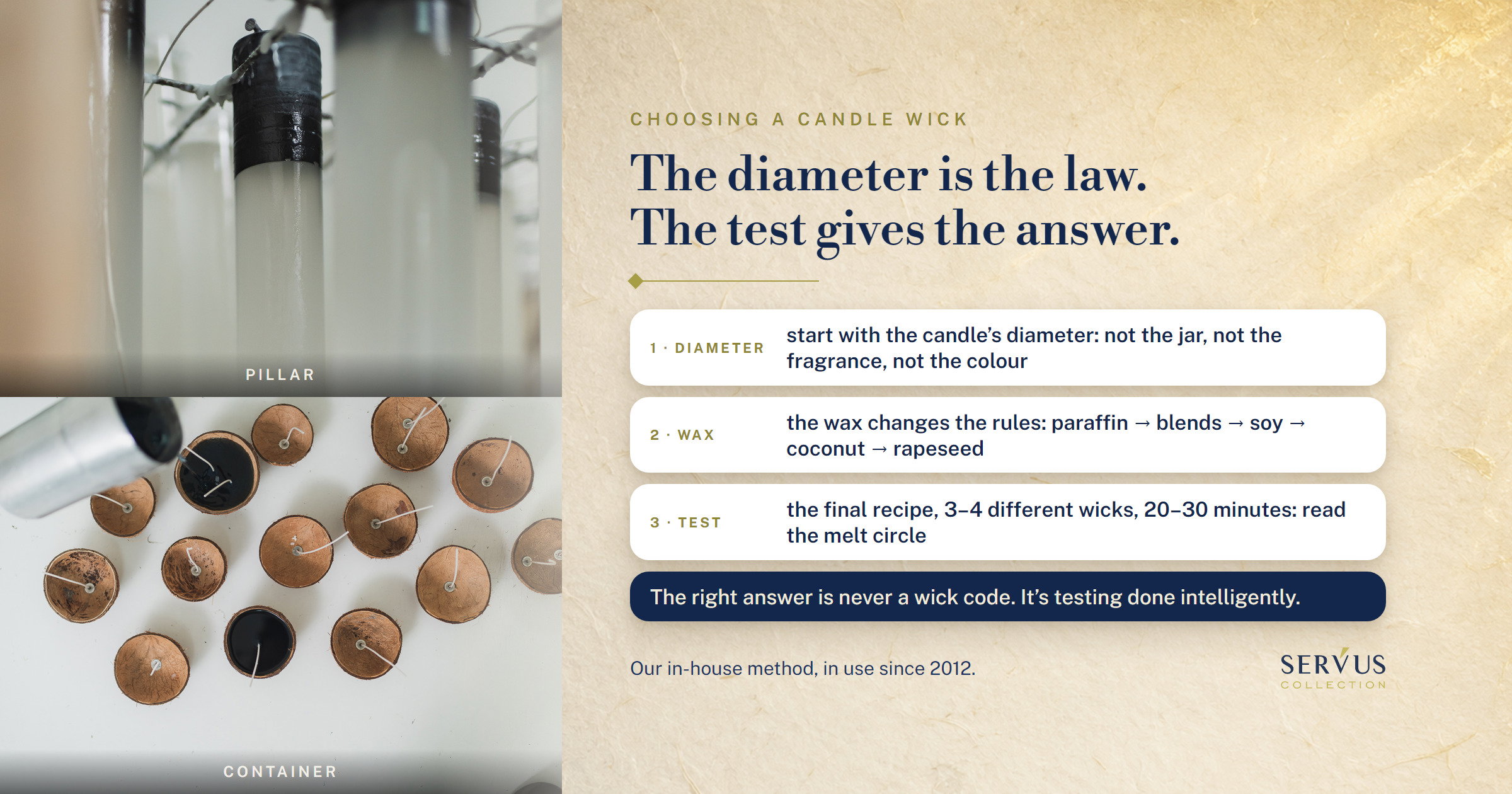
1. Start with the diameter, every time
The diameter is the law. Not the jar. Not the fragrance. Not the colour.
- 5–6 cm → small wick
- 6–7.5 cm → medium wick
- 7.5–9 cm → large wick
- over 9 cm → it depends on the wick series: check in the wick calculator
2. The wax changes the rules completely
The burn-strength order is:
paraffin → blends → soy → coconut → rapeseed
Soft plant waxes need a stronger wick than paraffin at the same diameter.
3. Fragrance and colour can weigh the wick down
Yes, fragrance makes it heavier.
Yes, dye slows it down.
Yes, essential oils can smother it.
That's why two identical candles can burn completely differently.
The promised bonus – the Servus secret for testing a wick quickly
This is the Servus in-house method, refined over more than 10 years of production, and it saves whole hours of testing.
1. Melt the final wax
Exactly the final formula, not a different wax.
2. Pour the wax into a small container
Ideal thickness: 2–3 cm.
3. Put in 3–4 different wicks
Here are the real technical details:
For pillar candles (moulds), cotton wick:
- 3x6
- 3x8
- 3x10
- 3x12
(compatible with Kerax Pillar, KeraGreen, Paraffin Type 1, Soy Pillar 4120; with pure plant wax they can turn out undersized, so try a size up)
For container candles, waxed wick with a tab:
- Waxed cotton wick with a tab, in various heights
(compatible with Kerax 4130, Keragreen Container in soy and sunflower, Cargill NatureWax, Servus blends; not for rapeseed wax)
4. Let the wax harden completely
Don't light the wicks while the wax is soft.
5. Light all the wicks at the same time
Wait 20–30 minutes.
6. Read the “melt circle”
- Small circle → wick too weak
- Large circle / unsteady flame → wick too strong
- Round, even circle → the right wick
This method shows you the truth in half an hour, without waste.
Where to find the wicks we test in the Servus workshop
In the workshop we don't work “by ear”. We choose only wicks that have been through real tests, in real combinations, exactly the way your candle burns, not the way it should burn “in theory”.
We've worked for years with specialist manufacturers, known in Europe for quality and consistency, including Schreiber GmbH, in Germany.
In the Servus shop you'll find only wicks that are:
- compatible with professional waxes
- tested in the workshop in real formulas (paraffins, soy, blends, fragrances)
- chosen after the burn tests in our workshop
- available in versions for pillar and container
https://www.lumanariservus.ro/en/wicks
I am the wick.
And I'm not here to impress you,
but to tell you the truth:
your candle will burn with exactly as much care as you put into choosing me.
I don't lie.
I don't hide flaws.
I don't accept shortcuts.
I only light what you've built with patience.
When you choose me well, I show you a quiet flame.
When you choose me badly, I show you where you rushed.
Not to judge you,
but to give you the chance to become better than yesterday.
That's the relationship between us:
you choose, I answer.
Simple. Honest. Straight to the point.
And one day, after a few tests, a few attempts and a few “Nu-i Bai”s,
you'll feel the moment when it all comes together:
the light, the wax, the fragrance, the quiet.
Then you'll know you haven't just found the right wick,
you've found the confidence you needed to keep going.
Nu-i Bai.
Let's light the light you're looking for. Together.