
 EN
EN  Romana
 Magyar
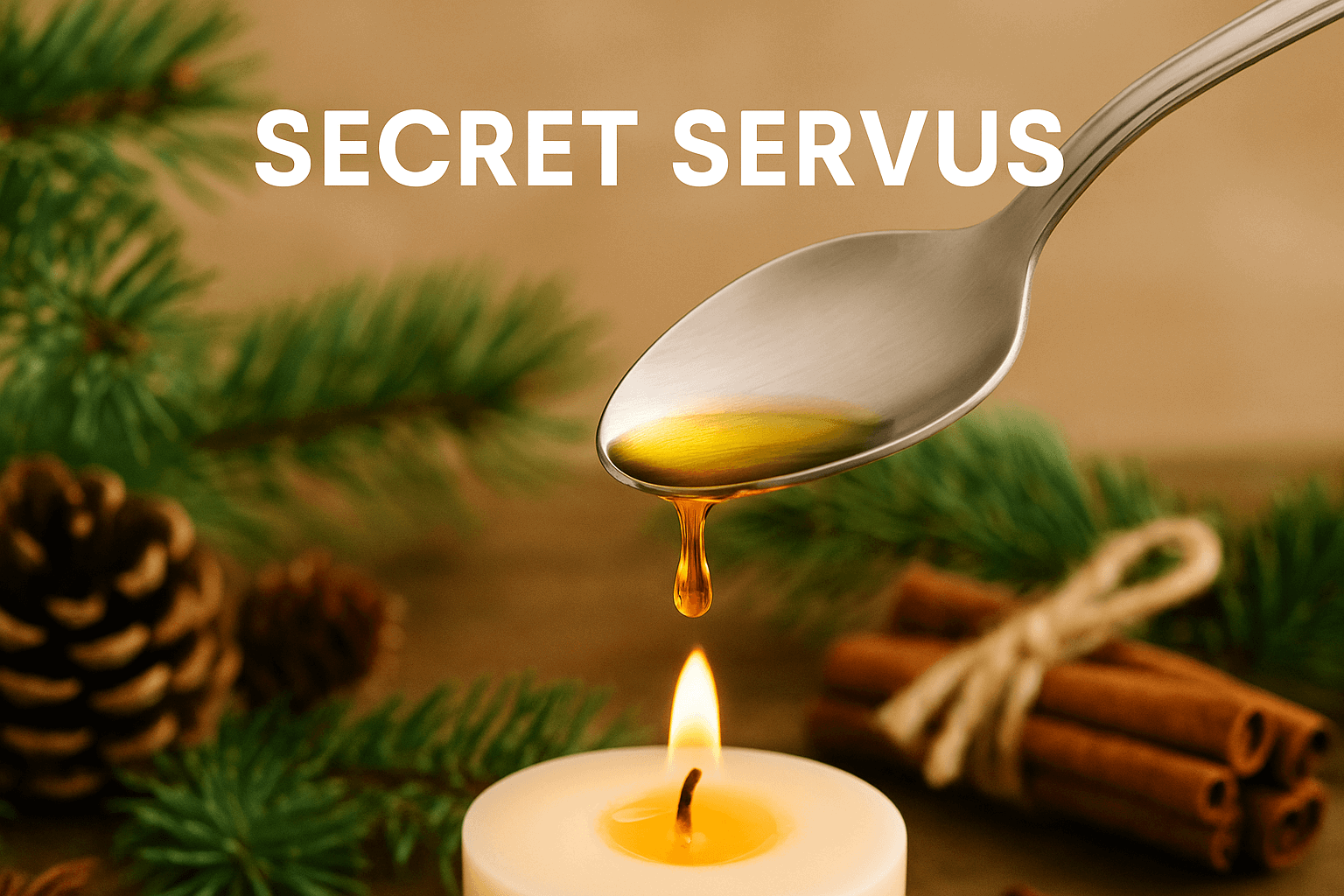
The atmosphere in the workshop
It’s warm in the workshop and it smells of December.
The wax melts slowly, and the steam rises in small spirals over the workbench. The empty jars wait patiently, and the light coming in through the window plays on their surface.
It’s the moment when the quiet of the workshop breathes… and then the first drop of fragrance appears.
When Ginger Cookie touches the wax, notes of golden-baked biscuits, warm vanilla and sweet cinnamon open up. It’s as if you can smell a kitchen where something has just come out of the oven.
This is where the candle’s story begins.
I’m Sînziana
Servus, I’m Sînziana.
If you’ve poured candles with us before, you already know I don’t write to you from textbooks, but from the workshop.
I write with my hands still covered in wax, with yesterday’s tests on the table behind me and with scraps of paper where I’ve noted what worked and what didn’t.
This is what Servus means to us:
not theory, but things lived and redone until they come out perfect.
Ginger Cookie is a fragrance that deserves exactly this treatment.
The Servus secret — the warmed drop
Before temperatures and percentages, in the workshop we have a simple ritual — so simple that it surprises everyone: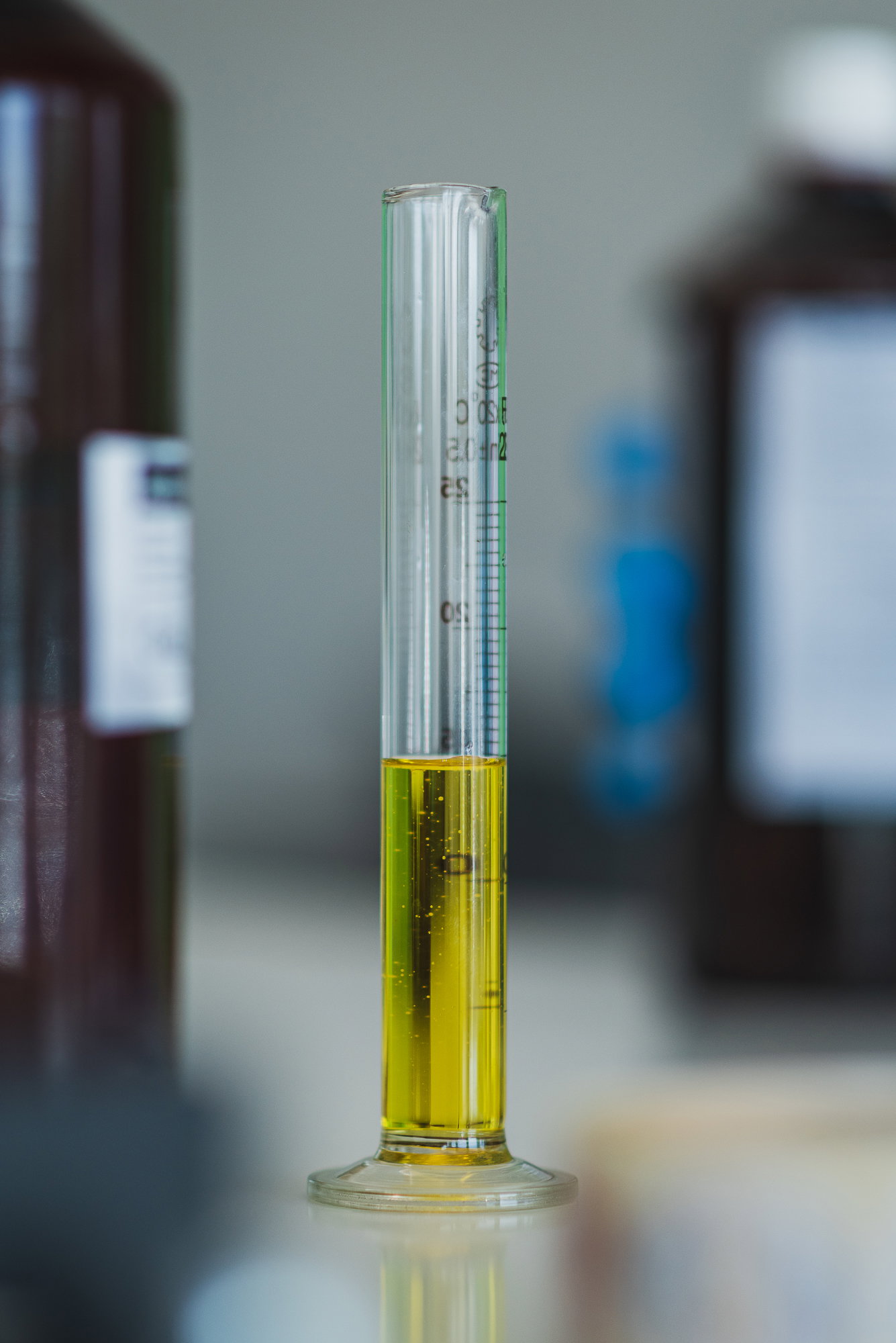
a drop of fragrance on a teaspoon.
We warm it gently: either above a candle or with a hairdryer, for a few seconds.
What happens next tells you more than any chart:
- If the fragrance opens up and becomes round → it will have a beautiful throw.
- If it turns thin → the notes are superficial and don’t deserve a high percentage.
- If an oily trace remains → there’s a heavy base, perfect for plant waxes.
- If it vanishes instantly → you’ll lose it in the candle too if you pour too hot.
Ginger Cookie passes this test flawlessly:
it unfolds into warm, dense, stable notes — exactly what a winter candle calls for.
How the fragrance behaves in wax — the workshop tests
After the teaspoon test, we move on to the “pro” part, tested in the workshop:
- Binding in the wax: best integrated at 60–70 °C.
- Slow stirring: 2 full minutes, without rushing.
- Pouring:
– at 62 °C → stability, a level surface
– at 58 °C → an even texture
– at 55 °C → cracks may appear (normal in a test) - Burning: tested in 160 ml and 300 ml.
- Cold nose vs. hot nose:
– cold = calm
– hot = explosive, delicious, soothing
Temperatures, percentages and common mistakes
Flash point > 93.3 °C
This is a safety figure: the temperature from which the fragrance’s vapours can catch fire from a flame. It is not the temperature for adding the fragrance; that window comes from your wax’s data sheet. Added too hot, it loses its delicate notes.
Recommended percentages:
- 6% in soy/coconut wax in container candles
- 5% in moulded candles
- maximum tested: 8%
Common mistakes:
- oil on the surface → temperature too low
- yellow in the wax → normal, the warm compounds colour the wax
- weak throw → the fragrance was added too hot or too cold
What the allergen declaration says — explained in a maker’s language
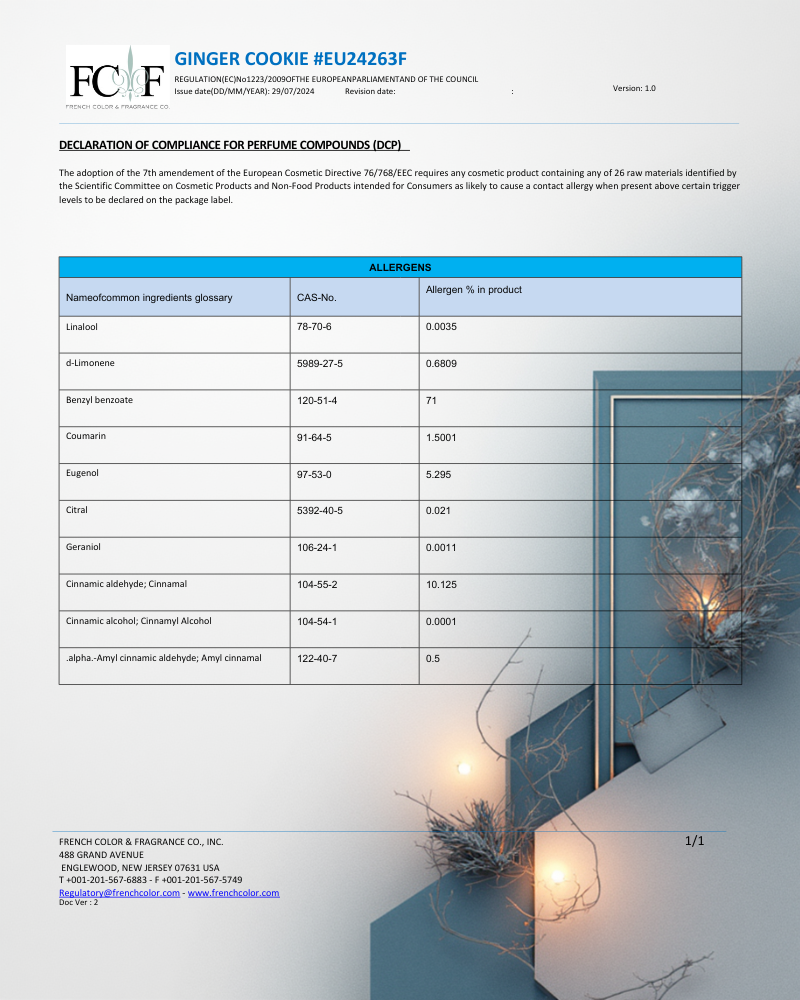 In the declaration, the “Allergens” table lists compounds with names that are hard to pronounce.
But each one says something clear about how the fragrance behaves.
Benzyl benzoate (71%)
This is the “skeleton” of the fragrance — the heavy base.
Thanks to it:
- the fragrance sits well in plant waxes,
- it doesn’t evaporate quickly,
- the hot throw becomes substantial.
Cinnamic aldehyde (10.125%)
The warm cinnamon note.
It gives the candle a natural cream colour and can accentuate cracks if you pour too cold.
Eugenol (5.295%)
The intense clove note.
It gives the fragrance depth and develops beautifully when warm.
Coumarin (1.5%)
The sweet, “cakey” touch.
It’s responsible for the feeling of biscuits fresh out of the oven.
Limonene, Linalool, Citral
Compounds found in basic perfumery.
They don’t affect the candle, but they matter in cosmetics, where they have to be declared.
This information isn’t just technical — it’s exactly why the fragrance settles so well in wax.
How to use Ginger Cookie in other creative projects (IFRA explained simply)
Soap (max 2.67%)
It works excellently in melt & pour and in milk-based versions.
If you want stability and a clear scent, you can use:
Servus dosage: 0.5–1.5%
Cosmetics (max 0.63%)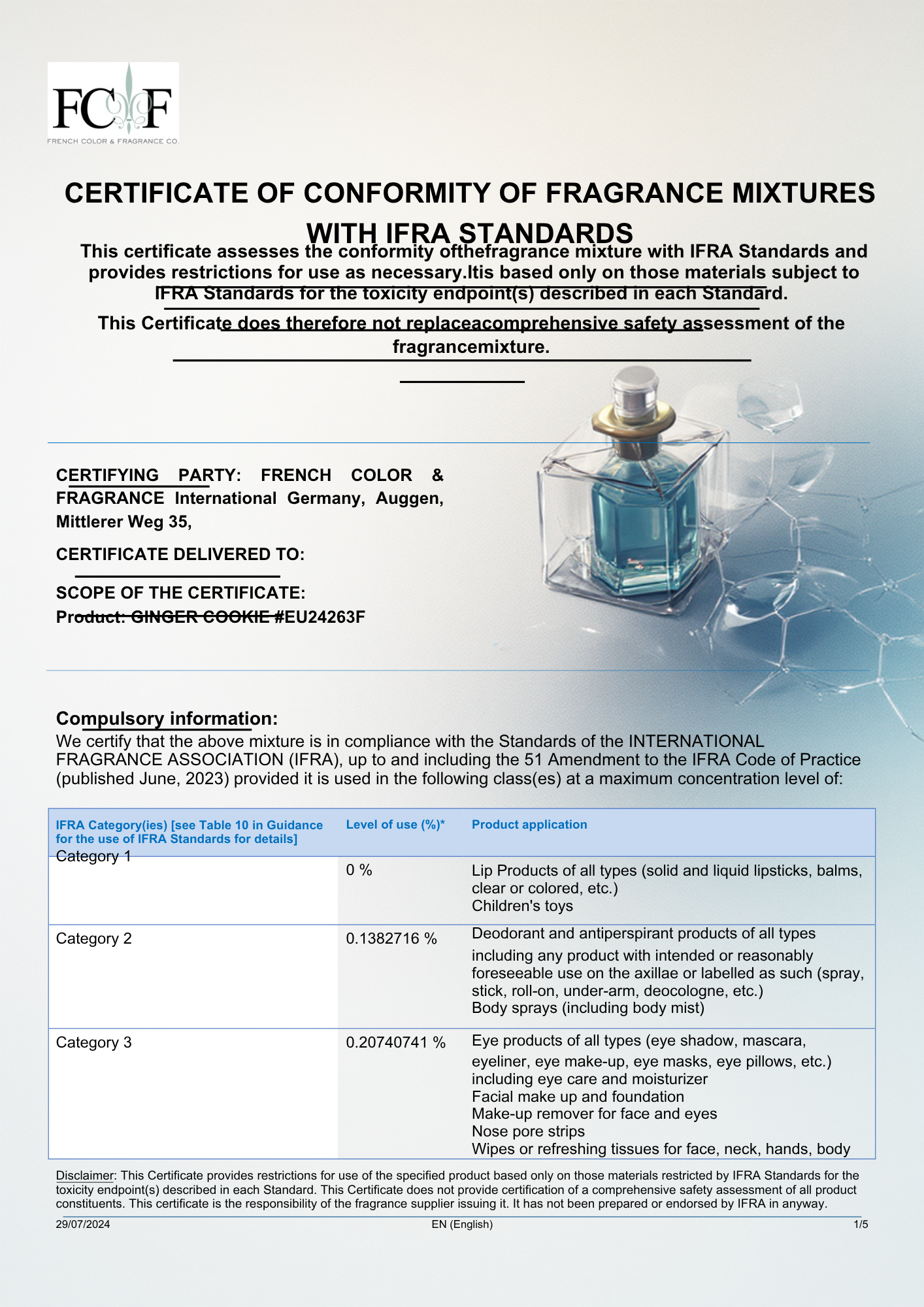
Perfect for bath caviar, solid creams or balms.
Recommendation:
Dosage: 0.3–0.4%
Diffusers (max 2.67%)
The fragrance behaves flawlessly in diffuser bases:
- DPG
- Augeo
- Diffusol M base
Aerosols / room sprays (max 16.9%)
You can make room fragrance, fabric fragrance or air fresheners.
Textiles / scentable paper (max 0.098%)
Excellent for scented cards, fragrant wardrobe sachets or seasonal wrapping paper.
A final thought
A scented candle isn’t just wax and fragrance.
It’s a moment of home.
An instant in which everything becomes warm and familiar.
Ginger Cookie isn’t just a scent — it’s a whole Christmas caught in a jar and lit every evening when you need quiet and a little magic.
If you want to see how we test all the raw materials in our shop, I’ve left you our workshop journal here:
https://www.lumanariservus.ro/en/blog/quality-candle-raw-materials-and-the-servus-experience.html
And if you want to create candles, diffusers, soaps or bath products, you’ll find in our shop the same materials we use ourselves.
May there be winter in every jar.
Servus