 EN
EN  Romana
 Magyar
You did everything right… and the candle still doesn’t smell
You chose a good wax. You put in 8% fragrance. You followed the “rules”.
You light the candle. You wait. And… nothing.
Or worse: it smells heavy, tiring. The customer doesn’t come back.
At that point, most people change the wax. Or the wick.
But the right question rarely comes up:
Have you really understood what IFRA says?
I’m Sînziana — and this is one of the most common misunderstandings in the workshop. Makers who follow IFRA perfectly. And still their candles don’t work.
Not because they get it wrong. But because they rely on a document that doesn’t tell the whole story.
What IFRA actually is
IFRA is not a performance guarantee.
It’s a safety limit.
It tells you:
- where you can use the fragrance
- how much you’re allowed to put in
- so as to avoid health risks
That’s all.
It doesn’t tell you:
- whether the candle will smell
- whether it will have hot throw
- whether it will burn clean
IFRA isn’t your candle’s recipe. It’s only the boundary you’re allowed to work within.
A safe candle isn’t automatically a good candle.
The mix-up that costs the most
An IFRA limit of 20% doesn’t mean your candle can carry 20%.
In practice, most plant waxes start to become unstable above 10–12%. They sweat oil. They lose control of the burn. The wick stops working properly.
IFRA tells you how much you’re allowed to put in from the point of view of chemical safety. It doesn’t tell you how much your system can carry — wax + wick + container + temperature.
How to read an IFRA certificate in 30 seconds
You don’t need to understand the whole document. Just two things:
The product category → for candles: Category 12
The maximum percentage → a real example: 100%
The correct reading: you can use the fragrance with no IFRA limit imposed from a safety point of view.
Careful — IFRA tells you how much you’re allowed. It doesn’t tell you how much you need.
The Servus table: the real difference
| What the IFRA certificate says | What the maker thinks | The reality in the workshop |
|---|---|---|
| 100% permitted | I can put in as much as I like | The candle smokes or sweats oil |
| Only a maximum, not a dose | 6–8% is the perfect recipe | It can be too little, with a weak hot throw |
| Complete documentation | The product is automatically good | Safety doesn’t guarantee scent impact |
Where the theory breaks down
We’ve had fragrances that were perfect on paper. Within IFRA limits. Fully documented.
And still: they had no hot throw. They got lost in the wax. They said nothing when they burned.
Why? Because fragrance doesn’t work alone. It goes into a system: wax, wick, container, temperature, concentration. Change one — and you change everything.
It wasn’t a document problem. It was a system problem.
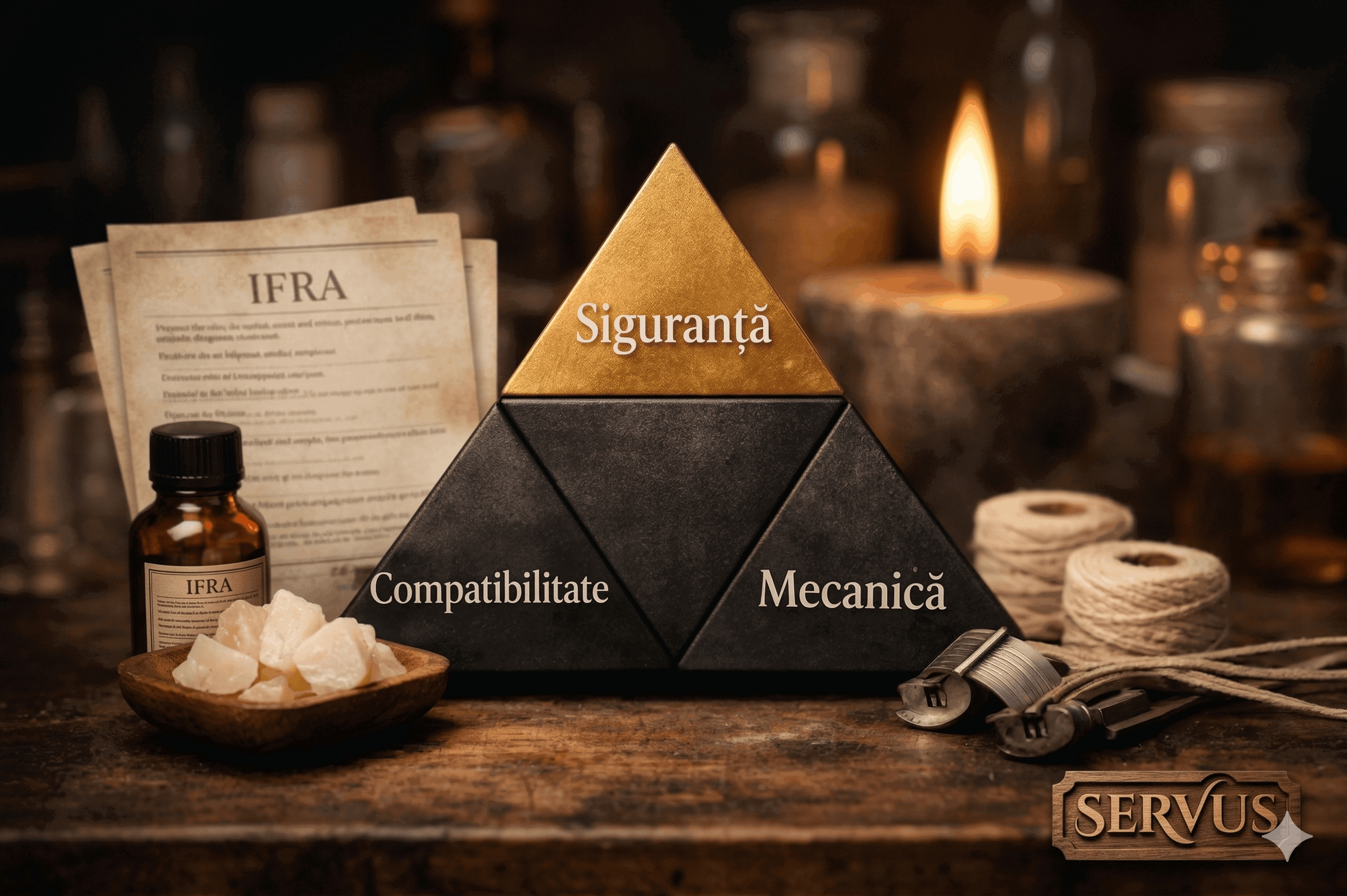
The Servus Performance Triangle
A candle only works when there’s a balance between three elements:
- Safety → what IFRA guarantees
- Compatibility → wax + fragrance, tested together
- Mechanics → the right wick for your system
Missing one = guaranteed problems. And IFRA covers only the first corner of the triangle.
If two candles have the same fragrance but different results, the problem isn’t the fragrance. It’s the system.
The first real filter: the spoon test
Before you risk a kilogram of wax, wicks and time — there’s a simple 30-second test.
A drop of fragrance on a metal teaspoon. A few seconds of heat. You smell it straight away.
The heat forces the top notes to evaporate quickly and shows you exactly what the customer will smell when the candle is burning.
If the fragrance doesn’t hold up here — we don’t push it any further. We don’t change the wax. We don’t raise the percentage.
A fragrance that fails the spoon test won’t get any better in a lit candle.
We’ve explained exactly how it works and how to read the results in the article: Why doesn’t your candle smell when it burns? The spoon test and the chemistry of volatility
How we choose fragrances at Servus
Servus fragrances don’t come from generic warehouse stock.
Each batch is made to order by French Color & Fragrance International — a specialist manufacturer in Germany — with our customer code and the batch’s internal reference.
When you get the bottle, the label carries exactly that code.
The documentation — the IFRA certificate and the safety data sheet (SDS) — is tied to the actual batch, not to the product in general. You don’t get what was valid six months ago. You get the documentation for the batch in your hands.
Minimal risk. No guesswork.
You can order a small unit, test it in your own workshop, check the documentation and decide with full knowledge.
And if you produce regularly and want to understand why serious workshops don’t change supplier — there’s a next level in your relationship with Servus. You’ll discover it yourself, after your first order.
Conclusion
IFRA is the beginning. Not the end.
You get safety from the document. You check compatibility with the spoon test. You build the result in the workshop — with a calibrated system, tested materials and real documentation for each batch.
The fragrances in the Servus collection aren’t chosen by how they smell in the bottle. They’re chosen by how they behave in the wax.
→ See the category: Fragrance Oils — Candles & Soap
In the workshop, we don’t pour hopes. We pour only what has passed the tests.