 EN
EN  Romana
 Magyar
You’ve poured the first candles you want to sell, at a craft fair or online. The recipe is good, the glass is lovely, and now you’re sitting in front of a blank label, not knowing what you have to write on it. On the bottle of fragrance you get from us there are pictograms, a signal word and a few lines of statements with codes. You wonder whether you copy them all onto the candle or put nothing at all.
Neither. The label of a candle you sell carries three kinds of information: who you are, how the candle is burned safely, and what hazard the fragrance in it brings, at your percentage. You put the first two on every candle. The third changes from fragrance to fragrance and from percentage to percentage, and you can’t copy it from anywhere.
Below you’ll find the map of the label, the table with the thresholds for the 31 fragrance oils we sell, worked out from their safety data sheets, and the calculator that gives you a label ready to print.
I’m Sînziana. We’ve been pouring candles in our workshop in Maramureș, Romania, since 2010, and we print the hazard labels for every bottle of fragrance we sell. When customers asked us what to write on their own candles, we worked out the answer for each oil separately. The table below is that calculation.
What to write on your candle label: three kinds of information, from three places
On the label of a candle you sell, you write your details, the burn warnings and, if the fragrance calls for it at your percentage, the chemical part: the pictogram, the signal word, the hazard and precautionary statements and the “Contains…” line. Each comes from a different place. Your details come from you, the burn warnings from a standard for candles, and the chemical part from the fragrance’s safety data sheet.
Which of your details go on the label?
Your name, address and phone number, or your company’s, that is, those of whoever places the candle on the market. Not ours, and not those of the fragrance’s manufacturer. Also put an electronic address, for example your e-mail, where a customer can reach you: the EU General Product Safety Regulation asks for it, and the phone number doesn’t take its place. Next to them you write the quantity, for example 180 g, and the batch, so that later you know which pour a candle came from if someone asks you about it.
Our calculator doesn’t print the label until you fill in the name, address, phone number and e-mail. You can write the batch there or by hand, on the line left blank.
Where do the burn pictograms go?
On the same candle, but they come from another document: the European standard for candle safety labels, EN 15494. The standard asks for three messages on any indoor candle: don’t leave it burning unattended, keep it away from things that can catch fire, and keep it away from children and pets. We explained them in detail, with the pictograms on our boxes, in our article on a candle’s first burn.
These pictograms are about fire. The hazard pictogram in the chemical part, the diamond with the red border, is about what’s in the wax. They’re two different things, and one doesn’t replace the other.
Where do the chemical warnings come from in our calculation?
In our calculation for candles, the wax and the colourant are counted as having no hazards of their own, so the chemical warnings that come out come from the fragrance. If you put anything else in the candle that has a safety data sheet, check that sheet too.
The fragrance in the bottle and the fragrance in the candle don’t have the same label, though. In the bottle is the concentrate. In the candle, at 8%, each substance in it is more than ten times more diluted, and many fall below the threshold from which they would have to be declared. That’s why you don’t copy the label from the oil bottle onto the candle. Nor the UFI code on it, which belongs to the oil, as its manufacturer declared it, not to your candle.
From what percentage of fragrance does the hazard pictogram appear?
It depends on the oil: across the 31 fragrance oils we sell, the threshold goes from 0.1% to over 20%. At 8% fragrance in the candle, 11 of them need the pictogram and “Warning”, and another 11 don’t need it even at 20%. The same percentage gives very different labels.
The thresholds for the 31 oils, read from the safety data sheets
We put each oil into the calculator, with the percentage worked out from the weight of the finished candle. For each substance we took the highest figure in the range written in the oil’s safety data sheet, so that the calculation comes out cautious. The data are from the current sheets of the manufacturer, French Color & Fragrance International, as of 30 September 2026. The table has the 31 oils that are in the shop now; the calculator also has three scents no longer on sale: Amber Noir, Perfectly Pumpkin and Pink Sands.
| The oil | First line on the label from | Pictogram and “Warning” from | What it says at 8% |
|---|---|---|---|
| Ginger Cookie | 0.1% | 0.1% | pictogram, “Warning”, H317, H412 |
| Hot Wine | 0.1% | 0.1% | pictogram, “Warning”, H317, H412 |
| Orange | 0.1% | 0.1% | pictogram, “Warning”, H317, H412 |
| Cinnamon | 0.1% | 0.3% | pictogram, “Warning”, H317 |
| Frankincense & Myrrh | 0.1% | 0.6% | pictogram, “Warning”, H317, H412 |
| Into the Woods | 0.1% | 1.0% | pictogram, “Warning”, H317, H412 |
| Eucalyptus Bamboo | 0.2% | 1.8% | pictogram, “Warning”, H317, H412 |
| Cashmere Kush | 0.4% | 3.3% | two pictograms, “Warning”, H317, H411 |
| Jasmine | 0.4% | 3.4% | pictogram, “Warning”, H317, H412 |
| Wild Jasmine & Bamboo | 0.4% | 4.0% | pictogram, “Warning”, H317, H412 |
| Lavender | 0.7% | 6.7% | pictogram, “Warning”, H317, H412 |
| Tsoureki | 1.0% | 10.0% | only “Contains…” |
| Egyptian Musk | 1.2% | 11.4% | H412, no pictogram |
| Coco Chanel | 1.3% | 12.1% | H412 + “Contains…” |
| Fresh Cut Peony | 1.3% | 12.5% | H412 + “Contains…” |
| Rose | 2.2% | 14.2% | H412 + “Contains…” |
| Blue Sage & Hinoki | 1.6% | 15.3% | H412 + “Contains…” |
| Strawberry Slush | 2.4% | 16.8% | only “Contains…” |
| Coastal Neroli | 1.9% | 18.2% | H412 + “Contains…” |
| Blue Raspberry | 2.0% | 20.0% | H412 + “Contains…” |
| Champagne Rose | 2.8% | no, up to 20% | H412 + “Contains…” |
| Black Cherry | 3.4% | no, up to 20% | H412 + “Contains…” |
| Coconut Lime | 3.4% | no, up to 20% | H412 + “Contains…” |
| Fresh Linen | 3.4% | no, up to 20% | H412 + “Contains…” |
| Prosecco Rose | 3.4% | no, up to 20% | H412 + “Contains…” |
| Weed Out | 4.7% | no, up to 20% | H412 + “Contains…” |
| Cappuccino | 5.3% | no, up to 20% | only “Contains…” |
| Opium | 6.1% | no, up to 20% | H412 + “Contains…” |
| Vanilla | 6.5% | no, up to 20% | H412, no pictogram |
| Magnolia | 6.7% | no, up to 20% | only “Contains…” |
| Juicy Watermelon Slice | 8.8% | no, up to 20% | no chemical warning |
Read the table down the third column. The oils at the top bring the pictogram from low percentages, because they contain, in large amounts, substances that can cause a skin allergy (H317). Those at the bottom contain them in small amounts or not at all, and don’t bring it even at 20%. The name of the scent doesn’t tell you which part of the table it sits in: Orange is at the top, Coconut Lime at the bottom. The second column tells you from what percentage you have something to write on the label anyway, even without a pictogram.
The table goes up to 20% because that’s how far the label calculation goes, not because we recommend it to you as a dose: for Lavender, for example, in our formulas we use 6–8% in containers and 5–6% in moulds. And even for the oils with no chemical warning, your details and the burn warnings stay on the label.
Why can a candle without a pictogram still have a statement on its label?
Because not every hazard statement comes with a pictogram. H412, “Harmful to aquatic life with long lasting effects”, is written on the label without the diamond and without “Warning”, just as a statement, with its precautionary statements. Vanilla at 8% is exactly this case: a single environmental statement, no pictogram.
The second case is the “Contains…” line. When a substance that can cause an allergy is in the candle below the threshold at which it would bring the pictogram, but above a lower threshold, its name is written on a separate line: “Contains linalool. May produce an allergic reaction.” This line is called EUH208, and it’s for people who already know they’re allergic to a particular substance.
Does the same fragrance in two recipes mean two labels?
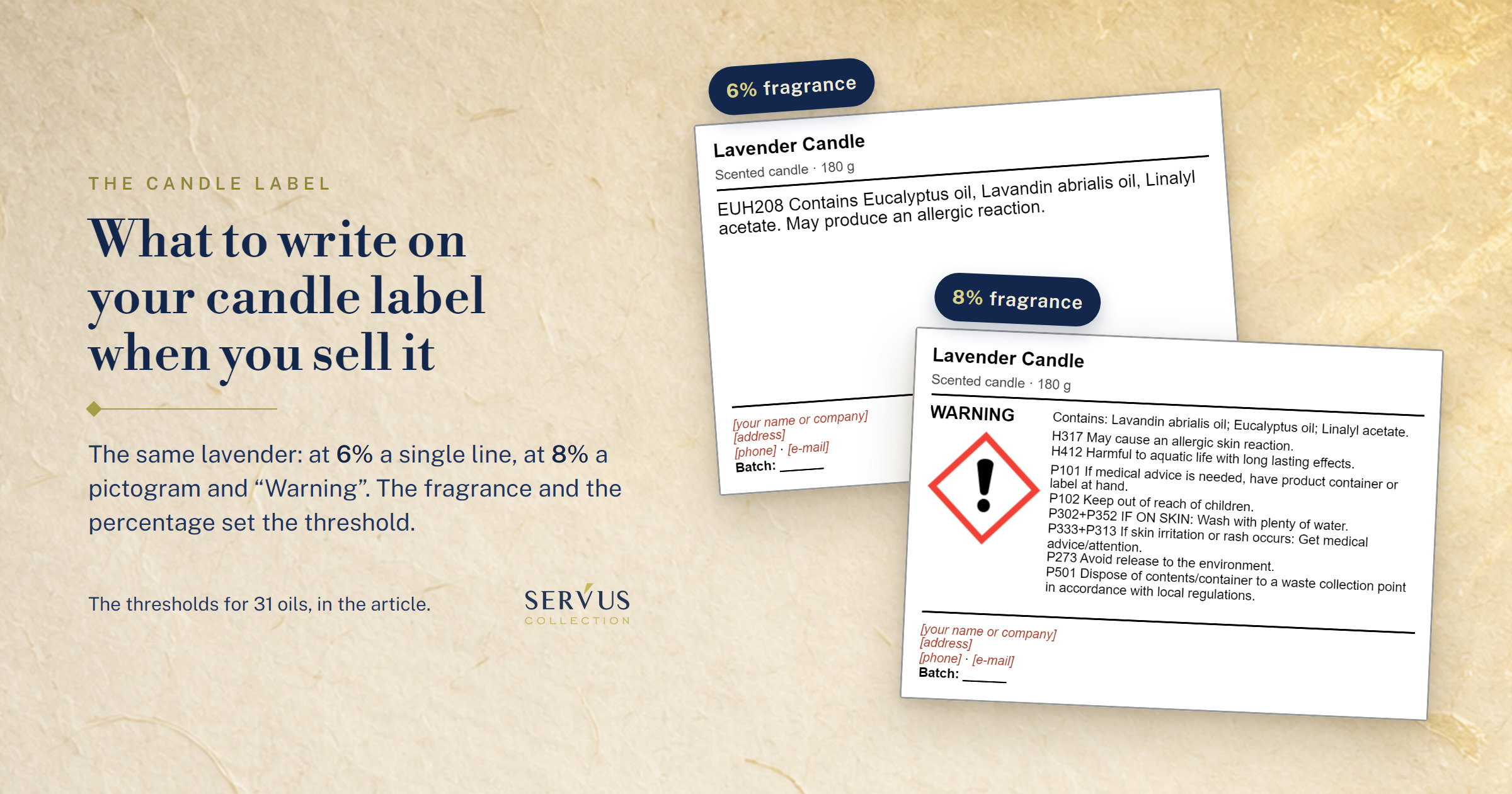
Yes, if the recipes sit on either side of a threshold. Lavender at 6% has only the “Contains…” line on its label, with three names: Eucalyptus oil, Lavandin abrialis oil and Linalyl acetate. At 8%, the same lavender brings the exclamation mark pictogram, the word “Warning”, statements H317 and H412 and six precautionary statements.
If you pour the same fragrance into a small glass, at 6%, and a large one, at 8%, you get two labels. Take each recipe’s percentage from the scale, and when it falls between two steps of the calculator, choose the step above.
Labelling candles, diffusers and sprays, with the calculator
The CLP label calculator does the chemical part for you. You choose the product (candle, reed diffuser or room spray), our fragrance oil and the percentage. It shows you the label, tells you why each line appears, and you print it straight from the page, in the 74 × 52 mm format, or 110 × 52 mm when the text doesn’t fit. The text is black, but the pictograms have a red border, and that’s how it has to stay: when the label has a pictogram, you print it in colour. Under the label you also see the safety data sheet it was worked out from. CLP is the European regulation that says how chemical products are labelled, and on a candle, the part of the label that falls under it comes from the fragrance.
How do you work out the fragrance percentage?
From the weight of the finished product. 8 g of oil in a 100 g candle is 8%. If you work out the percentage on the wax, convert it: 7 g of oil per 100 g of wax gives 7 ÷ 107 = 6.54%, so in the calculator you choose 6.6%, the step above. If you enter the percentage on the wax directly into the calculator, the label comes out stricter than it needs to be.
Why does the diffuser always have “Warning”, and the candle doesn’t?
Because with a diffuser the base counts too, not just the oil. Diffusol M, the base you put the oil in for diffusers and sprays, is classified as an eye irritant (H319). It makes up most of the product, so the pictogram, “Warning” and H319 appear on every diffuser or spray made with it, however little oil you put in.
With a candle, in our calculation, the wax brings nothing. The chemical part comes from the fragrance, and that’s why a candle with Juicy Watermelon Slice at 8% comes out with no chemical warning at all, while a diffuser with the same oil has one.
With diffusers and sprays there’s one more limit: the IFRA certificate of each oil sets a maximum percentage for each type of product. For Opium, for example, the limit is 0.88% in a diffuser and 2.05% in a spray. The calculator won’t let you go past it. It also has a rule of our own: oils with a flash point below 70 °C, like Strawberry Slush, can’t be chosen for diffusers and sprays, because once the oil is mixed with the base, the flash point can’t be worked out from the data sheet.
What doesn’t it calculate?
Three things. Soap and creams, because the Cosmetics Regulation applies there, with a different label, on which the allergens in the fragrance are written by name. Oils from other suppliers, because we don’t have their safety data sheets. And ingredients in your candle that have their own safety data sheet, apart from the oil. The calculator guides you, but you are responsible for the label.
What do you check before the first print run of labels?
Five things, on the printed label, not on the screen:
- The percentage in the calculator is the one in the recipe you’re pouring, worked out on the finished candle.
- Your details: name, address, phone number, e-mail, quantity and batch.
- The burn warnings are on the candle, alongside the chemical part.
- The chemical part is the one from the calculator, with the pictograms in colour, and you haven’t copied anything from the oil bottle. If the candle comes out classified for health, for example with H317, your own UFI code is on the label, and the notification for it has been sent and validated. The environmental statement H412, on its own, doesn’t call for this route.
- The label holds up: it can be read, it doesn’t stain and it doesn’t peel off on a real glass.
You check the first four between the recipe, the calculator, the printed label and the confirmation of the notification, when one is needed. You check the fifth only on a used sample.
Point 4 calls for a separate route when the candle comes out classified for health, like H317 for the 11 oils in the table that bring it at 8%, or H319, which every diffuser and spray made with Diffusol M has. You create your product’s UFI code in the ECHA UFI generator, with your company’s VAT number or, if you don’t have one, with the company key the generator also gives you, plus an internal recipe number, and you send the notification to the poison centre through ECHA’s notification portal (PCN). In the dossier you can give the UFI code of our oil, from the bottle and the safety data sheet; your own code goes on the label. Who receives the notification in your country, you’ll find in the ECHA list of appointed bodies. The calculator shows you under the label when your product is in this situation.
Print one, stick it on and keep it for a week
Before you print a whole sheet, print a single label, stick it on a real glass and use the candle for a few evenings. Fragrance oil can stain the paper, the heat from the glass can lift the corners, and a line in five-point type can be hard to read on a rounded glass. You won’t find out any of this on the screen.
For our fragrance labels we have this rule written down: no roll is printed until we’ve seen the proof on a sample. We recommend the same to you, because a wrong label on a candle leaves stuck to every glass in the batch.
If you’re only just thinking about selling, our article on the moment you start selling tells you what else changes, beyond the label. If you have a question about a particular oil or percentage, write to us on WhatsApp or call us at +40 726 162 810 (we answer in English), Monday to Friday, between 8:00 and 16:30 (Romanian time). Send us the scent, the percentage and the product, and we’ll tell you what comes out on the label.