
 EN
EN  Romana
 Magyar
 Straight Wooden Wick in Exotic Wood – 90 × 10 mm – Set of 20
![Straight exotic wooden wick 90x10 mm for container candles – Servus Collection [0]](https://op.gomagcdn.ro/domains/lumanariservus.ro/files/product/medium/fitil-din-lemn-exotic-tip-drept-90-10-mm-set-20-buc-981975.webp "Straight exotic wooden wick 90x10 mm for container candles – Servus Collection [0]")
![Straight exotic wooden wick 90x10 mm for container candles – Servus Collection [1]](https://op.gomagcdn.ro/domains/lumanariservus.ro/files/product/medium/fitil-din-lemn-natural-14x152-mm-960903.png "Straight exotic wooden wick 90x10 mm for container candles – Servus Collection [1]")
![Straight exotic wooden wick 90x10 mm for container candles – Servus Collection [2]](https://op.gomagcdn.ro/domains/lumanariservus.ro/files/product/medium/fitil-din-lemn-exotic-tip-drept-90-10-mm-set-20-buc-079306.webp "Straight exotic wooden wick 90x10 mm for container candles – Servus Collection [2]")
![Straight exotic wooden wick 90x10 mm for container candles – Servus Collection [3]](https://op.gomagcdn.ro/domains/lumanariservus.ro/files/product/medium/fitil-din-lemn-exotic-tip-drept-90-10-mm-set-20-buc-312241.webp "Straight exotic wooden wick 90x10 mm for container candles – Servus Collection [3]")
![Straight exotic wooden wick 90x10 mm for container candles – Servus Collection [4]](https://op.gomagcdn.ro/domains/lumanariservus.ro/files/product/medium/fitil-din-lemn-exotic-tip-drept-90-10-mm-set-20-buc-769037.webp "Straight exotic wooden wick 90x10 mm for container candles – Servus Collection [4]")
![Straight exotic wooden wick 90x10 mm for container candles – Servus Collection [1]](https://op.gomagcdn.ro/domains/lumanariservus.ro/files/product/original/fitil-din-lemn-exotic-tip-drept-90-10-mm-set-20-buc-981975.webp "Straight exotic wooden wick 90x10 mm for container candles – Servus Collection [1]")
![Straight exotic wooden wick 90x10 mm for container candles – Servus Collection [2]](https://op.gomagcdn.ro/domains/lumanariservus.ro/files/product/original/fitil-din-lemn-natural-14x152-mm-960903.png "Straight exotic wooden wick 90x10 mm for container candles – Servus Collection [2]")
![Straight exotic wooden wick 90x10 mm for container candles – Servus Collection [3]](https://op.gomagcdn.ro/domains/lumanariservus.ro/files/product/original/fitil-din-lemn-exotic-tip-drept-90-10-mm-set-20-buc-079306.webp "Straight exotic wooden wick 90x10 mm for container candles – Servus Collection [3]")
![Straight exotic wooden wick 90x10 mm for container candles – Servus Collection [4]](https://op.gomagcdn.ro/domains/lumanariservus.ro/files/product/original/fitil-din-lemn-exotic-tip-drept-90-10-mm-set-20-buc-312241.webp "Straight exotic wooden wick 90x10 mm for container candles – Servus Collection [4]")
![Straight exotic wooden wick 90x10 mm for container candles – Servus Collection [5]](https://op.gomagcdn.ro/domains/lumanariservus.ro/files/product/original/fitil-din-lemn-exotic-tip-drept-90-10-mm-set-20-buc-769037.webp "Straight exotic wooden wick 90x10 mm for container candles – Servus Collection [5]")
The set contains 20 wicks. The metal stand is NOT included and is ordered separately.
A flat wick of exotic wood, laser cut: 90 × 10 mm, 0.6 mm thick. For candles poured in containers.
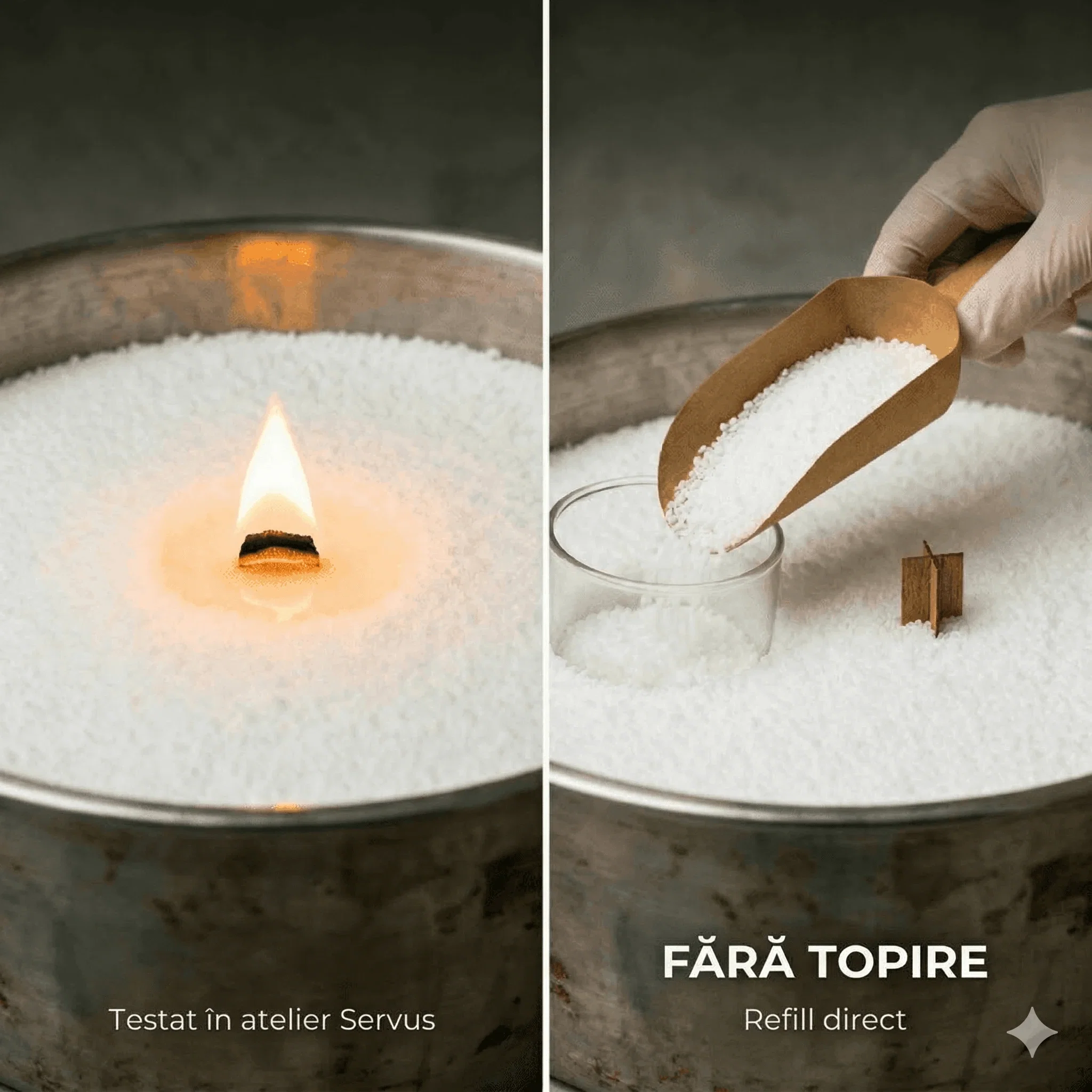
Tested in the Servus workshop, with a single wick: soy 5–5.5 cm · granules 5.5–6 cm · paraffin 4.5–5 cm. Above these diameters, use two.
With wood, the width sets the flame, not the length. You cut the length yourself.
| Quantity Discounts | ||||
|---|---|---|---|---|
| From | Discount | Price / each | You save | |
| 5 each | -6% | 25,03 RON | 7,99 RON | + |
| 10 each | -12% | 23,43 RON | 31,96 RON | + |
| 20 each | -18% | 21,84 RON | 95,86 RON | + |
| 40 each | -24% | 20,24 RON | 255,64 RON | + |









- Description
- Characteristics
- Video (1)
- Reviews (1)
- FAQ
The set contains 20 wicks. The metal stand is NOT included and is ordered separately: you'll find it here. Without it, the wick won't stand straight in the container when you pour.
A flat wick of exotic hardwood, laser cut, 0.6 mm thick. Length 90 mm, width 10 mm. Used for candles poured in containers.
With wood, the width sets the flame
You cut the length yourself, to the height of the glass. The width is what decides how big it burns, and that is why a 10 mm wick can't be compared with a 7 mm one just because both are 90 mm long.
Sînziana says: “Wood isn't sized like cotton. With cotton you count the threads; with wood you look at the width and the thickness, and the tables don't carry over from one to the other. We've burned this one in the workshop and I'll tell you straight what we saw: on its own, in a glass wider than 5.5 cm, the flame stays small and the melt pool doesn't reach the edges. It isn't a weak wick. It's a wick with its own range, and outside that range you use two.”
Tested in the Servus workshop
The figures below come from our burn tests, with a single wick. They are starting points, not promises: the container diameter, the wax recipe and the amount of fragrance change the result.
| Wax | Container diameter, single wick |
|---|---|
| Soy wax | 5 – 5.5 cm |
| Granule / sand-type wax | 5.5 – 6 cm |
| Paraffin | 4.5 – 5 cm |
Above these diameters, move to two wicks. It works with container waxes (soy, paraffin, granules) and can be combined with the other shapes in the wooden range: cross, wave, round.
How it behaves in production
- Width drives the flame. The wider the wick, the bigger the flame and the faster the melt pool opens. At 10 mm you are in the range of small and medium-diameter candles.
- On its own it has a narrow range; in pairs it covers more. One wick holds well up to around 5–5.5 cm, depending on the wax. Beyond that, the flame falls behind and the edges stay cold. Two wicks spread the heat evenly and open the melt pool across the whole surface.
- Wood isn't a uniform material. The grain isn't identical from one piece to the next, and that shows in the burn. With each new batch, burn a test piece before a run.
- The crackle depends on the combination. In some recipes and containers, the wick gives a gentle crackle, like wood in a fireplace. It happens often, but not with every wax and every diameter.
Fitting on the metal stand
The metal stand holds the base of the wick in the container and keeps it upright while you pour. It is ordered separately: Stable metal stand for wooden wicks.
Why we sell the stands separately. A wooden wick is cut to the height of the glass, and the offcuts make good pieces for smaller candles. The stands, on the other hand, get used up faster than the wicks. In the workshop we work with them separately, so we use the material right to the end.
What this wick doesn't do
- It is NOT a wick for every candle. The same piece burns differently in different recipes. The range in the table is the starting point, not the verdict.
- It does NOT cover wide containers on its own. Above about 5.5 cm, a 10 mm wick falls behind the melt pool. There, use two, or move to a greater width.
- It is NOT a pillar wick. It is designed for container candles, on a metal stand. For candles poured in moulds, with stearin, go for the braided cotton wick.
- The crackle can't be promised. It depends on the wax and the diameter.
- It does NOT come with a metal stand. It is ordered separately.
Even when the dimensions are exact, the result depends on the container, the wax, the fragrance and the burning conditions. Before a large run, test on the final recipe.
Technical properties
| Property | Value | Source |
|---|---|---|
| Shape | straight (flat) | measured |
| Length | 90 mm | measured |
| Width | 10 mm | measured |
| Thickness | 0.6 mm | measured |
| Pack contents | 20 pieces | measured |
| Fitting | metal stand, ordered separately | workshop |
| Wood | exotic hardwood, Sapele type | stated by the manufacturer |
| Processing | laser cutting | stated by the manufacturer |
| Moisture | approximately 6–10% | stated by the manufacturer |
| Treatment | chemically untreated wood | stated by the manufacturer |
| Wood source | FSC-certified supplier | stated by the manufacturer |
The right-hand column isn't decoration. What says “measured”, we checked ourselves. What says “stated by the manufacturer” comes from the manufacturer's data sheet and we haven't tested it: we pass it on as it was given to us, with their name on it.
Sapele is a hardwood with a dense, even grain, dimensionally stable and resistant to high temperatures. Grain density matters in a wooden wick: it affects how steadily the wax rises through the material. Moisture matters too: wood that is too damp burns poorly, which is why it is kept in a dry place.
Step by step
- Start from the container diameter and the wax you are pouring.
- Above about 5.5 cm, use two wicks, equally spaced from the centre.
- Fit each wick on the metal stand before pouring and check that it stands upright.
- Cut the length to the height of the glass, with the wick already fixed.
- The burn test: light it and read it after 2–3 hours. The melt pool should reach the edge. Too small: move to two wicks or to a greater width. An unsteady flame that jumps: you have too much wick for that diameter.
- Change one variable at a time and note the batch, wax, fragrance and diameter.
Servus Collection
Since 2010, from craft to real distribution.
We sell selected materials, tested and explained from real workshop experience. From Maramureș, for workshops in Romania and abroad.
Servus. See you at the pouring table.
Tip produs Servus MP: fitil_lumanari
Can this wick be used with soy wax?
Yes. The wick is compatible with soy wax for containers, though the container diameter and the fragrance concentration can affect how it burns.
Does this wick need a metal stand?
Yes, and the metal stand is NOT included and is ordered separately. The set contains 20 wicks, without stands. The stand holds the base of the wick in the container and keeps it upright while you pour; without it, the wick leans in the still-soft wax. We sell them separately because the wick is cut to the height of the container and reusable pieces are left over, while the stands get used up faster.
Why can the flame be small with a single wick?
In wider containers, a single wick can give a smaller flame. In these cases, two wicks are recommended for a more even spread of heat.
Should wooden wicks be trimmed before or after burning?
Wooden wicks should be trimmed to 0.5 cm before the candle is lit. If the wick is too long, the flame can become unsteady or produce smoke.
Why can wooden wicks make a crackling sound?
The grain structure of the wood and the way it feeds the wax can sometimes create a gentle crackling effect, like wood burning in a fireplace. This effect depends on the type of wax and the size of the container.
Are the wooden wicks chemically treated?
No. The wicks are made from chemically untreated wood and are laser cut for precise dimensions and even edges.
Why don’t wooden wicks all burn identically?
Wood is not a uniform material: the grain structure, the wood’s own oil content and its moisture can vary slightly. These variations can affect how the flame behaves.
Can two wicks be used in the same candle?
Yes. In wider containers, two wicks are often recommended, for a more even spread of heat and for the melt pool to form properly.
How do I choose the right wick size for my candle?
The wick size should be chosen according to the container diameter, the type of wax used and the fragrance concentration. Burn tests are recommended before any series production.
What type of wood are the exotic wooden wicks made from?
In many cases, hardwoods such as Sapele are used, known for their dense grain and good stability at high temperatures. These properties matter for wooden wicks because they affect how the wax is absorbed and fed to the flame.
Daniela Dumitrica,
Bună ziua,
ReplyAu ajuns în regula toate produsele. Sunt minunate! Va mulțumesc si va doresc o zi buna în continuare!
Was this review useful?