 EN
EN  Romana
 Magyar
1. "Why do I sell, but make no profit?"
"I sold the whole batch of candles, but when I wanted to order new stock, I realised I didn’t have enough money for a full order."
It’s a more common situation than you’d think.
Most makers work it out like this:
wax cost + fragrance cost + glass cost = production cost
It seems logical. But this formula is incomplete.
The price of a candle isn’t made only of what you see in the finished product, but of the whole technical and operational process behind it.
If you ignore the invisible part, you end up working hard, selling well... and still not growing.
2. The trap of invisible costs
A candle doesn’t get into the glass on its own. Raw materials aren’t delivered for free. Tests aren’t free. Your time isn’t free.
To set a correct price, you have to move from "per-piece calculation" to operational calculation.
That means including:
- the delivery of raw materials
- wick tests
- rejects and remelts
- packaging consumables
- utilities
- monthly fixed costs
- your work
Only then do you start to see the real cost.
Why we know these calculations matter
In the Servus workshop, many years ago, we calculated exactly like everyone else: wax + wick = cost.
It looked like we were making a profit.
Until the day we left a pot of wax on the heat too long. The wax overheated, and the batch could no longer be used. It wasn’t much. But it was enough to hurt.
That’s when we understood something simple:
If you don’t include in the price of the candles that turn out well the cost of tests, mistakes and unavoidable losses as well, the first error eats a week’s profit.
Since then, we don’t calculate the ideal. We calculate the real.
A real workshop means testing, adjusting, sometimes losing. The price has to support that reality, not a perfect version from theory.
3. A real example from the workshop – 5 kg of 4120 wax
Let’s take a concrete example.
You’ve bought:
- 5 kg of KeraSoy Pillar 4120 soy wax
- Discounted price: 33.36 lei/kg
- Parcel locker delivery: 19.69 lei
Step 1 – Raw material cost
5 × 33.36 lei = 166.80 lei
Step 2 – We add delivery to the cost
166.80 + 19.69 = 186.49 lei
Step 3 – Real cost per kilogram
186.49 / 5 = 37.30 lei/kg
Not 33.36 lei/kg.
The real cost of the wax in the workshop is 37.30 lei/kg.
Difference: almost 4 lei/kg.
If you use 250 g of wax in a candle:
0.25 × 37.30 = 9.33 lei
Across 100 candles, delivery alone can eat almost 100 lei of your margin without you noticing.
4. The anatomy of a candle’s real cost
To calculate correctly, I recommend splitting your costs into clear categories:
| Cost category | What it includes | How it’s calculated | Why it matters |
|---|---|---|---|
| Direct raw materials | Wax, fragrance, wick, container, label | Total cost of materials / no. of pieces | The basis of the product |
| Supply logistics | Delivery of raw materials | Total delivery / no. of kg or pieces | Raises the real cost per kg |
| Technical losses | Tests, rejects, remelts | +10–15% of the raw material cost | Covers unavoidable errors |
| Labour | Production + packaging | (Hourly rate × hours) / no. of pieces | The workshop has to pay for your time |
| Fixed costs | Accounting, platform, apps, utilities | Monthly fixed cost / no. of pieces produced | The workshop doesn’t run without them |
| Taxes | VAT, income taxes | Applied at sale, not part of the production cost | Gross profit ≠ real profit |
This structure is simple, but it radically changes the way you see price.
5. The simple workshop formula (with a full worked example)
Let’s say that for one candle you have:
1. Direct materials
Wax (250 g) → 9.33 lei
Fragrance + wick + container + label → 8.67 lei
Total materials: 18 lei
2. Delivery, shared out
The wax delivery is already in the 9.33 lei (37.30 lei/kg) → don’t add it a second time
3. Technical buffer (the Servus 15% rule)
For tests, remelts and losses:
18 × 15% = 2.7 lei
If you want to understand why this percentage is vital and how you keep testing losses under control, I’ve set out the process here: What no one tells you before you lose your first batch of candles
4. Your work
If you make 20 pieces in 2 hours and want to earn 50 lei an hour:
100 lei / 20 = 5 lei per piece
5. Fixed costs, shared out
Let’s say:
- Accounting
- Online platform
- Apps
- Utilities
Monthly total: 1,500 lei
Monthly production: 300 pieces
1,500 / 300 = 5 lei per piece
Final recalculation
Materials: 18 lei
Delivery: included in materials
15% buffer: 2.7 lei
Labour: 5 lei
Fixed costs: 5 lei
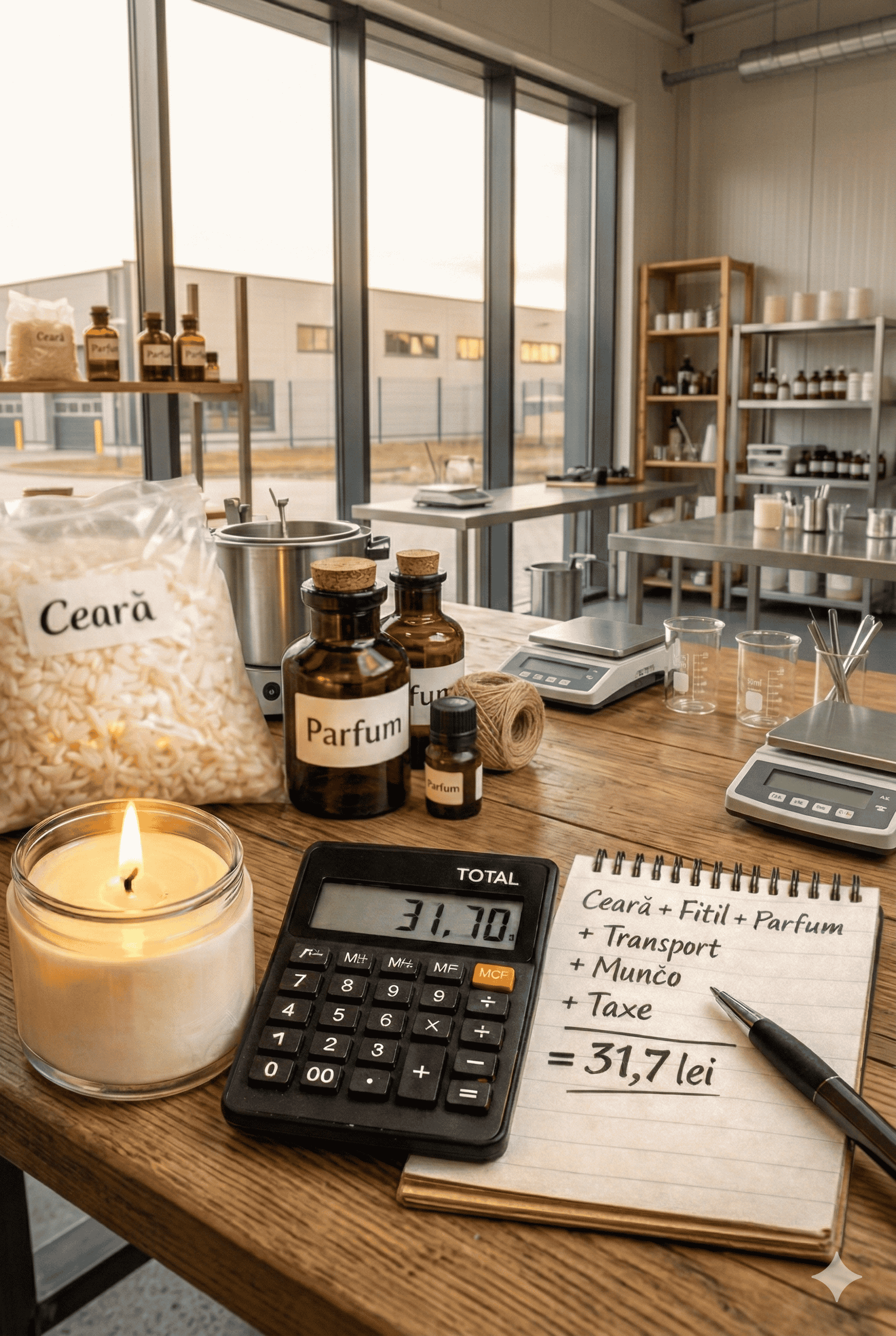
REAL production cost: 30.7 lei
This is the point where you break even.
Only above this figure does real profit begin.
6. What real profit means
Profit isn’t just the difference between price and cost.
Out of it you have to:
- pay taxes
- reinvest
- grow your stock
- get through the slower periods
If your price only "covers the visible costs", the workshop doesn’t grow. It just turns money over.
7. Where you can raise your margin without lowering quality
There are two ways:
- You raise the final price.
- You lower the real cost per piece.
The second option is more stable.
How?
- Bigger orders → lower delivery cost per kilogram
- Volume prices → better cost per kg
- Steady stock → fewer urgent orders
You can look at the differences directly in our dedicated category: https://www.lumanariservus.ro/en/raw-materials
If you buy regularly and you’re logged in to your account, the discounts applied through Servus Club lower the cost of raw materials directly, which raises your margin on every candle.
See how it works here: https://www.lumanariservus.ro/en/servus-club
Conclusion
The right price for a candle isn’t a theoretical formula. It’s a real calculation based on:
- materials
- logistics
- technical losses
- time
- fixed costs
- taxes
If, after this calculation, you find that your current price is below the real cost, it isn’t a failure.
It’s the moment your workshop moves from enthusiasm to maturity.
The right price doesn’t mean selling at a higher price. It means building a workshop that lasts.