 EN
EN  Romana
 Magyar
"Good morning, I’ve been following you for a while and I’d like to start making candles. I’m trying to work out how much wax I should order to begin with, and whether you have a recommendation for a melter."
— Loredana, an email Servus received (translated from Romanian)
This article started from the question above. It’s the situation we come across most often, and it shows exactly where the real block is: the fear of ordering the wrong thing and losing the material.
Is it normal to lose money on your first batch?
Most people who start pouring candles are afraid of one thing: that they’ll order too much wax, get the temperature or the fragrance wrong and have to throw everything away.
The truth is this:
Your first batch isn’t lost because you made a mistake. It’s lost because you don’t yet know what to do with the material once a problem shows up.
In a real workshop, a mistake isn’t the end of the road. It’s a stage of processing.
The Servus story: the coffee pot on the stove and the real beginning
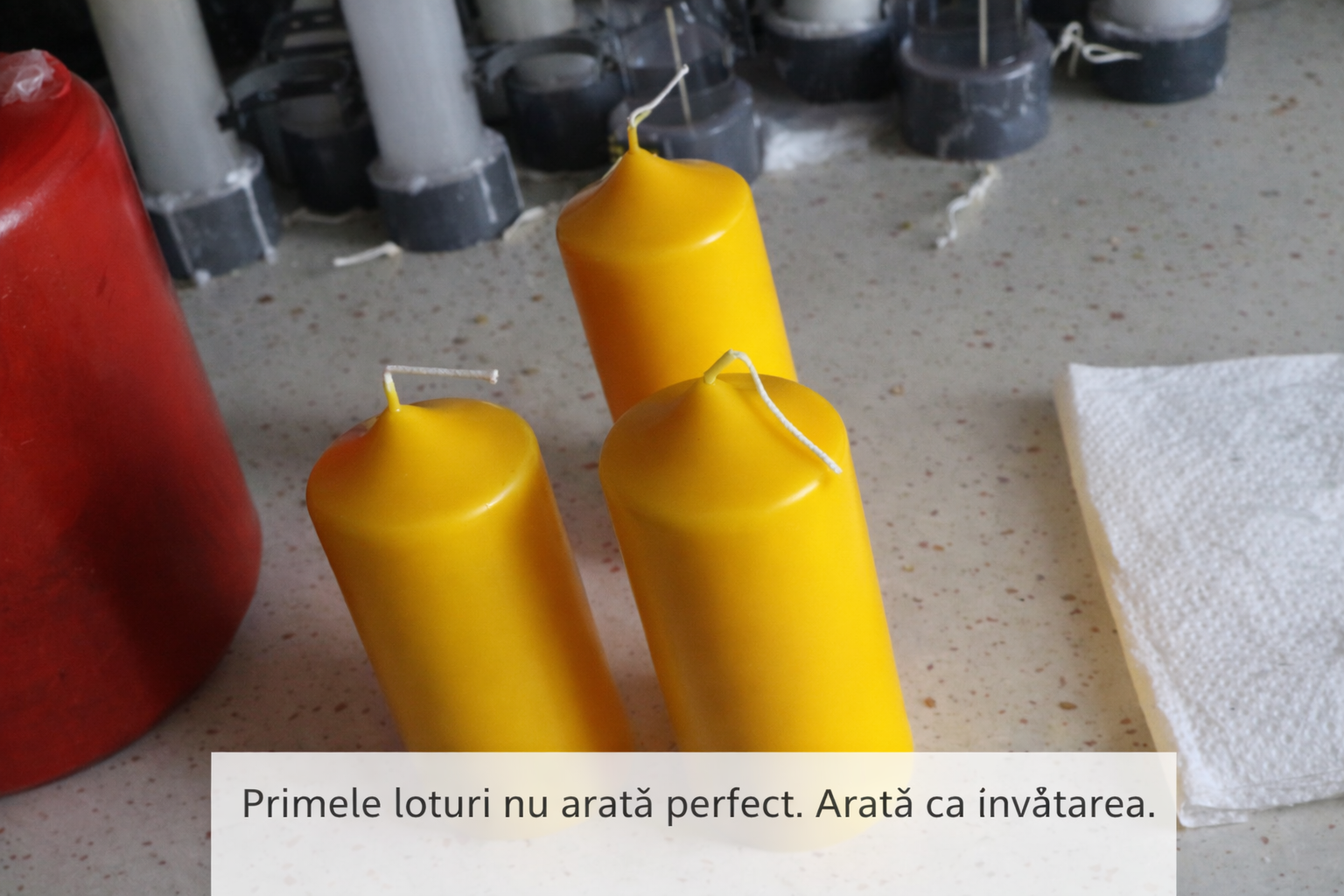
Fifteen years ago, Servus didn’t start with production halls, stainless steel vats or processes. It started exactly the way many people start:
- 2 moulds
- 1 kg of granulated blend (paraffin + stearin)
- a small coffee pot set straight on the gas flame, without a water bath
The first pours were chaotic. Sometimes the wax heated up too quickly and smelled overheated. Other times it cooled suddenly and made "waves" down the sides.
At the time we had no clear explanation. We only noticed that the same wax, remelted, no longer behaved the same way from one pour to the next.
Only later did we understand what was happening in practice: every cycle of heating and cooling changed how it behaved. The problem didn’t disappear, it showed up differently: in how the wax crystallised, how it held the fragrance, how it settled as it cooled.
Back then we couldn’t put a name to it. We knew only one thing for certain: if you don’t control the temperature, the wax shows you at the next pour.
But because the volume was small, nothing was lost for good. Everything could be remelted, adjusted and poured again.
That’s where the rule that still guides us today was formed:
The beginning has to be small so you can learn. Volume comes only after you understand the material.
Autopsy of a batch: what the "failed" candle tells you
The difference between a beginner who throws away 5 kg of wax and a workshop that produces consistently is the ability to diagnose the problem.
Before you throw anything away, look at the candle that didn’t turn out well. It shows you exactly which parameter you broke.
Table 1 – Visual diagnosis: what you see vs. what went wrong
| Visual symptom | Technical cause | What you do at the next test |
|---|---|---|
| Milky / cloudy wax | Overheating, thermal shock | Melt slowly, don’t go above 85 °C |
| White patches (frosting) | Cooling too fast | Preheat the containers |
| Deep tunnel | Undersized wick | Test a wick one size larger |
| Oil on the surface | Fragrance added too cold / too much | Add within the window on the wax’s data sheet; 6–8% in containers, 5–6% in moulds |
| Cracks on the surface | Draughts, sudden cooling | Slow cooling, no fluctuations |
In most cases, the wax is still good. The problem is the way it was worked.
The workshop solution: how to save the material without spoiling the next batch
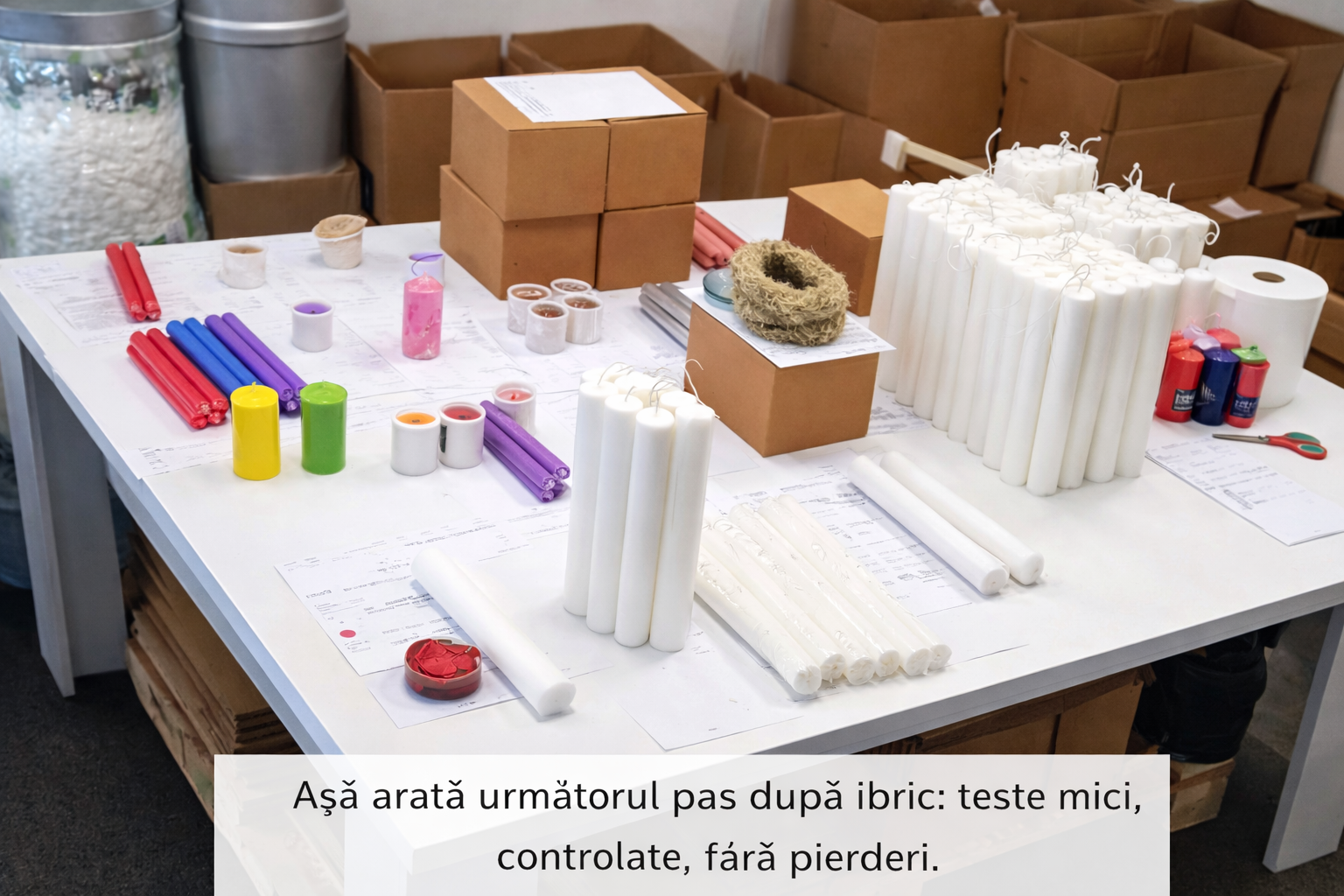
In a mature workshop, problem wax (cracks, frosting, the wrong colour) isn’t thrown away. It’s worked back in, in a controlled way.
In daily production, these happen inevitably:
- moulds that leak,
- unbalanced pours,
- differences in colour.
We’re not talking about "rejects" here, but about kilograms of material.
The process is standard:
- Collection – strictly by type of wax (soy with soy, paraffin with paraffin)
- Filtering – compulsory, for bits of wick and impurities
- Storage – poured into pots of ~10 kg → a rework block
Table 2 – Safe limits for reworking (the Servus rule)
| Parameter | Safe limit | Why |
|---|---|---|
| Rework percentage | max. 10–15% | above it → unstable structure |
| Type of wax | the same base | different melting points |
| Block size | ~10 kg | stable thermal mass |
| Residual fragrance | treated as a "base" | needs less new oil |
Why only 10–15%? Because remelted wax is more thermally "tired". In a small dose you can’t tell. In a large dose, it becomes unstable.
The lesson from the workshop: the only material you lose is the material you don’t know how to control.
What makes the difference in the long run: respect for temperature
There’s a moment in the life of every workshop when you understand the real risk. For us it was the day of a pot forgotten on the heat.
The flame wasn’t the problem. The ignored temperature was. Since then, the thermometer is no longer a suggestion in the Servus workshop. It’s a rule.
Wax is a living material: if you respect it, it listens to you. If you rush it, it shows you straight away, through smoke, cracks, smell.
The right decision at the start
If you’re just starting, don’t start "so that it turns out beautiful". Start so that you can correct.
- Work with 2–5 kg of wax
- Use a single type of wax until you understand it
- Write down the temperature at every pour
Most of the problems that look like "losses" actually start from the wrong temperature.
Correct temperatures for each type of wax – Servus guide
Conclusion
Your first batch isn’t lost. It’s learned from.
The difference is whether you learn chaotically or with a process.
Now that you know the material can be diagnosed and controlled, you can work with more courage and less stress.
The raw materials we use and test in this process are here: Raw Materials category – Candles & Soap