 EN
EN  Romana
 Magyar

First you choose the shape, then the wax.
You’ve opened the online shop and you see two rows that look like the same thing. Soy wax. And soy wax again. The same brand, the same white flakes, a similar price. You pick one of them because you have to pick something.
You don’t choose mould wax or container wax from the bag. You choose it from the shape you’re pouring into. Mould wax shrinks as it cools, so the piece comes out of the mould. Container wax stays soft and sticks to the sides of the glass. They’re two opposite behaviours, and one wax can’t have both.
I’m Sînziana. This order looks like a trifle. It is, in fact, the difference between a good batch and a week lost on adjustments that had nothing to fix.
Below is what you can see on the technical data sheet, what you can see on the cold candle and how you check your choice on a small batch, before you order a whole bag.
Why do you choose mould wax or container wax by the shape?
The shape decides because it sets what the wax has to do once it has cooled. In a mould, the wax has to come away. In a glass, it has to stay stuck. There’s no material that does both well.
For our soy wax for moulds, KeraSoy 4120, the shrinkage on cooling is written on the data sheet as an advantage: it’s what makes the release from the mould clean and keeps the fine details. The same shrinkage, in a jar, is the main defect.
What happens if you pour mould wax into a glass?
The wax shrinks as it cools and pulls away from the sides of the glass. The data sheet of the mould wax says it plainly, without beating about the bush: it isn’t for containers, because there the shrinkage pulls the wax away from the glass.
The sign shows in the first twenty-four hours. You look sideways, through the glass, and you see light coming in between the wax and the side. Sometimes you can hear it: you lift the glass and the block of wax moves inside it. It isn’t a batch defect and it isn’t your hand. It’s the material doing exactly what it was formulated to do, in the wrong place.
This is where most people lose their first batch. The wax was good, the wick was good, the fragrance was good. Only the shelf was wrong.
Why won’t a candle poured from container wax hold its shape?
Because it’s too soft to support itself. Our container wax, KeraSoy 4130, has a typical penetration of 60 dmm, against 32 for its mould partner. The limit is written on the data sheet in three words: not self-supporting.
In practice that means a piece that comes out of the mould and doesn’t keep its edges. It marks when you touch it, it sags where it stood on the shelf, and in a tall shape it leans instead of standing. Anyone who has tried it knows the feeling already: it seems it hasn’t cooled enough, you leave it another day, and it stays soft all the same.
It isn’t a question of patience. Penetration is measured at 25 °C, that is, at room temperature. That wax will be just as soft tomorrow.
The mistake that looks like a saving and isn’t
A single bag of wax for both techniques costs you more, not less. It turns out badly both in the mould and in the glass, and you pay twice: once for the bag, a second time for the batch.
Many of the people who call us first ask where they can find the cheapest soy wax. It’s an honest question and I understand it. Only, a failed batch doesn’t cost what the wax in it costs. It costs the wax, plus the wick, plus the fragrance, plus the colour, plus your hour of work and the glasses you now have to wash.
My advice, when someone asks me on the phone: buy a little of the right wax, not a lot of the cheap wax. You increase the quantity once you know what you’re doing with it.
And you increase it cheaply. On wax we have a quantity scale that applies itself in the basket: −6% from 5 kg, −12% from 10 kg, −18% from 20 kg. You don’t have to ask for anything and you don’t need an account. The scale rewards you for taking a lot of the right wax, not for finding the cheapest one. The same order as before, taken all the way: first you find out which shelf you’re on, then you buy in quantity.
How do you recognise the right wax on the technical data sheet?
You look at two rows: penetration and congealing point. The rest of the data sheet is useful, but those two tell you whether the wax is for moulds or for containers, whatever it says on the label and whichever category it was put in on the website.
The data sheet isn’t a guarantee. It’s a safety range, and real batches settle somewhere inside it. On the two batches of 4120 for which we have a certificate of analysis, the congealing point came out at 49 and 50 °C, against a declared typical of 47. Within specification, but not in the middle of it.
What does the penetration number say about a wax?
Penetration measures how deep a standard needle goes into the wax at 25 °C, in tenths of a millimetre. A low number means a firm wax that holds itself up. A high number means a soft wax that moulds itself to the sides.
If you remember a single thing from the whole article, it’s this. It’s the only figure that tells you the shelf before you open the bag.
The pairs in our range, with the values from the manufacturers’ data sheets:
| Wax line | Mould version | Container version |
|---|---|---|
| KeraSoy, soy | 25–40 dmm (typical 32) | 40–80 dmm (typical 60) |
| EcoSoya, soy | 18 dmm | 40 dmm |
| EcoCoco, coconut | 32 dmm | 80–120 dmm |
| EcoOlive, olive | 23 dmm | 37 dmm |
Read the table across, not down. It doesn’t matter which line has the lowest number, but how far apart the two columns are in the same line. With coconut, the gap is huge: the container version is several times softer than the mould one and won’t come out of a shape whole, however long you wait. With olive, the gap is small, and the two behave more alike.
This number isn’t on the label of the bag. It’s on the data sheet, in the "penetration" row, with the measuring method next to it. If a product page doesn’t give it to you, you have every right to ask for it before you buy.
With us you don’t have to ask. The manufacturer’s documents are uploaded on the page of each wax, as PDFs you can download before you put anything in the basket: for 4120, for example, the KeraSoy Pillar 4120 technical data sheet (TDS v6.0, Kerax) and the KeraSoy Pillar 4120 safety data sheet (SDS v5.0, Kerax). The safety data sheet isn’t red tape: it tells you what you have in your hands and what to do if it spills, and if you sell on, you need it. You can open them without an account and without asking us. A supplier who doesn’t give them to you before you buy is asking you for trust in place of proof.
How do you choose the pouring temperature for each of them?
Mould wax is poured hotter, container wax cooler. For the soy pair we work with: 55–65 °C for moulds and 45–55 °C for containers, from the manufacturer’s data sheets.
The difference has a mechanical reason, not one of taste. In containers you pour close to the congealing point, so the wax grips the side while it’s still moving. Pour too hot into a cold jar and you get exactly the pulling away you were trying to avoid. In moulds you pour hotter so the wax gets into the detail, then you let the shrinkage release your piece.
Three temperatures you write on paper before you melt:
- Melting. Up to 90 °C, for a short time. Above that, the wax discolours. A stainless steel pot, never copper or zinc.
- Pouring. The range on your wax’s data sheet, not the one from a general table. For figurines with fine details, in the workshop we’ve narrowed it to 58–62 °C: below that the wax turns brittle, above it, it loses the detail.
- Preheating the container. For glasses and jars, 45–50 °C. A jar taken cold off the shelf undoes everything you’ve done well up to then.
Write them on a note stuck by the cooker and work with the thermometer in your hand, not by eye. The fragrance goes in within the window your wax’s data sheet gives; with our container wax it’s added just before pouring, at the pouring temperature, so it isn’t lost in the steam.
What do you check before ordering a new bag?
Five rows, in the order you look for them on the page or on the data sheet:
- The declared category: moulds or containers. If the page doesn’t say, don’t assume.
- Penetration at 25 °C. A low number is for moulds, a high number is for containers.
- The congealing point. The lower it is, the softer the wax at room temperature.
- The maximum fragrance percentage. For our mould wax, 5–10%; above that, the fragrance separates. For the container one, up to 10–12%.
- The limit row. "Not for…" is the most useful sentence on the whole data sheet.
If these five rows match what you want to pour, you order. If two of them are missing, you don’t order yet, you ask.
A warning that saves you an argument: you’ll find pages that write "melting point 80 °C" for a wax whose manufacturer gives a congealing point between 43 and 52 °C. Those aren’t properties of the material, they’re process instructions presented as properties. Someone comparing two pages sees specifications that contradict each other and no longer knows whom to believe. The truth is on the manufacturer’s data sheet and in the certificate of analysis of the batch, not in the shop’s description.
The same soy wax, two different shelves
The brand tells you nothing about the technique. Kerax makes both 4120 for moulds and 4130 for containers. EcoSoya has a mould version and a container version too, with a penetration of 18 against 40. To look at, in your palm, they’re the same flakes.
That’s why the decision is made before you look at the bag. The category name is a promise of use, and the measurement is on the data sheet. When the two don’t match, the data sheet wins.
What do you choose if you pour candles in jars?
Container wax, a wick sized to the diameter of the jar, the jar preheated. With us, in container production, the wax is KeraSoy 4130.
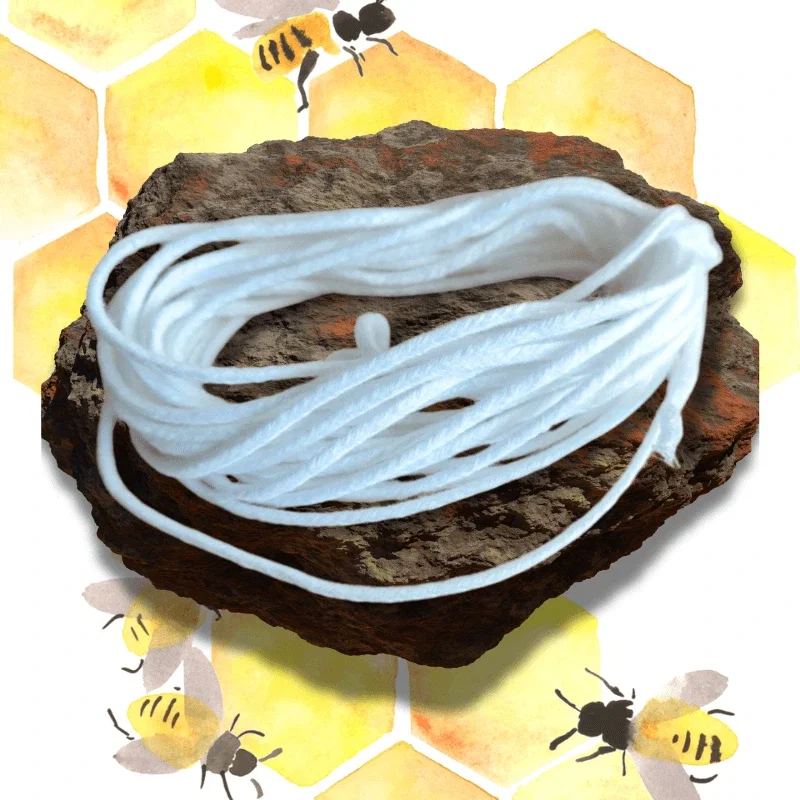
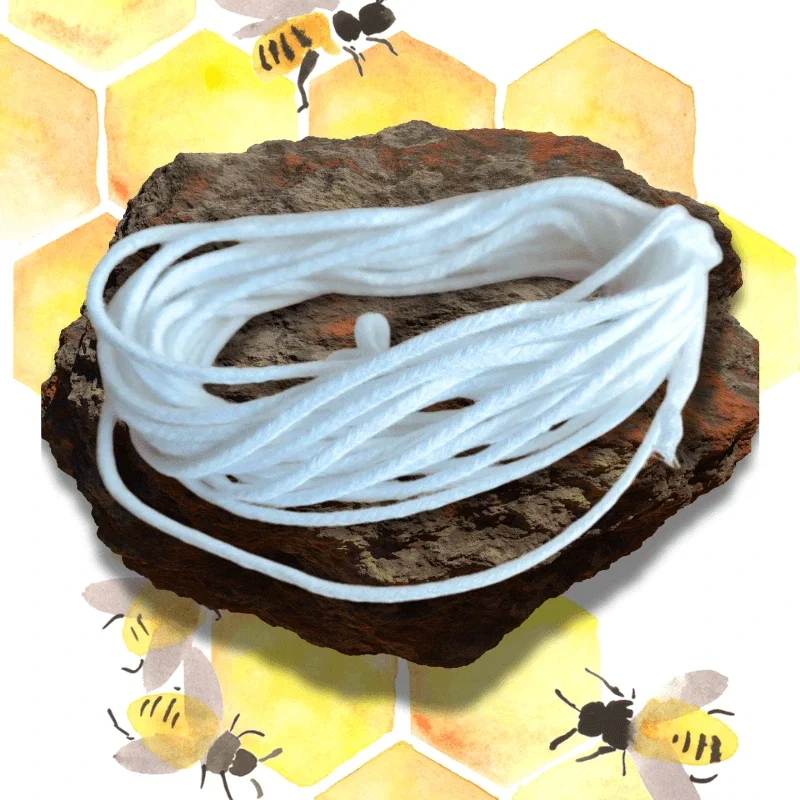
The diameter isn’t guessed. You measure the jar with a ruler, on the inside, and read the wick from the table on the waxed cotton wick with tab:
| Wick code (Ø/H cm) | Guide burn Ø | Container type |
|---|---|---|
| 30 / 3.5 | ~3 cm | mini containers (tealight, mini votive) |
| 30 / 10 | ~3 cm | small tall containers |
| 40 / 7.5 | ~4 cm | small containers (small jars) |
| 40 / 10 | ~4 cm | small to medium containers |
| 50 / 7.5 | ~5 cm | medium low containers |
| 50 / 10 | ~5 cm | medium containers (standard glasses) |
| 60 / 7.5 | ~6 cm | jars Ø 6–7 cm |
| 60 / 12.5 | ~6 cm | medium tall containers |
| 70 / 10 | ~7 cm | medium-large containers |
| 70 / 15 | ~7 cm | medium-large tall containers |
| 80 / 10 | ~8 cm | large containers |
| 80 / 15 | ~8 cm | large tall containers |
| 100 / 10 | ~10 cm | very large containers |
| 100 / 15 | ~10 cm | deep containers |
| 100 / 17.5 | ~10 cm | very deep containers (production) |
The first figure is the diameter, the second is the height of the wick. You take the diameter from the jar, the height from its depth: a glass 5 cm wide and 10 cm deep needs 50/10, not 50/7.5. A wick that’s too short drowns in the wax before it finishes the candle.
Adhesion doesn’t come from the wax alone, but from the combination of pouring temperature and container. A low pour into a preheated jar means wax stuck to the side. A hot pour into a cold jar means white patches and pulling away. In large jars you top up once, before the first pour has cooled completely, otherwise you’re left with a dip around the wick.
Natural waxes need a bigger wick than paraffin. In practice that means one size up from the table: for a 6 cm jar with soy wax you start from 60 and are ready to move to 70 if, at the first test, unburnt wax is left on the edges. For rolled beeswax, where the burn is a different story altogether, we go with another wick line: Special Wick No. 5 for candles of Ø 20–40 mm and Special Wick No. 7 for Ø 50–80 mm, both certified for 100% beeswax and borax free.
The complaint "it won’t burn any more, the wick goes out" is almost never about the wax. It’s about a wick too small for that diameter, which digs a tunnel and drowns in its own melt pool.
What do you do if you don’t want to melt anything?
You roll. The honeycomb wax sheet is rolled cold, by hand, with no melting, no pouring and no thermometer. We timed the first candle made this way: 98 seconds, from the cold sheet to the lit candle, with the stopwatch running, written up step by step.
It’s the third technique, and the one most often overlooked. It was put to us in exactly these words, in a message: "what wax do I use to roll by hand?" (translated from Romanian). The answer is that you don’t use wax from a bag at all. The sheet and the wick are all you need.
It’s worth saying what it isn’t, too: rolling isn’t a cheaper version of pouring. It’s a different technique, with a different result and a different look. If you want a smooth candle in a glass, the sheet won’t give you one, however well you roll.
Where do you start?
You start with a sentence written on paper. "I want a candle that stands on its own on the table" or "I want a candle in a glass". That sentence chooses your shelf, and the shelf chooses your wax. In that order, not the other way round.
The first statement sends you to mould wax. The second, to container wax. They’re two separate shelves in the shop precisely because they’re two opposite behaviours in the wax: the split isn’t about organisation, it’s about the material.
I’ve seen people who bought three times before they got it right, not because they hadn’t read, but because they started from the bag. The order isn’t a preference of mine. It’s the only one that doesn’t produce a failed batch at the first attempt.
How do you test your choice on a small batch?
You pour 500 grams before you order a bag. That’s two or three glasses or two small mould pieces, that is, enough to see the behaviour and little enough not to hurt if it turns out badly.
You let the batch cool undisturbed, at room temperature, and don’t touch it for 24 hours. Only then do you light it. A burn test done two hours after pouring tells you about a wax that’s still settling, not about your candle. If the batch is scented, you do the burn test only at 48 hours: the fragrance needs time to bind with the wax.
At 24 hours you look at three things:
- The side. In a glass, does the wax touch the glass everywhere or has it pulled away from it?
- The edge. On the piece from the mould, are the corners whole or have they rounded when touched?
- The surface. Uneven is normal with natural waxes. The block moving in the glass isn’t.
If all three are fine, you order the large quantity with peace of mind. If one isn’t, you’ve found out on 500 grams something you’d otherwise have found out on ten kilograms.
Choose a single shape this week and buy the wax for it, not for both. It’s the cheapest decision in the whole process, and it’s made before you open the shop.
The reality check, so you don’t hear it later from your batch: the right wax doesn’t guarantee you a good candle. It only guarantees that, if it turns out badly, the cause is somewhere else and you can find it. That’s all a correctly chosen material does. The rest is still work.
If you’re not sure which shelf you’re on, write and tell us what you want to pour and into what: on WhatsApp or by phone at +40 726 162 810 (we answer in English), Monday to Friday, between 8:00 and 16:30 (Romanian time). The shape and the container, that’s all we need to tell you the shelf. We’d rather have a question before the order than a ruined batch after it.