 EN
EN  Romana
 Magyar
You’re standing in front of the shelf and everything on it says wax. Soy, coconut, olive, palm, rapeseed, sunflower, shea, beeswax, paraffin. Nine families, plus gel and flakes, which are none of them. The granules look almost the same in your palm, the prices are close, and nowhere does it say which one is the good one.
None of them is. Each wax family does one thing better than the others and falls short at another, and the limit is written on the same technical data sheet as the advantage. Whoever sells you a wax that’s good at everything is actually selling you a limit they haven’t mentioned.
I’m Sînziana. I’m writing this because, since 2010, every wax below has been through our hands, for better and for worse. Below is what each family does, where it falls short, and the line on the data sheet that tells you which one you need, without pouring a batch to find out.
What decides the choice between types of candle wax?
Two things decide it, in this order. First, the form you pour into, which cuts half the catalogue. Then, among what’s left, the compromise you’re willing to accept. You don’t choose by what you want to gain, but by what you’re willing to lose.
That sounds the other way round from how wax is sold. But a wax’s advantage and its limit are almost always the same physical thing, seen from two sides.
If it’s your first candle, the road is even shorter. If you pour into a glass, you start from a container wax. If you pour into a mould, you start from a mould wax. You only choose the family after that, and the rest of the article is about the compromise between them.
What does the right wax mean, if not a good one?
Right means its advantage falls exactly on what you need, and its limit falls on something that doesn’t hurt you.
Take the softness of soy container wax. On our KeraSoy 4130 data sheet, the penetration at 25 °C is between 40 and 80, typically 60, and the limit is written in a single line: not self-supporting. In a glass, that softness is exactly why the wax stays stuck to the glass. In a mould, it’s why the piece sags and marks when you touch it.
The same property, an advantage and a defect, depending on where you put it.
What changes when you move from one wax family to another?
Four things change at once, not one. The temperature it melts at, how firm it stays at room temperature, how much fragrance it holds and what wick it needs.
The difference in melting between families is bigger than anyone expects. Our soy container wax melts between 42 and 48 °C, the refined paraffin in our range between 56.7 and 60.5 °C, depending on the grade, and white beeswax has a drop point between 61 and 66 °C. That’s almost twenty degrees between the two ends, in materials that look the same in the sack.
The fragrance moves too. Our soy mould wax holds 5 to 10 per cent, and above that the fragrance no longer binds and comes out of the wax. Its container partner holds 10 to 12. Same brand, same base raw material, different ceilings.
And the wick doesn’t move with you automatically. Natural waxes need a bigger wick than paraffin, at the same diameter. Anyone who changes wax family and keeps the wick they were working with ends up with the complaint we get most often: the candle goes out on its own after a while, with the wick still glowing.
Why the technical data sheet tells you more than the label
Because the label says what the wax is good for, and the data sheet also says what it isn’t. The most useful sentence on a technical data sheet starts with “not for”. The data sheet for our soy mould wax says it isn’t for containers, because there the shrinkage pulls the wax away from the walls. The data sheet for its container partner says it isn’t for moulds, because it doesn’t hold itself up. Two opposite limits, declared by the same manufacturer, on two products you can’t tell apart in your palm.
What we know is tested. What we don’t know, we say. It’s less comfortable than a table filled in to the end, but a table filled in from guesses costs you a batch, not me.
Soy and palm behave differently, even though they’re both plant waxes
They’re both plant waxes, they both crystallise as they cool, and they both lead to the most frequent question that reaches us by message: why does it look like this?
Only with one of them, crystallisation is a surface effect you can control, and with the other it’s the very product you bought.
What does soy wax do well, and where does it fall short?
Soy wax does two things well. It sticks to the walls of a container and it holds a lot of fragrance. It falls short on firmness and on the look of the surface.
The adhesion doesn’t come from the wax alone, but from the temperature you pour at. The data sheet for our soy container wax links better adhesion to pouring close to its solidification point, that is, between 45 and 55 °C, into a clean container at least at room temperature; preheating to 45–50 °C, the data sheet also says, can help.
Where it falls short, in the order it hurts:
- Firmness. Penetration is measured at 25 °C, that is, at room temperature. A container wax at typically 60 is just as soft three days later. It isn’t a question of patience.
- The surface. Soy doesn’t give you the smooth finish of paraffin. Frosting and variations on the surface appear even when the recipe is right, because they come from the material, not from your hand.
- The wrong fragrance. The data sheet for our container wax warns directly: fragrances developed for paraffin give poor results in soy and sweat out. A fragrance that’s good in one wax can be a defect in another.
- The sales story. For one of the soy waxes on our shelf, the manufacturer says non-GM sourcing is done wherever possible, but doesn’t guarantee it. If you sell on that promise, it’s a sentence you need to read first.
Firmness is also the point where our customers found a solution on their own, before we asked them. It was told to us exactly like this, in interviews: soy is softer, they break if I don’t combine it with paraffin (translated from Romanian).
In the workshop we arrived at a different solution to the same problem, one that doesn’t take the candle out of plant wax. Not paraffin, but a plant-based additive in flakes, palm lipids, blended into the soy mould wax. It hardens the piece in the heat, helps with demoulding and reduces the stickiness of the surface. The ratio we work with is written on its page: 15 to 20 per cent additive, the rest wax. Below 15 per cent you barely see it.
Why does palm wax come out grainy in a glass?
Because that’s what crystallised palm does. It sets into crystals as it cools, and the graininess you see is its very mechanism, not a batch accident.
Here is the part missing from most product pages: palm isn’t one family, it’s two, and they split on a single number from the certificate of analysis. The acid value. On our shelf there are six palm waxes, three on each side.
- Crystallised palm. High acid value. The two mould waxes came out at 155 and at 175, and that acid value is exactly what builds the crystal pattern as it cools, honeycomb-type on one, star-type on the other. They melt between 59 and 66 °C. The third crystallised one is made for containers, and we poured that one ourselves, not just listed it.
- Refined palm. Low acid value, below 0.2 on the three we have, one of them at 0.049. It’s smooth and doesn’t crystallise the same way. It melts between 46.5 and 56 °C, depending on the product, from an extra-soft one for containers to a firm one for moulds.
This number isn’t on the sack label. It’s in the batch’s certificate of analysis, on the acid value line, and it’s the clearest sign, in advance, of whether that wax will make a pattern or a smooth surface.
But the acid value only tells you half. The other half is the form the wax was made for, and that’s written on the product, not on the certificate. The mistake made in practice isn’t pouring crystallised palm into a glass. It’s pouring into a glass a crystallised palm made for moulds. The decorative pattern, which in a mould is the product, turns into graininess in a container it wasn’t made for. The objection reached us in these words: the website says it’s perfect for containers, it should look perfect, not like this (translated from Romanian).
He was right to be upset. Not with the wax, with the description.
So if you want the crystal pattern in a glass, you ask for the crystallised palm made for containers. If you want a smooth surface in a glass, you don’t ask for crystallised at all, but for refined.
And the limit, said honestly even if it costs us a sale: crystallised mould palm won’t give you a smooth surface in a container, however correctly you work. In the ceramic we worked with, it’s even more visible: the cooling was slower and more uneven than in glass, and the crystals had time to grow large. If a clean surface is what you want, the right base is soy or a refined palm, and the crystallised one stays in the recipe only for the effect.
The white spots aren’t mildew and they don’t come off
The white spots on the walls of a plant wax candle are called frosting, and they’re the wax’s natural crystallisation. They aren’t mildew, they aren’t spoiled wax, and they affect neither the burn nor the scent. Melted wax wants to return to its crystalline structure, and if the cooling is uneven, the crystals form chaotically and show on the wall like frost flowers. They appear on plant waxes. They don’t appear on paraffin. The declared exceptions on our shelf are two: the sunflower wax and the Keragreen soy container wax. Both data sheets say they don’t crystallise as they cool. That’s the manufacturer’s claim, not a measurement of mine.
What keeps them in check, in the order it matters: a preheated container, pouring close to the solidification point, and slow cooling, away from draughts, with the candles next to each other. What makes them worse: the fridge. For our soy mould wax, the data sheet says directly that forced cooling causes cracks, frosting and loss of gloss.
One thing I don’t promise you: they don’t disappear completely. In a wax without additives, frosting is reduced, not eliminated.
The other plant waxes on the shelf: coconut, olive, rapeseed and sunflower
Soy and palm are the ones people write about. On the shelf there are four more plant waxes, each one chosen for a particular reason.
None of them makes palm’s crystal pattern. Coconut and olive come in pairs, one for moulds and one for containers; rapeseed and sunflower are for containers only. But each has its own pouring window, written on its data sheet, and you don’t move from one to another at the same temperatures. I put them here with their figures and their limits, not as a shelf list.
What does coconut bring, apart from not being soy?
Throw. That is, how strongly you smell the fragrance, cold in the room and warm while it burns. It’s what you pay the difference over soy for, and it’s the very positioning the manufacturer gives it on the data sheet.
Coconut comes in two versions, and the distance between them is the biggest on the whole shelf. The container one has a penetration between 80 and 120, so it’s softer than anything else we sell, including soy container wax, which sits at 60. The mould one is at 32 and solidifies at 52 °C. Same brand, same coconut, two opposite behaviours. It holds fragrance up to 12 per cent, two points above soy container wax.
Where it falls short, and it’s a limit of vocabulary, not of material: it isn’t coconut wax, it’s a predominantly coconut blend with natural additives. The manufacturer writes that in the first sentence of the data sheet. If you resell it as “coconut wax”, you’re saying more than the document behind it says.
Why does olive wax smell of olives?
Because the blend on our shelf is predominantly olive, and the manufacturer doesn’t hide it. It’s the only limit in the whole article that the manufacturer itself wrote on the data sheet, recommendation included: test on small batches, batch by batch, before production.
Its own smell doesn’t clash with every fragrance. It clashes with the fine, discreet ones, exactly the ones you choose when you want something subtle. With a full fragrance, you don’t notice it.
What you gain in exchange is firmness. The mould version melts at 62 °C and has a penetration of 23, so it’s the firmest in that line of blends, firmer than both the soy mould wax and the coconut mould wax. The container version gives a subtle sheen that the other plant waxes don’t.
Where it falls short: the smell, and the same limit of vocabulary as with coconut. It’s a predominantly olive blend, not pure olive wax.
What are rapeseed and sunflower doing on the container shelf?
They’re there for a question we hear more and more often: is there something that doesn’t come from across the ocean? Both are European crops, both come from the same French distributor, both are soft container waxes.
Rapeseed solidifies between 32 and 42 °C and has a penetration between 45 and 65. Its colour isn’t white, it’s a warm ivory, and it shows in the finished product. If you want pure white, it isn’t the one.
Sunflower is white and takes colour easily. Its data sheet has a sentence missing from most plant waxes: it doesn’t shrink and doesn’t crystallise as it cools. It melts between 46 and 51 °C, and the manufacturer also writes that the flame is gentle and that it doesn’t smell when burning. Where it falls short: the adhesion to glass is good, but the same data sheet recommends a small addition of fats to improve it. So it isn’t a case of pour and done.
What do you do when plant wax doesn’t give you what you need?
Sometimes it doesn’t. You want a tall piece that doesn’t sag in summer, or a clean surface soy won’t give you, or a sheet you can roll by hand without melting anything. There are two answers outside the plant wax shelf, and we tell you both with their limits, including the one that puts us in an awkward light.
What is paraffin good for in candles, and why do some people avoid it?
Refined paraffin is the best at firmness and predictability of the families in the table. It falls short on just one thing, but one that for many people ends the discussion: it isn’t plant-based.
The figures, from the data sheets of the grades we have. The penetration at 25 °C is 19 on all three, that is, significantly firmer than our soy mould wax, which is typically 32. The three grades differ only in melting point, 56.7, 58.7 and 60.5 °C, so you choose the grade by how heat-resistant you want the piece to be. The oil content stays below half a per cent, and its own smell is rated at the minimum on the data sheet’s scale, which means it doesn’t clash with the fragrance you put in. And, unlike plant waxes, it doesn’t frost.
Now the awkward part. We sell paraffin and we pour paraffin. We could keep quiet about it, or write about it in words that sound like an excuse. We do neither. If your message to your customers is plant-based or vegan, paraffin takes you out of the story, and no wording can fix that. If your message is a piece that holds its shape and a smooth finish, paraffin does the job better than any plant wax on our shelf.
The choice is yours, and it depends on who buys your candles from you, not on who’s right.
What do you gain and what do you lose with beeswax?
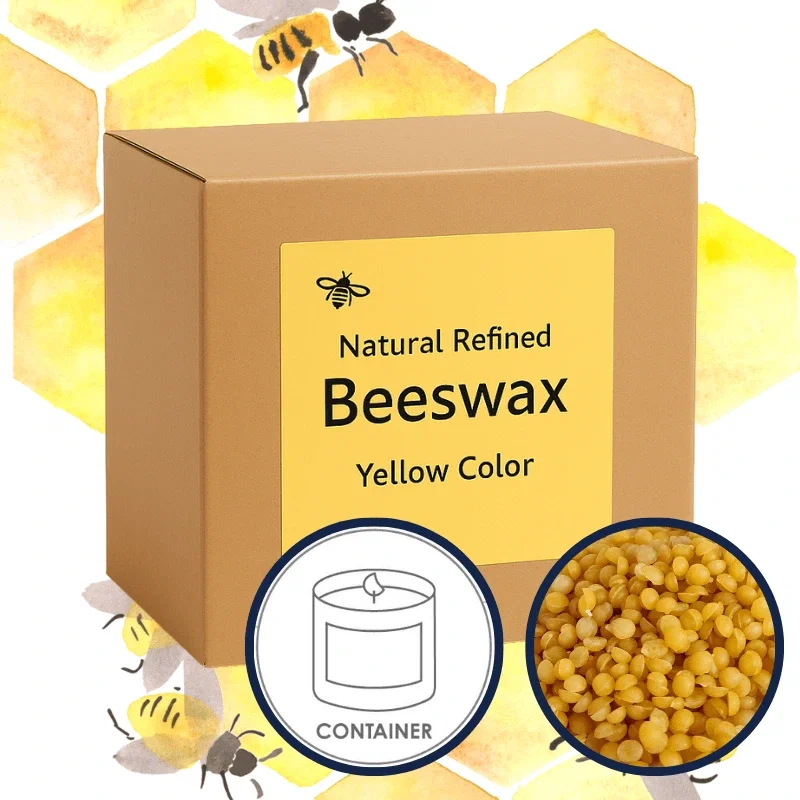
You gain natural firmness at high temperature and a technique the other families don’t give you at all. You lose plant-based, part of the fragrance and peace of mind at demoulding.
White beeswax has a drop point between 61 and 66 °C, according to the pharmacopoeia data sheet. That’s among the highest values in the article, alongside crystallised mould palm and olive mould wax, and its shrinkage on cooling is low. That makes it good for poured pillars and for the sheet you roll a candle from by hand, cold, without melting and without a thermometer.
What you lose, point by point:
- It isn’t vegan. It’s of animal origin and never belongs in a plant-based message, however natural the word sounds.
- It has its own smell. The yellow, unbleached version smells of honey. That’s lovely in itself and a selling point on unscented candles, but it gets into the fragrance you add.
- It needs a bigger wick. The high melting point translates directly into the wick, or into a blend with a softer wax.
- It sticks to metal. Low shrinkage is an advantage for the shape and a nuisance at demoulding. It adheres strongly to metal moulds, so you work in silicone.
When a blend is worth it and when it isn’t
It’s worth it when you want one single thing from another family and you accept testing. It isn’t worth it when you want to fix three problems at once with a single sack.
The two blends our customers make most often are soy with paraffin, for rigidity, and a smooth base with a little palm, for the effect. Both work for the people who use them.
What I don’t give you is the percentage for the palm blend, for the effect. We don’t have a batch poured in our workshop to give you a figure from, and a plausible figure is more dangerous than no figure, because you believe it. I also have a concrete reason: in our internal notes, two different ratios for the palm blend are going around, from different conversations. Until I pour one myself, it stays a direction, not a recipe.
What I do give you is the discipline of testing. A blend shifts the firmness, the pouring window and how much fragrance the mix holds, all at the same time. So you change one ratio per batch, keep the same fragrance, the same wick and the same container, and write everything down in your notebook.
Where you start
You start from the sentence you write on paper before you open the catalogue. Not “which wax do I buy”, but “what do I want to come out, and what am I willing to lose”.
If the answer is a candle in a glass that smells strongly, you lose firmness and the perfect surface. If it’s a piece that stands on its own on the table and doesn’t sag in summer, you lose the plant-based message or you lose fragrance. If it’s a clean, shop-window surface, you lose the decorative effect. It’s the list you have anyway, only most people discover it after ordering a sack.
How to choose your wax family on a small batch
You choose two candidate families from the table below, pour 500 grams of each, and leave them undisturbed for 24 hours before lighting them. If you’ve scented them, you wait 48: the fragrance needs time to bind with the wax.
The values are from the technical data sheets and the certificates of analysis of the products we stock. The right-hand column is the one resellers don’t write.
| Family | Melting or solidification, from the data sheets | Strength | Where it falls short |
|---|---|---|---|
| Soy, container | solidification 34–42 °C, typically 39 | adhesion in a glass, 10–12% fragrance | soft at 25 °C, not self-supporting, frosts |
| Soy, mould | solidification 43–52 °C, typically 47 | clean demoulding, fine detail | pulls away from the walls of a glass |
| Coconut, container | solidification 36–41 °C | strong throw, up to 12% fragrance | the softest on the shelf, 80–120 dmm |
| Coconut, mould | solidification 52 °C | strong throw, pure white, clean demoulding | blend with additives, not pure coconut |
| Olive, container | solidification 40 °C, melting 56 °C | subtle sheen, strong throw | its own olive smell |
| Olive, mould | solidification 55 °C, melting 62 °C | the firmest in the line of blends | its own olive smell |
| Rapeseed, container | solidification 32–42 °C, melting 48–52 °C | European plant wax, warm ivory | soft, not self-supporting; not pure white |
| Sunflower, container | solidification 36–41 °C, melting 46–51 °C | no shrinkage, white, easy to colour | adhesion needs an addition of fats |
| Refined palm | melting 46.5–56 °C, by product | smooth surface, firm in a mould | doesn’t give the decorative effect |
| Crystallised palm | melting 59–66 °C for the mould ones | crystal pattern, honeycomb or star type | the mould one goes grainy in a glass |
| Beeswax | drop point 61–66 °C | natural firmness, sheet for rolling | animal origin, its own smell, sticks to metal |
| Refined paraffin | melting 56.7 · 58.7 · 60.5 °C | high firmness, minimal own smell, no frosting | not plant-based |
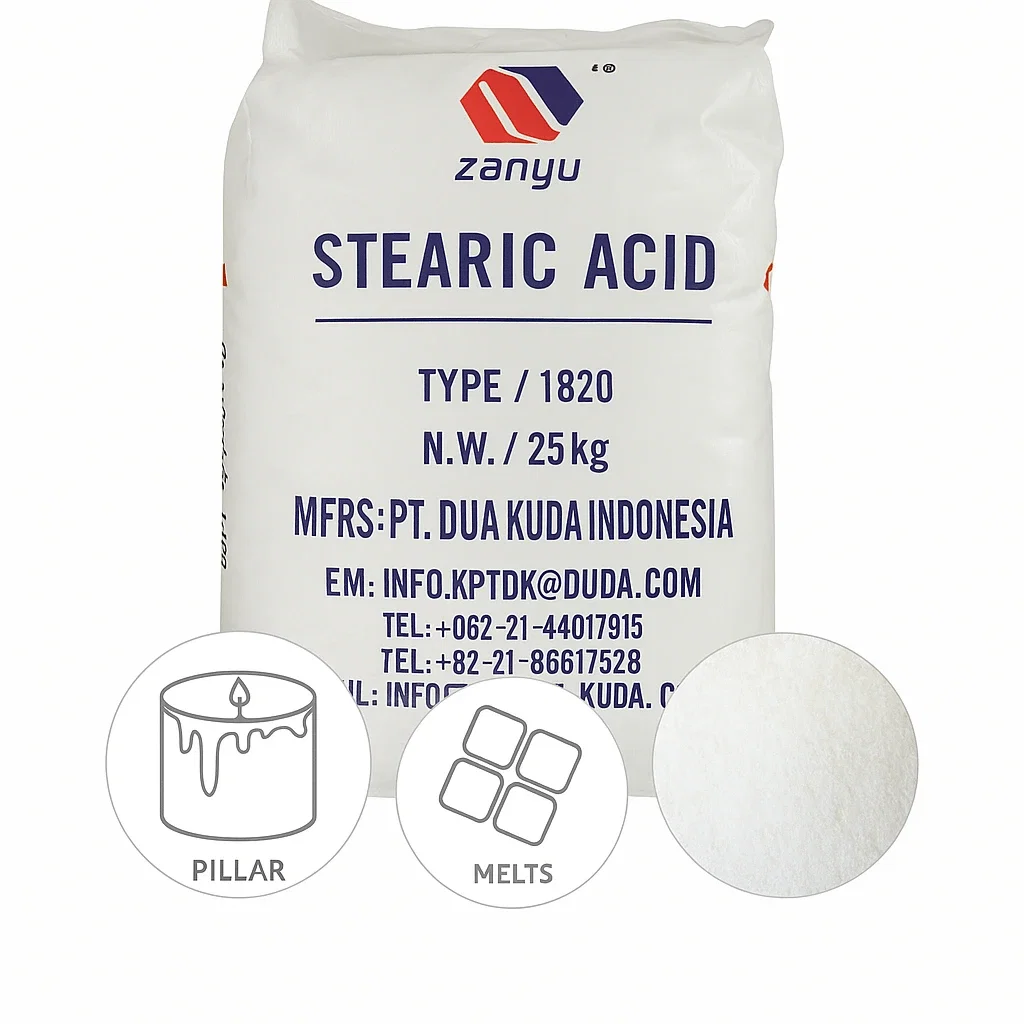
Five things on the shelf aren’t in the table, because they aren’t base waxes, and I mention them so you don’t look for them there. Stearin and vegetable flakes are additives: they’re added to a base to harden it, not poured on their own. The white synthetic wax on the mould shelf comes out of the mould on its own and needs no additives, but it’s neither plant wax nor paraffin. Transparent gel is another story altogether: only in glass containers, it doesn’t mix with any other wax, and it needs a paraffin wick, not a soy one. And pearled wax doesn’t melt at all; it’s poured like sand around a wick.
At 24 hours you look at three things and note them down: what the wall or the edge looks like, what the surface looks like, and how it burns for the first two hours. That’s all. A wax isn’t judged two hours after pouring, because at that point it’s still settling.
Pick a single sentence this week and buy for it. Five hundred grams of the right wax will clear things up faster than ten kilograms of the wax you’ve read the most about.
The reality check, so you hear it from me and not from your batch: the right wax family doesn’t guarantee you a good candle. It only guarantees that, if it turns out badly, the cause is somewhere else and you can find it. The rest is still work, a thermometer and a notebook.
If you don’t know which family you need, write to us what you want to come out and what you’re pouring into. On WhatsApp or by phone, at +40 726 162 810 (we answer in English), Monday to Friday, between 8:00 and 16:30 (Romanian time). We’ll tell you which shelf to start from, the mould one or the container one, and with which wax, before you buy the sack. We’d rather have a question before the order than a ruined batch after it.