 EN
EN  Romana
 Magyar
You poured a row of glasses in the evening, and in the morning, when you turn them towards the light, you see some lighter areas on the glass, like islands, where the wax no longer seems to stick. The candle looks whole, the top surface is fine, but through the glass you can see that something has pulled away from the side. They’re called wet spots, and the first things you check are three temperatures: of the wax when you poured it, of the glass when you filled it, of the room it cooled in.
The short answer is that wax shrinks as it cools, and if it cools too abruptly next to the side, it comes away in patches. Where it no longer touches the glass, you see a spot. The less short part is that the figures that protect you from this aren’t the same for every wax, and on some data sheets they don’t exist at all. We read the technical data sheets of the container waxes on our shelf side by side, and I’ve set them out below, with what each one says and what we noted when pouring.
In the order below: what the spots are and how to tell them apart from frosting; what each container wax’s data sheet says about adhesion; how to pour so the wax stays stuck; what you note down and what you send us if a batch comes out with spots.
I’m Sînziana. In our workshop in Maramureș, Romania, we’ve been pouring candles since 2010, in glasses and in moulds, and we also sell on the waxes we work with. What you find here comes from the manufacturers’ data sheets and from what we’ve written on our pages after pouring; where the data sheet is silent and I don’t have a test of our own, I tell you so, I don’t fill the gap with a figure that sounds right.
Why does wax pull away from the glass after it cools?
Because wax contracts as it cools, and if it cools too quickly next to the side, it pulls away from the glass before it has settled. On the page for our soy container wax we write down the two situations in which we see it most often: you poured too hot or you poured into a cold glass. The area that has come away is left with air between the wax and the glass, and that’s why it looks different from the rest of the candle.
What wet spots look like and how to tell them apart from frosting
Wet spots are whitish areas with an outline, which through the glass look like damp patches: there, the wax no longer touches the side. They only appear where the wax sits against the glass, because only there does it have something to come away from.
Frosting is something else, with a different mechanism. It’s the wax itself crystallising unevenly and forming a white veil, like frost on a window pane; we’ve written about it separately. Frosting is a pattern in the wax; a wet spot is the wax coming away from the side. The difference matters, because the remedies aren’t the same: with frosting you work on crystallisation and cooling, with wet spots you work on the pouring temperature and on the glass. And that’s why conclusions aren’t borrowed from one to the other: what we know about burning with wet spots, below, comes from the workshop, not from frosting.
What happens at the side when you pour too hot?
On the page for KeraSoy Container 4130, the soy container wax we use in the workshop, we write what we see: poured too hot or into a cold container, the wax contracts and comes away from the glass, leaving white areas. Very hot wax has a long way to fall before it sets, so it has a lot to shrink; a cold glass speeds up cooling precisely in the layer stuck to it. In both cases, the wax next to the side shrinks before the rest.
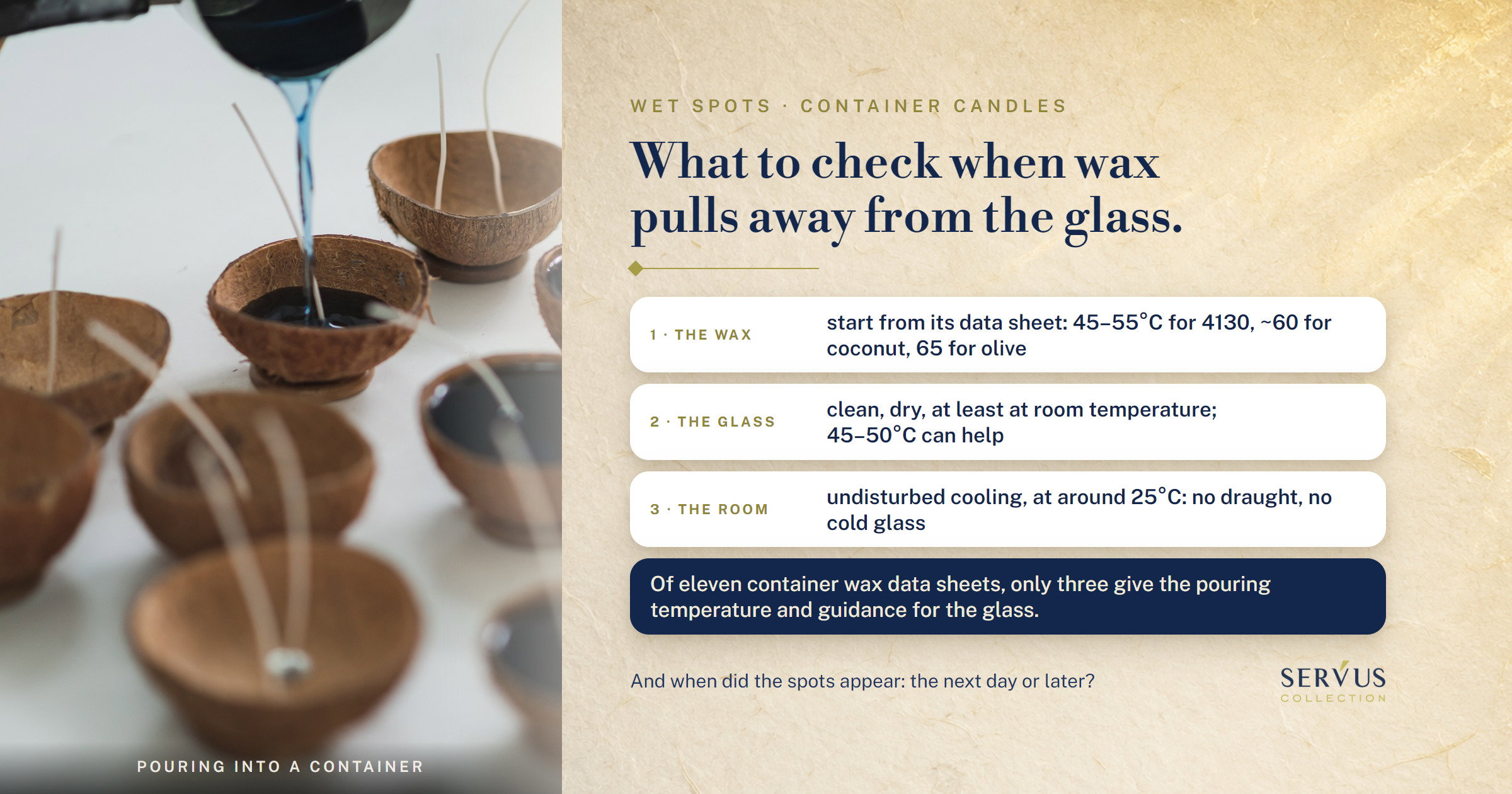
The 4130 data sheet says that adhesion to the container is better when you pour close to the congealing point, that is, at around 45–55 °C, with wax that has only a little way left to fall before it sets. The same data sheet also says that the pouring temperature varies with the container, the fragrance and the dye, and that if you have difficulties, you try lower or higher, in steps of 5–10 degrees. So 45–55 is the starting point for adhesion, not a threshold below which you’re no longer allowed to go.
Do they only show through the glass, or do they change the burn too?
They only show. In our workshop, a glass with wet spots burns the same as one without. The data sheets we’ve read say nothing about burning on this point, so the answer comes from our pours, not from the data sheet, and it isn’t borrowed from frosting either.
What’s left is the part you can see: on the shelf, in the product photo and in the hands of the customer who turns the glass towards the light and asks you “why does it look like that?”. It’s a cosmetic defect, but if you sell candles in glass, the look is exactly what you’re selling.
What does each container wax’s data sheet say about adhesion?
Less than you’d think, and not the same thing. Of the eleven container waxes on our shelf for which we have the manufacturer’s documents, only three give both the pouring temperature and guidance for the glass; one gives only the pouring temperature; two say that the wax doesn’t contract as it cools; the rest say nothing about the glass. The table below sets them side by side; in the second column is the manufacturer’s data sheet, in the third what we noted when pouring, on our pages.
| Wax | What the manufacturer’s data sheet says | What we noted when pouring |
|---|---|---|
| KeraSoy Container 4130 (soy) | better adhesion when poured close to the congealing point, at around 45–55 °C; clean container, at least at room temperature, preheating to 45–50 °C “can be beneficial”; in large containers, a second pour before it has fully cooled | poured too hot or into a cold glass, it comes away from the sides |
| EcoCoco Container (coconut) | pour at around 60 °C; “very good glass adhesion”; container at least at room temperature, preheating to 45–50 °C “can be beneficial” | we have no written test |
| EcoOlive Container (olive) | pour at 65 °C; container at least at room temperature, preheating to 45–50 °C “can be beneficial” | we have no written test |
| Keragreen Container (soy) | no pouring or container temperatures; “good adhesion to glass, improved with small proportions of butters or fats”; “no contraction or crystallisation on cooling” | we have no written test |
| Keragreen sunflower | no temperatures; the same two statements, good adhesion and no contraction on cooling | poured at 55–60 °C, into containers at room temperature: proper adhesion, wet spots reduced, not absent; more appear on cold glass |
| Keragreen rapeseed | no temperatures and no statement about adhesion | poured at 55–60 °C, into glass and metal, at room temperature: minimal wet spots, not absent |
| EcoSoya Container (soy) | nothing about pouring or the container | we have no written test |
| Cargill NatureWax C-310 (soy) | starting pour temperature 55–65 °C; “lower temperatures generally give fewer surface defects”; nothing about the glass | we have no written test |
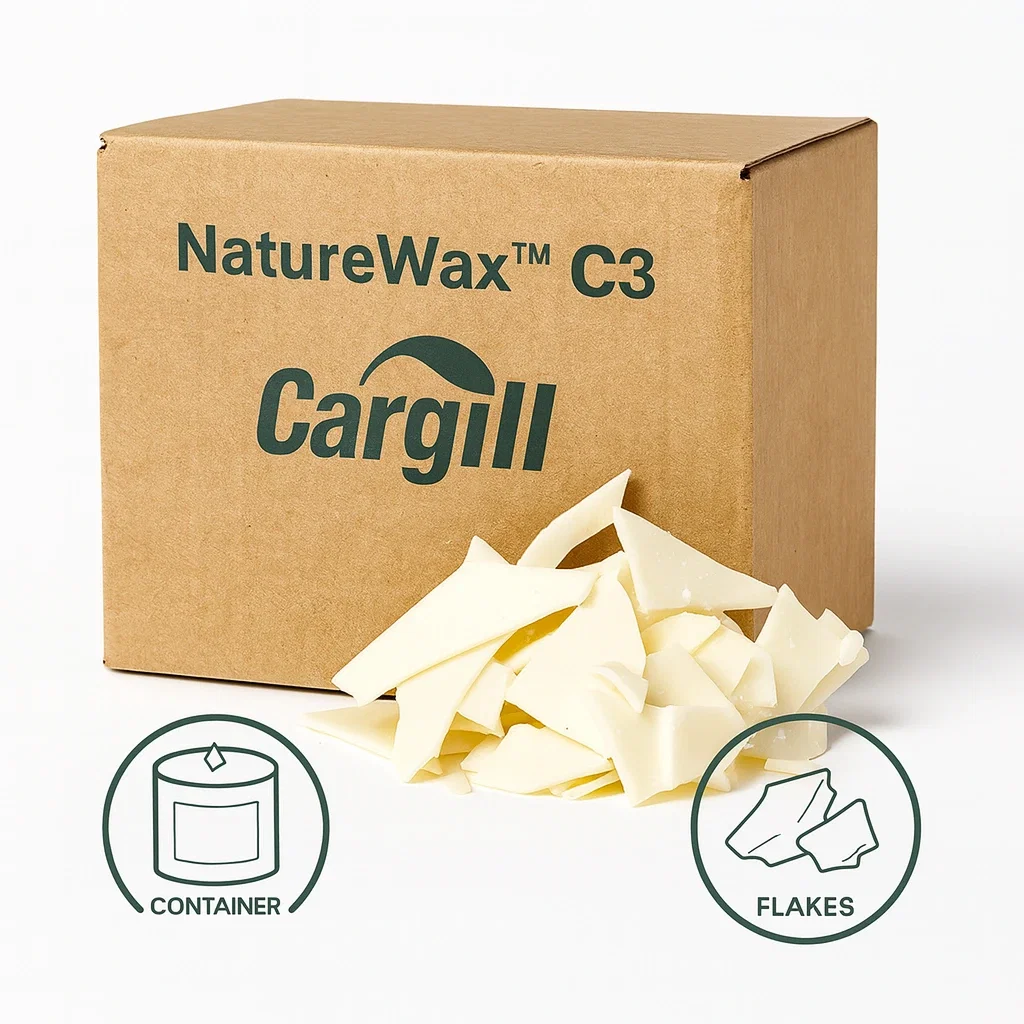
| Cargill NatureWax C3 (soy) | only the analysis: colour, fatty acids, peroxide value, melting 51–55 °C; nothing about pouring | we have no written test |
| Refined palm BW10110 and BW10610 | only the certificate of analysis: melting, acidity, colour; nothing about pouring | we have no written test |
The three data sheets that give the pouring temperature and the glass temperature
They are 4130, EcoCoco and EcoOlive, and they don’t agree on pouring: 45–55 °C, around 60, 65. The difference doesn’t come from the congealing point: 4130 sets between 34 and 42 degrees, coconut between 36 and 41, olive at around 40, so three waxes that set at about the same point start from pours between 45 and 65 degrees. The rule “pour close to the congealing point” is written on the 4130 data sheet, not on the others, and you can’t move it from one wax to another just because it sounds logical.
A fourth data sheet, NatureWax C-310’s, also gives a pouring temperature, 55–65 °C as a starting point, and says that lower temperatures generally give fewer surface defects. It says nothing about the glass, so I don’t count it among the three.
The three do agree, however, in the same words, on the glass and on what you do when it doesn’t come out right. The glass has to be clean and at least at room temperature, and preheating to 45–50 °C “can be beneficial”. The pouring temperature varies with the container, the fragrance and the dye, and is moved in steps of 5–10 degrees if you have difficulties. And cooling is done undisturbed, at room temperature, at around 25 degrees.
You take the pouring temperature from the data sheet of the wax you’re pouring, not from a general table, nor from the wax you used before. If you change wax and keep the temperature you were used to, that temperature may no longer suit the new wax, and the spots may come from exactly there.
What does “no contraction” mean on the Keragreen data sheets?
It’s the manufacturer’s statement: the data sheets for the Keragreen soy wax and sunflower wax say that they don’t contract or crystallise on cooling. We haven’t measured the contraction. What we observed with sunflower, poured at 55–60 °C into glasses at room temperature, is proper adhesion and few wet spots, not none; that doesn’t prove the wax doesn’t contract at all, only that in our pours the spots were few. For Keragreen soy we don’t have a written test yet.
There’s one more line on the same data sheets worth reading: adhesion to glass “improves with a small addition of butters or fats”. The manufacturer gives no percentage, and we haven’t poured this blend, so I won’t give you a figure. If you want to try it, it’s a new variable, with a separate test, not something you put into the batch from the start.
What do you do when the data sheet says nothing about the glass?
First you ask for guidance. Write to your supplier, and if the wax is from us, write to us: for rapeseed and sunflower we have our pours noted down, for the others we’ll tell you what we have and what we don’t. Only after that, if you still don’t have a figure, do you make a trial, and you treat it as a trial, not as a recipe.
The trial looks like this: you pour two glasses from the same batch of wax, with the same recipe, into identical glasses, filled the same way and cooled side by side, in the same room. The only difference is the glass: one preheated, one at room temperature. You compare them the next day. If the spots appear on both, you move the pouring temperature in steps of 5–10 degrees; it’s the step all three data sheets that do speak about it give, and here you use it as a test step, not as a recipe figure for a wax that doesn’t state it.
How to pour so the wax stays stuck
You pour starting from the temperature on the wax’s data sheet, into a glass that’s clean, dry and at least at room temperature, you top up large glasses in time and you let the candles cool in peace. Three things, in the order in which they go wrong.
How much do you preheat the glass, and why?
The data sheets don’t require it, they recommend it: all three say that the glass must be at least at room temperature and that preheating to 45–50 °C can be beneficial; the 4130 data sheet explicitly links it to better adhesion to glass. The reason is the one above: a cold glass draws the heat out of the layer of wax stuck to it, that layer hardens first and pulls away. A warm glass lets the wax next to the side cool together with the rest. The data sheets give the temperature, not what you heat it with; any method that brings the whole glass, not just its base, to the temperature you want does the job.
The glass also has to be clean and dry. On the rapeseed and sunflower pages, among the frequent causes of the wax coming away we list, next to the cold glass, the dirty glass; the data sheets ask for containers that are “clean, free of contaminants”.
When do you do the second pour on large jars?
Before the first pour has cooled completely. The 4130 data sheet says that in most containers a single pour is enough, and that with some large containers a top-up is needed for a good surface: a little wax, at a temperature slightly higher than the first pour, added before the candle has cooled completely. The same data sheet warns that a top-up poured onto a completely cold candle can reduce adhesion to the container. It doesn’t give a diameter from which a glass counts as “large”; you can tell from the surface, which sinks in the middle as the wax shrinks.
The mistake you only see the next day
Leaving the glasses to cool where they cool quickly. All three data sheets ask for undisturbed cooling, at room temperature, at around 25 degrees; on the sunflower page we wrote that spots can appear on cold glass or in cold spaces, and on the rapeseed page we list the cold container among the causes of the wax coming away. That means no cold windowsill, no open window, no fan and no fridge “so it sets faster”. A well-poured candle can come out with spots just because it spent the night in a draught, and you won’t see that until the morning.
What to send us if you have a batch with spots
If you have a batch with spots and can’t work out where they come from, send us the pouring details and two photos, and we’ll try to narrow down the cause: pouring, glass, cooling or storage. Without details, any answer is general advice, and general advice doesn’t fix your next batch.
The three things you note down when pouring
- The wax and the recipe: the wax and its batch, the temperature you poured at, read on the thermometer, and what you put in it, with the doses: the fragrance, the dye, the additives, if you used any.
- The container: what it’s made of, its dimensions and how much you poured into it, whether it was clean and dry, whether it was preheated and to what temperature, and which batch of packaging it comes from. On our rapeseed and sunflower pages we recommend a control glass from each batch of packaging, before the run.
- Cooling and storage: the room it cooled in, how warm it was, whether it was near a window or a draught; and when you saw the spots: the next day, after cooling, or only later, after the candles had been stored or transported.
With these, plus two photos through the glass, in daylight, one of the glass with spots and one of a good glass from the same batch, if you have one, write to us on WhatsApp or call us on +40 726 162 810 (we answer in English).
You see the spots on the glass in the morning, but the first causes you look for are from the evening: the temperature of the wax, of the glass and of the room. You take the first from your wax’s data sheet, the second from the same data sheet, if it has it, and the third you choose yourself. And if the spots weren’t there the next day and only appeared later, tell us that too: then the question moves to where the candle was kept.