 EN
EN  Romana
 Magyar
Frosting explained and how to control it
1. The next-morning panic
You worked a whole evening. You melted the wax at exactly the right temperature, added the fragrance with care, centred the wick perfectly. The candles looked like liquid mirrors when you switched off the light in the workshop.
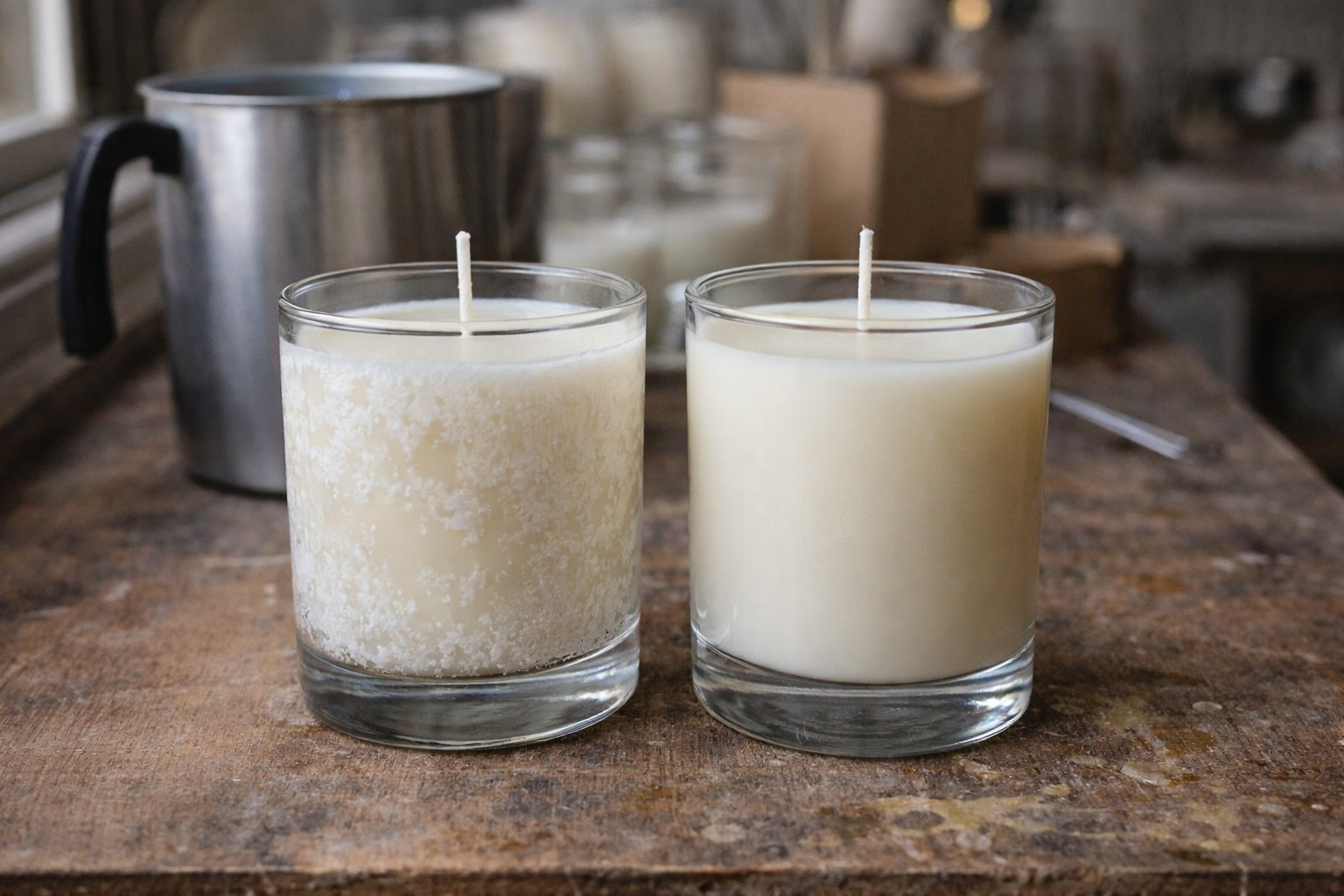
In the morning, you go in to check them and… shock. White, irregular spots have appeared on the sides of the glass, like frost flowers, or worse, like white mildew.
The first reaction of any artisan is to blame the goods: “The wax is old” or “I got a bad batch”. The technical truth is different: your wax isn’t spoiled. Your wax is trying to return to its natural structure.
2. What frosting is (polymorphism)
In chemical terms, the phenomenon is called polymorphism. Soy wax is, at its base, a hydrogenated oil that wants to crystallise. It has a natural crystalline structure.
When we melt it, we destroy that structure. As it cools, it tries desperately to “rearrange itself” into its solid form.
If the cooling is uneven (for example, the glass is cold and the centre hot), the crystals form chaotically. Those “frost flowers” are, in fact, the areas where the wax has crystallised more than the rest.
3. Risk table: when does frosting appear?
You can’t eliminate 100% of frosting from pure soy (without additives), but you can reduce it massively if you control these factors:
| Risk factor | What actually happens | The Servus solution |
|---|---|---|
| Low room temperature (below 20 °C) | The wax is “shocked” on contact with the glass. Crystals form instantly on the side. | Warm the glasses (heat gun / oven). |
| Overheating (above 75 °C) | Cooling is too slow → the crystals have time to grow large. | Pour as cool as possible, at the low end of your wax’s range (container 45–55 °C, mould 55–65 °C). |
| Aggressive stirring | You bring in air, which becomes a nucleus for crystallisation. | Stir slowly, in a circle. |
| Dark colours | The pigment doesn’t cause frosting, but it makes it extremely visible (contrast). | Use matt or amber containers. |
Data taken from Servus internal tests – Source: Top 10 Mistakes.
4. What we tell customers about frosting
In our first years in the workshop, we fought frosting. We threw batches away, remelted, got annoyed. We were trying to make soy look like paraffin: perfect, glossy, uniform.
Until we understood that we were fighting against the nature of the material. Paraffin rarely frosts. Synthetic additives (plasticisers) eliminate frosting. This bloom appears in plant waxes, but not in all of them: for some, like the soy and sunflower waxes from Keragreen, the manufacturer states on the data sheet that they don’t crystallise on cooling.
Today, in the Servus workshop, we see things differently. If a candle has a slight trace of “frost flower”, we don’t hide it. We explain to the customer what they’re seeing: the natural crystallisation of plant wax, not mildew and not spoiled wax.
Frosting doesn’t affect the burn. It doesn’t affect the scent. It’s just an aesthetic whim of nature.
5. Checklist: how to minimise the effect (if you want perfection)
If you want a candle that looks as clean as possible, here is our “attack” procedure:
- Preheating – Never pour into cold glass. The glass should be warm to the touch.
- Pouring temperature – Bring the temperature down. With soy wax (e.g. Cargill NatureWax C3 or KeraSoy 4130 for containers, KeraSoy 4120 for moulds), pour close to the congealing point – for containers at 45–55 °C, for moulds (pillar) at 55–65 °C. The wax should be slightly cloudy in the pouring jug.
- Slow cooling – Don’t put them next to an open window. Place the candles in a cardboard box or let them cool slowly, next to each other (they keep each other warm).
For details on exact temperatures, see the complete guide: Correct temperatures for each type of wax – Servus Guide 2025
Conclusion
Don’t be alarmed by white spots. They are the natural crystallisation of the wax. Next time you see frosting, don’t think you got it wrong. Think that you managed to keep the material natural.
If you want to work with stable plant waxes, tested by us to minimise these effects, you’ll find them here: See the Raw Materials category – Wax for moulds (Pillar Wax) and See the Raw Materials category – Wax for containers (Container Wax)