 EN
EN  Romana
 Magyar
The big frustration: the scent that disappears
Has it ever happened to you that you buy a fragrance oil that smells amazing in the bottle, you pour it carefully into the wax, and when you light the finished candle… you smell nothing?
Or, worse, you smell only a faint whiff of burnt wax or something “chemical”, hard to pin down.
This is the difference between cold throw (the scent when cold) and hot throw (the scent when burning). And this is where most makers get stuck.
The classic reflex is to add more fragrance: 10%, 12%, “maybe it’ll hold”. Most of the time, the result is a candle that sweats oil, burns unevenly or goes out.
The truth from the workshop is different: not all fragrances are built to withstand the temperature of the flame.
Technical body: what happens chemically to the fragrance when hot
Fragrances are made up of notes with different volatilities:
- top notes – very volatile, they evaporate quickly
- middle notes – they give the character
- base notes – heavy, stable, long-lasting
When a candle burns, the wax locally reaches high temperatures. If the fragrance is dominated by light notes or thermally unstable solvents, the scent “runs away” before the mass of wax heats up enough to spread it.
That’s why it:
- smells strong in the bottle
- smells lovely when cold
- disappears completely when burning
The problem isn’t the wax. The problem is the structure of the fragrance.
The Servus secret: the Spoon Ritual
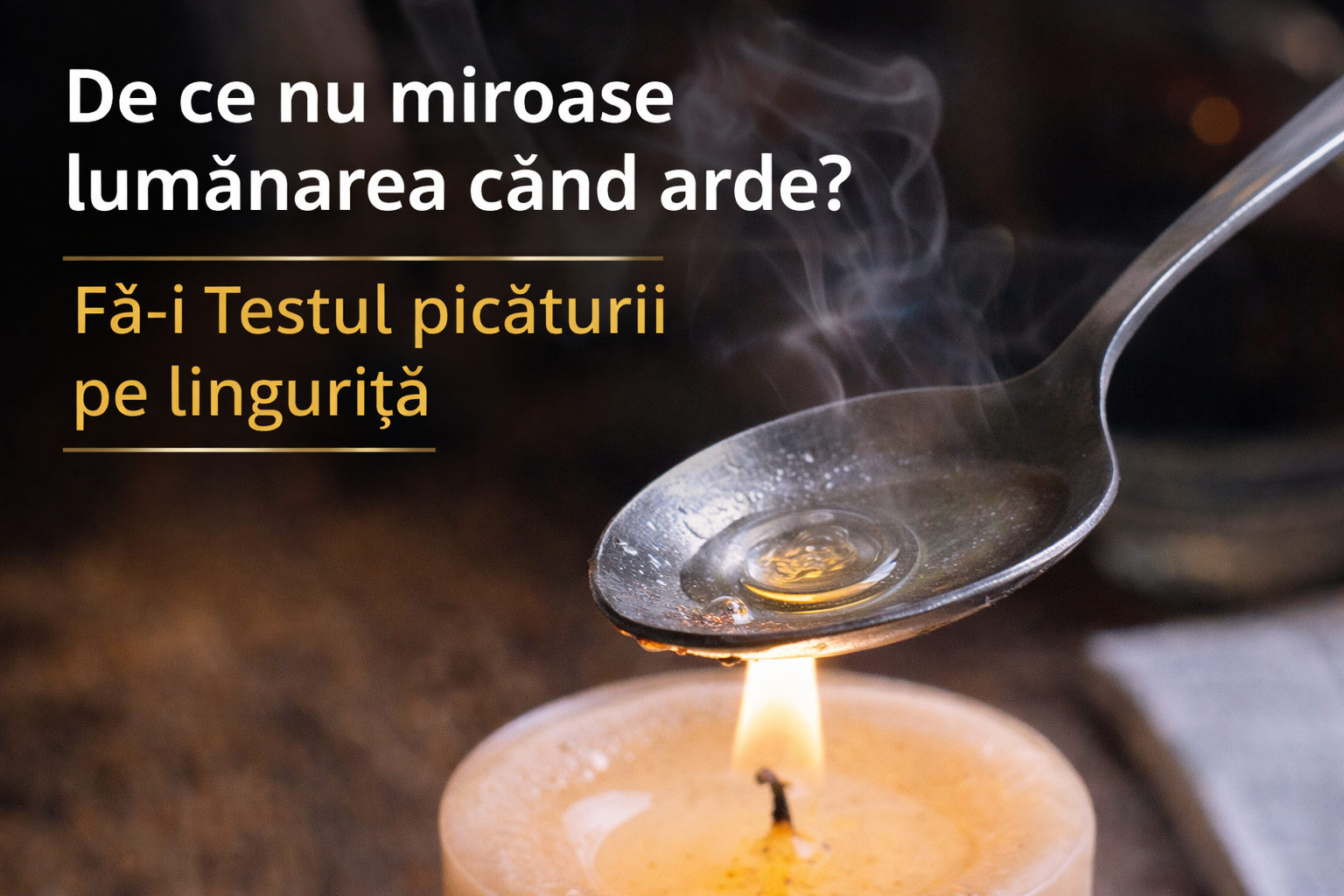
Before we risk a kilogram of wax, wicks, containers and time, in the Servus workshop we use a simple method for quick sorting. We call it the Spoon Test.
It’s an empirical, very visual method that tells us in 30 seconds whether a fragrance has a real chance in a lit candle.
How the test is done:
- Take an ordinary metal teaspoon.
- Put a single drop of fragrance oil in it.
- Hold the spoon over a flame (a lit candle) or use a heat gun, for a few seconds. A heat gun is safer than a flame next to a concentrated fragrance.
- Smell straight away (without breathing the vapours in directly).
The heat forces the top notes to evaporate quickly and shows you the “heart” of the fragrance – exactly what the customer will smell when the candle is burning.
One interpretation table – what the spoon tells you
This table helps you decide whether or not the fragrance is worth pouring into the wax.
| Reaction on the spoon (when hot) | What it means technically | Verdict for a candle |
|---|---|---|
| Sour, plasticky smell | Thermally unstable fragrance | DO NOT use – it will smell burnt |
| The scent disappears in 1–2 seconds | Top notes only, high volatility | Weak – hot throw almost non-existent |
| The scent “opens up” and fills the air | Heavy, stable base | Excellent – it will scent the room |
| An oily film stays on the metal | Dense, stable fragrance | Good – needs a suitable wick |
Data based on the internal testing procedures of the Servus workshop.
Why the fragrance’s “base” matters
On the technical data sheets of some fragrances (Ginger Cookie, for example), you’ll often come across compounds such as Benzyl Benzoate. It’s not a term to be scared of. It’s what we call the “anchor”.
This base makes the fragrance:
- heavier
- more stable
- able to withstand the temperature of the melted wax and of the flame
Diluted, cheap fragrances smell strong in the bottle because they “jump” straight into your nose. Professional fragrances are denser and need heat to open up, they don’t disappear when they meet it.
The golden rule for blending into the wax
Even a fragrance that passes the spoon test can be spoilt during pouring.
In the Servus workshop we strictly follow two parameters:
Adding temperature
- Soy / coconut: 60–65°C – at 80°C the delicate notes evaporate; at 50°C it doesn’t dissolve well in the wax
Mixing time
- 2 continuous minutes, slowly
- The fragrance molecule has to be “caught” between the wax molecules – a simple swirl isn’t enough
See the full guide here: Correct temperatures for each type of wax – Servus Guide 2025 https://www.lumanariservus.ro/en/blog/correct-temperatures-for-each-type-of-wax.html
Closing from the workshop (Servus finale)
In the workshop, before we pour a new fragrance into a kilogram of wax, we do one simple thing. We take a teaspoon. One drop. A few seconds of heat.
If the fragrance doesn’t hold up here, we don’t push it any further. We don’t change the wax. We don’t raise the percentage. We don’t “try to save it”.
A fragrance that fails the spoon test won’t get any better in a lit candle.
That’s not caution. It’s respect for the material, for time and for your work.
If you want to work with fragrances that have already passed our tests for stability when hot, for blending into the wax and for real burning, you’ll find them here:
See the Fragrance Oils – Candles & Soap category https://www.lumanariservus.ro/en/fragrance-oils
In the workshop, we don’t pour hopes. We pour only what has passed the tests.