 EN
EN  Romana
 Magyar
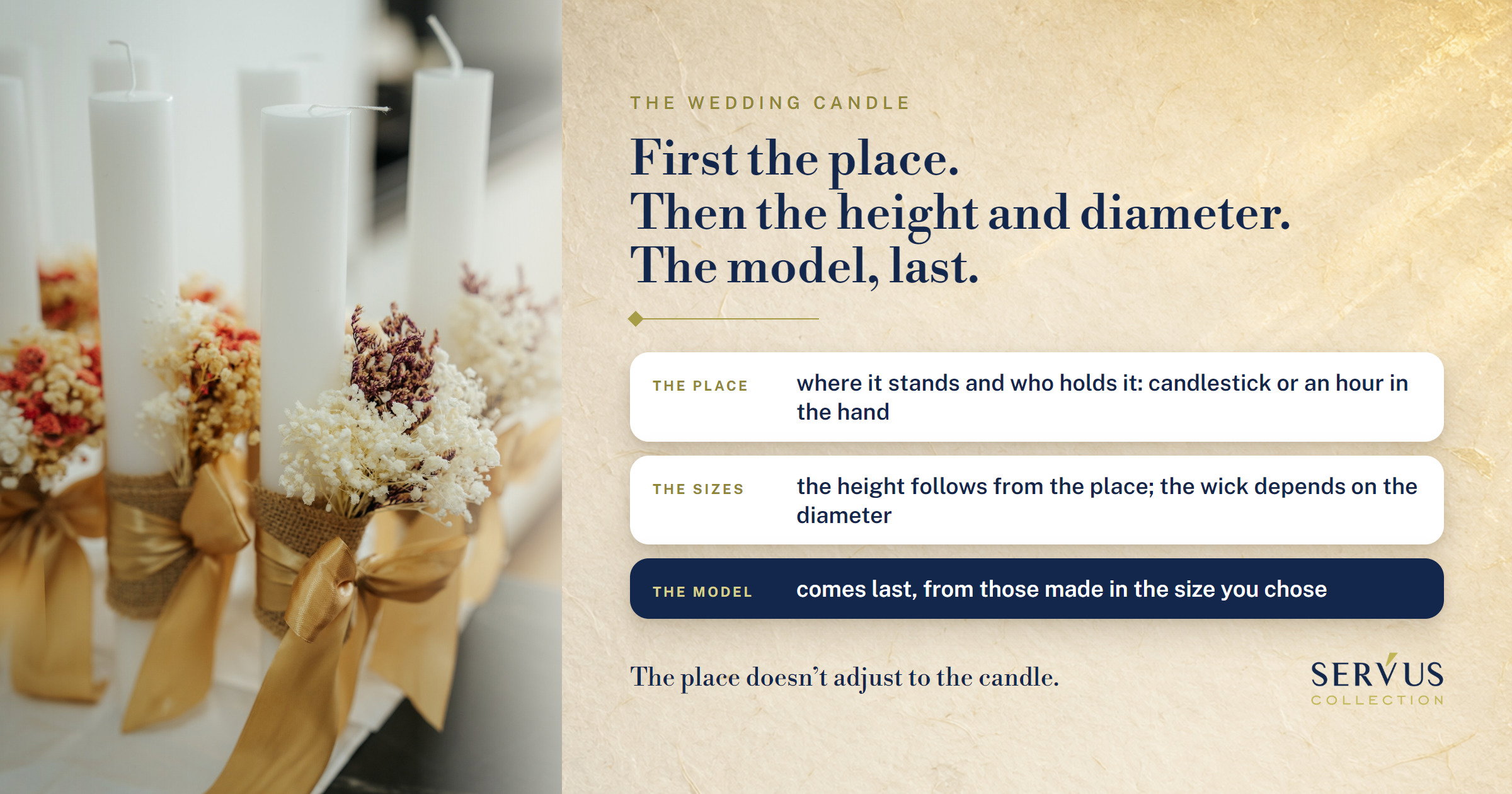
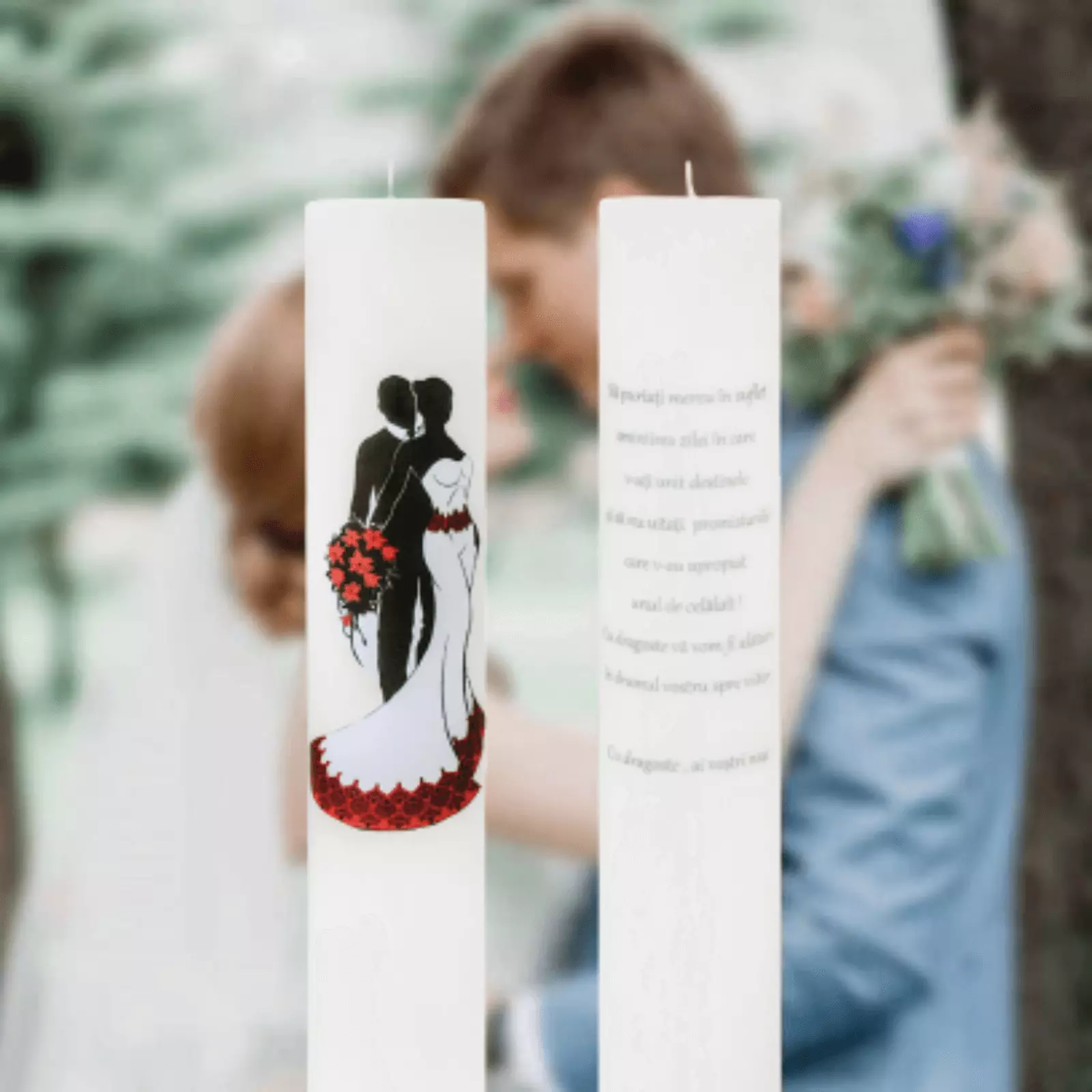
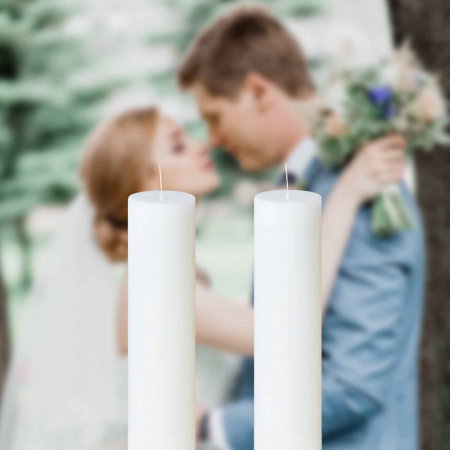
You’re looking at a photograph. Two tall white candles, with a ribbon and a few dried flowers, in a church with good light. You like it, you save it, you send it on. The photograph doesn’t tell you how tall the candle is, how thick it is, or how long it had been burning before the picture was taken.
The choice is made on three measurements, in this order: the height, which depends on where the candle stands, the diameter, which decides the wick, and how long it stays lit, which follows from the first two. The model, the ribbon and the flowers come after. None of them changes any of the three.
I’m Sînziana. We’ve been pouring candles in our workshop in Maramureș, Romania, since 2010, and a wedding ceremony candle reaches us as an order with a single delivery date and zero chance of a second try. Below is how the three measurements are chosen and what you ask beforehand, so you don’t find them out on the day.
What actually decides the choice of a wedding ceremony candle?
Two things you can’t see in the photograph decide it: where the candle stands during the service and who holds it. Everything else follows from them.
| The measurement | What it decides | How you check it before you order |
|---|---|---|
| Height | whether the candle stands in a holder or is held in the hand | you ask the church what candlesticks they have and where the candles are placed |
| Diameter | which wick goes in, so how fast the wax burns down | you read the diameter in the product description, you don’t estimate it from the photograph |
| How long it stays lit | whether it lasts from lighting to the last photograph | you count the minutes it stays lit, not the length of the service |
The table is read from top to bottom, once, before you open the catalogue. If the first two rows have an answer, the third almost sorts itself out. If you start the other way round, from the model, you’ll end up fitting the place to the candle, and the place doesn’t fit.
How do you choose between a tall candle and one you hold in your hand?
You choose by who holds it and for how long. A very tall candle needs a stable holder and a place decided in advance; one that someone holds in their hand needs to be comfortable to hold for an hour, with wax burning down above the fingers.
The tallest candle we’ve poured was a special order of 1 metre 20 centimetres, at a diameter of 7 centimetres. It can be done, and we do it when the project calls for it, but at that height the candle can’t be improvised in a corner: it needs a candlestick and a position decided beforehand.
A concrete example, from the way things go wrong: you choose a tall pair because it looks impressive in photographs, you get to the church and the candlesticks are taken or too small for the diameter. From that moment, the candles are held in the hand, for an hour, by someone who wasn’t expecting it, and that’s exactly what shows in the pictures.
What sizes of wedding candles do you usually find?
In our wedding candles category you find four diameters: the white models at 4.5, 5.5 and 7 centimetres, and the fluted ones at 6. What made the order above special wasn’t the diameter but the height: 7 centimetres is a diameter we keep in the catalogue, 1.20 metres isn’t.
The heights in the catalogue go from 30 to 70 centimetres: 30, 35, 40, 50, 60 and 70, on each of the white diameters. The fluted ones, at 6 centimetres, come in 30, 35 and 40. Above 70 it becomes a custom order, like the 1.20 metre set earlier. The exact size of each model is written in its description: you read it there, you don’t work it out from the photograph, because a product photograph has no scale. The same candle looks different next to a bouquet and different on its own against a white background.
The difference between 4.5 and 5.5 centimetres looks small on paper. In the hand it isn’t small at all, and for the wick it’s even less so: each step in diameter takes a different wick, because a thicker candle needs a wider melt pool so it doesn’t burn only in the middle.
Where the candle stands decides the rest
The place is settled first, and the height is chosen after it. It’s the measurement almost nobody asks about, and the only one that can no longer be changed on the wedding day.
There are three situations that change the choice completely: the candle stands in the church’s candlestick, the candle is held in the hand for the whole service, or the candle is moved after the ceremony, to the reception or for the photos. Each comes with a different requirement. In a candlestick, what matters is that the diameter fits. In the hand, what matters is the weight and the height. When it’s moved, what matters is that it doesn’t lean on the way.
The mistake I see most often is that the place is assumed, not asked about. Nobody rings the church to ask what candlesticks they have, because it seems a small question next to the dress, the venue and the photographer. It’s small until the minute the candle won’t go into the holder.
How long it stays lit, and why the figure reads differently than it seems
It lasts longer than you think, but not in the way the figure is usually read. These are the burn times we’ve measured in the workshop, also written on our frequently asked questions page:
| Diameter | Burn time for every 5 cm |
|---|---|
| 4.5 cm | ~10 hours |
| 5.5 cm | ~12 hours |
| 7 cm | ~15 hours |
The key is in the column heading: those hours are for every 5 centimetres of candle, not for the whole candle. You work it out by multiplying: a pair 5.5 centimetres thick and 35 tall has seven portions of five centimetres each, so about 84 hours of burning. Your service will last a fraction of that. The gap between the two numbers is the reason burn time isn’t the criterion a wedding ceremony candle is chosen by, even though it’s the first one people look for.
Where what I know ends, so you don’t lean on the figure more than it holds: they’re measured in the workshop, so they’re an indoor maximum, and the real burn time depends on draughts, on how short the wick is and on how the candle was lit. Outdoors, they drop. By how much, we haven’t measured.
What links the diameter to the rate of burning?
The diameter decides the wick, and the wick decides how fast the wax burns down. We don’t choose the wick separately and we don’t choose it by how it looks: we start from the diameter and adjust it to the composition of the wax and to the way the candle will be used.
From here comes the assumption made most often: that a candle twice as thick lasts twice as long. It doesn’t, because the wick grows along with the diameter. More wax, but also more burned per hour. You gain something, you don’t double it.
The rule shows most clearly when you turn it round. If you put too small a wick in a large diameter, the candle burns only in the middle and digs a tunnel, and the rest of the wax stays untouched at the edges. If you put in one that’s too big, the flame is too strong for the body of the candle. In neither case do you get a better burn time, you get a defect.
What size of wedding candle does a long service call for?
It calls for a candle chosen by the minutes it stays lit, not by how long the service lasts. They’re different things, and the difference usually comes out in favour of a longer stretch than the one you’re thinking of.
You count like this, in the order things happen:
- The minutes before, when the candles are lit and set in place.
- The service itself, with the length the priest tells you, not one taken from the internet.
- The photographs afterwards, if you want the candles lit in them.
- The move to the reception, if the candles go on there.
You add up the four and get the number you actually need. It almost always comes out longer than the ceremony, and the difference comes from steps 1 and 3, exactly the bits nobody puts into the sum.
The reality check, so you don’t find out on the day: the length of a wedding ceremony isn’t a constant. It differs from church to church and from priest to priest. That’s why step 2 on the list is a question put to a person, not a figure read somewhere.
What happens if you put it out and light it again
Nothing gets damaged, and it’s the simplest solution when the sum is tight. The candle is put out after the ceremony and lit again for the photos or at the reception, and the wax used up only adds up over the stretches when it actually burned.
It’s useful to know this beforehand, because it changes the choice. If you know the candles will be put out between moments, you don’t need such a big reserve and you can choose the model you like, not the biggest one.
One thing is worth saying honestly: relighting isn’t completely neutral. Each time the candle is put out, the wax around the wick cools and hardens, and when it’s relit the melt pool forms again from scratch — the first minutes don’t burn like a candle that has already settled into its rhythm. It isn’t a problem, but it’s the reason I don’t count the burn in continuous hours.
What keeps the candle straight to the end
The composition keeps it straight, not the model. A tall candle has more of its own weight to carry on the same base, and if the material softens in the heat, it leans. It doesn’t break, it doesn’t drip dramatically, it just tilts slightly, and that shows in every photograph.
What are the tall candles poured from?
They’re poured from ultra-refined paraffin enriched with stearin and natural palm wax. I don’t hide it behind a prettier word, because each of the three has a precise job in our formula:
- Ultra-refined paraffin gives the surface its even look.
- Stearin strengthens the structure, which is exactly what a candle standing upright for an hour needs.
- Natural palm wax adds hardness and support, and matters most at large heights, where deformation shows first.
This combination is our choice for the plain models poured in the workshop and for the tall special orders. If you’re looking at a set from someone else, ask what it’s poured from. An answer that sounds like an adjective, not a material, tells you something too.
What’s different about the honeycomb sets?
Everything: the honeycomb isn’t poured, it’s a wax sheet rolled by hand, so the composition above doesn’t apply to it. It’s a different product, with a different behaviour, even if it sits on the same shelf as the others.
The practical consequence, if you like the honeycomb: nothing gets written on it. Personalisation needs a smooth surface, and the criterion is the relief, not the material — on honeycomb and on flutes the text doesn’t sit straight. If you want the names and the date printed, you choose a smooth model. I’m telling you this now so you don’t build the whole decoration around a model you then can’t personalise.
The heat in the church is the variable nobody sees
Heat is the reason the composition matters more in summer than in winter. A full church, in July, with candles lit all around, isn’t at the temperature of the storeroom where the set sat until then.
This is where you see the difference between a candle that holds its shape and one that softens: not at lighting, but after it has stood for a while near a source of heat. That’s why the stearin and the palm wax in the composition aren’t data-sheet decoration, they’re exactly the part that keeps the candle straight in the photos.
So you don’t worry where there’s no need: our parcels travel all over the country in summer, in courier vans, and we don’t get candles sent back deformed from transport. The composition is made for that journey. What’s worth avoiding is something else, and it’s down to you: a candle taken out of its packaging and left lying in direct sun, through a window. Keep the set in its packaging, upright and in the shade, until the church — a candle that has bent slightly doesn’t straighten again.
What you do before you order
You make a short list of questions and ask them before you choose the model, not after. This order saves the only resource you can’t get back: the days before the wedding.
What do you ask the church before you choose?
You ask four things, and you note the answers on your phone:
- What candlesticks they have and what candle diameter fits in them.
- Where the candles are placed during the ceremony and who holds them.
- Roughly how long the service lasts at that church.
- Whether the candles are lit before going into the church or inside.
With the four answers, the choice takes five minutes and makes itself: you know the height from where the candle is placed, the diameter from the candlestick, and the time needed from the sum earlier. Without them, you choose from photographs and hope.
If you can’t ask, or if the church doesn’t give you a clear answer, message us on WhatsApp or call us on +40 726 162 810 (we answer in English), Monday to Friday, between 8:00 and 16:30 (Romanian time). Tell us where the ceremony is and how the candles are placed, and we’ll tell you which size fits. If we don’t know, we’ll tell you we don’t know.
If you take away one thing from all of this, take away the order. First the place and who holds the candle, then the height and the diameter, then the model. You add up the minutes at the end, as a check that it’s enough, not to choose by them. You can do it the other way round, and people often do, but then you’re fitting the day to the candle.
The next step is a single question put to the church, this week, about the candlesticks and about who holds the candles. With that answer, the rest of the choice takes five minutes.
The reality check, to close honestly: the burn times above are measured in the workshop, that is in a room with no draughts. Outdoors they drop, and by how much we haven’t measured and won’t round off. I’d rather give you the whole mechanism and its limit than a figure that sounds good.
When you have the measurements, see the wedding candles and write to us if you’d like an opinion before you order. If you also have the date set, the calendar before you order tells you when the last possible moment is.