 EN
EN  Romana
 Magyar
You chose the courtyard. Or the church steps, or the garden at the reception venue, because that’s how it looks in the photos and because nobody wants their ceremony in a hall with no windows. The day comes, the priest begins, the godmother holds the candle, and at the third gust the flame is gone. Someone takes out a lighter. It’s lit. It goes out again.
The short answer: you choose a larger diameter and you light it under shelter, some time beforehand, not in the full wind, thirty seconds before the service begins. Those two are the part you can influence, and one of them costs nothing.
I’m Sînziana. I’ll start with the part I don’t like: I have no measurement in the wind. I haven’t taken a ceremony set out into the courtyard with a measuring device beside me, so I could tell you at how many kilometres an hour it goes out. What I have is the mechanism, the same one I watch when I calibrate a wick in the workshop, and a condition written in black and white on our own frequently asked questions page, which nobody reads: a candle burns properly with a calibrated wick, with the wick trimmed to 5 mm and without a draught. A ceremony in the courtyard breaks exactly that last condition.
Why does an outdoor wedding candle go out?
Because the flame doesn’t burn solid wax. It burns wax vapour, rising from the tip of the wick, which draws liquid wax up from a small melted pool at its base. The gust doesn’t "blow the candle out", as we say to keep it short. The gust breaks the link between the vapour and the flame.
This difference sounds pedantic until the moment it changes what you buy. If the problem were the wind itself, the only solution would be a screen. If the problem is the melt pool, then part of the solution is in the candle, and it’s chosen beforehand, from home.
What actually puts the flame out, the wind or the melt pool?
The wind, but through the melt pool. A gust does two things at once: it pushes the vapour sideways, away from the wick, and it cools the top of the candle. For a second the flame is left without fuel and without the heat it used to make that fuel for itself.
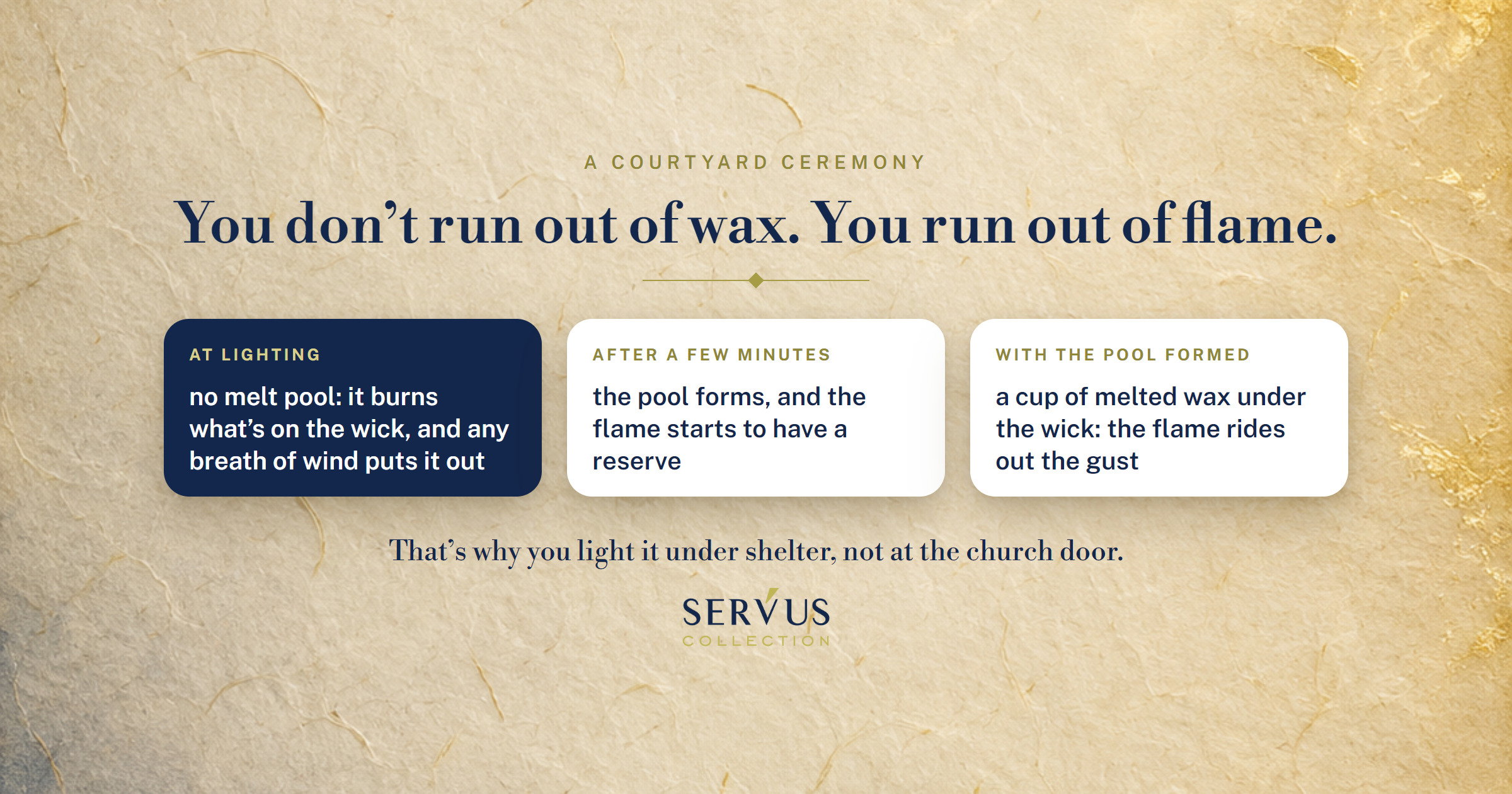
A candle that has been burning for a while has a small cup of melted wax at the top, and the wick stands with its foot in it. It has liquid fuel, warm, close at hand. The vapour comes back quickly, so the flame rides out the gust. One that has only just been lit has none of this. It burns from the wax on the wick and that’s all.
That’s why, in the workshop, with container candles we don’t judge the wick by how the flame looks, but by the depth of the melt pool after two hours of burning, seen from the side through the glass. The flame is what you see. The pool is the engine.
What a flame about to give in looks like
It stretches, thins and leans over in the direction the wind is blowing. Then it starts to smoke, and the wax runs down one side only, the side facing the wind, instead of melting evenly around the wick.
Running down one side isn’t a problem of looks, even though it shows in the photos. It’s the sign that the pool has broken: on the cold side the wax stays solid, on the warm side it runs out, and the wick is left uncovered and with no reserve. From that moment, any breath of wind puts it out.
If during the service you notice the wax running down one side only, there’s nothing to fix on the spot. It’s only the information that your candle is now more fragile than it was five minutes ago, and that there’s no point moving it into an even stronger wind so it will "burn better".
Why are the first minutes after lighting the most fragile?
Because the melt pool hasn’t formed yet. It’s the only stretch of the whole burn in which the candle has no reserve, and it’s exactly the stretch in which we light it, at the church door, with the guests around us.
Do it the other way round. Light the candles under shelter — a porch, the back of a wall, a sheltered corner — and let them burn for a few minutes before you carry them into the wind. Not in the car and not next to anything that catches fire. It isn’t a craftsman’s trick, it’s the only thing that costs nothing.
The practical consequence, if it goes out anyway: relighting in a gust starts again from zero, with no melt pool. Until the pool has formed again, the flame stays just as vulnerable as at the first lighting. It isn’t bad luck adding up, it’s the same mechanism, every time.
What do you choose for an outdoor wedding, so it lasts the ceremony?
The diameter. It’s practically the only variable in the candle that you choose, and outdoors it matters more than the model, than the colour and than the height.
A larger diameter means a larger wick, so a larger flame, with more heat in it and with a melt pool that forms faster and lasts longer. It isn’t a measurement, it’s the mechanism, and I don’t give it to you as a guarantee against the wind: it’s the most useful lever of the ones you tick when you order. I’ll tell you now where what I know ends: how much longer it holds out in the wind, I haven’t measured.
How much does the diameter actually matter?
It matters through how much melted fuel you have available at any moment. These are the diameters we make for our ceremony candles, with the approximate times from our frequently asked questions page:
| Diameter | Burn time for every 5 cm | Heights |
|---|---|---|
| 4.5 cm | ~10 hours | 30 / 35 / 40 / 50 / 60 / 70 cm |
| 5.5 cm | ~12 hours | 30 / 35 / 40 / 50 / 60 / 70 cm |
| 7 cm | ~15 hours | 30 / 35 / 40 / 50 / 60 / 70 cm |
Those hours are for every 5 centimetres of candle, not for the whole candle: at 4.5 centimetres thick and 40 tall, that comes to about 80 hours. And they’re measured in the workshop — so an indoor maximum, not a promise for the courtyard. The page we took them from also says, in the line under the table, that the real burn time depends on draughts, on how the wick behaves and on how the candle is lit.
One thing worth saying plainly, so you don’t read more into the table than it says: those figures measure how long the wax lasts, not how long the flame holds out in the wind. They’re two different things, and only the first is measured.
What this means for you, very concretely: at an outdoor ceremony you don’t risk running out of wax. The service doesn’t last eighty hours. You risk running out of flame. They’re two different problems and they’re solved differently, and the second isn’t solved by the 70 cm height, however good it looks on the steps.
What does the wick do in a draught?
You don’t choose the wick, we choose it when we pour, matched to the diameter of the candle. I’ll still tell you how it’s decided, because everything you’ve read above comes from there.
We start from the diameter and adjust for the wax. A wick too small for its diameter melts only in the middle, digs a tunnel and leaves a wall of unburnt wax around it, and the flame stays small and with no reserve. One too large smokes and leaves soot. Between the two extremes there isn’t a single correct figure, there’s a range, and it moves from one wax to another: plant waxes need a larger wick than paraffin, at the same diameter.
In a draught, an already small flame, from an under-wicked candle, is usually the first to give in. That’s why the correct sentence isn’t "the wind put it out", but "the thin candle I chose gave me a flame that anything puts out".
The wax the ceremony sets are made from
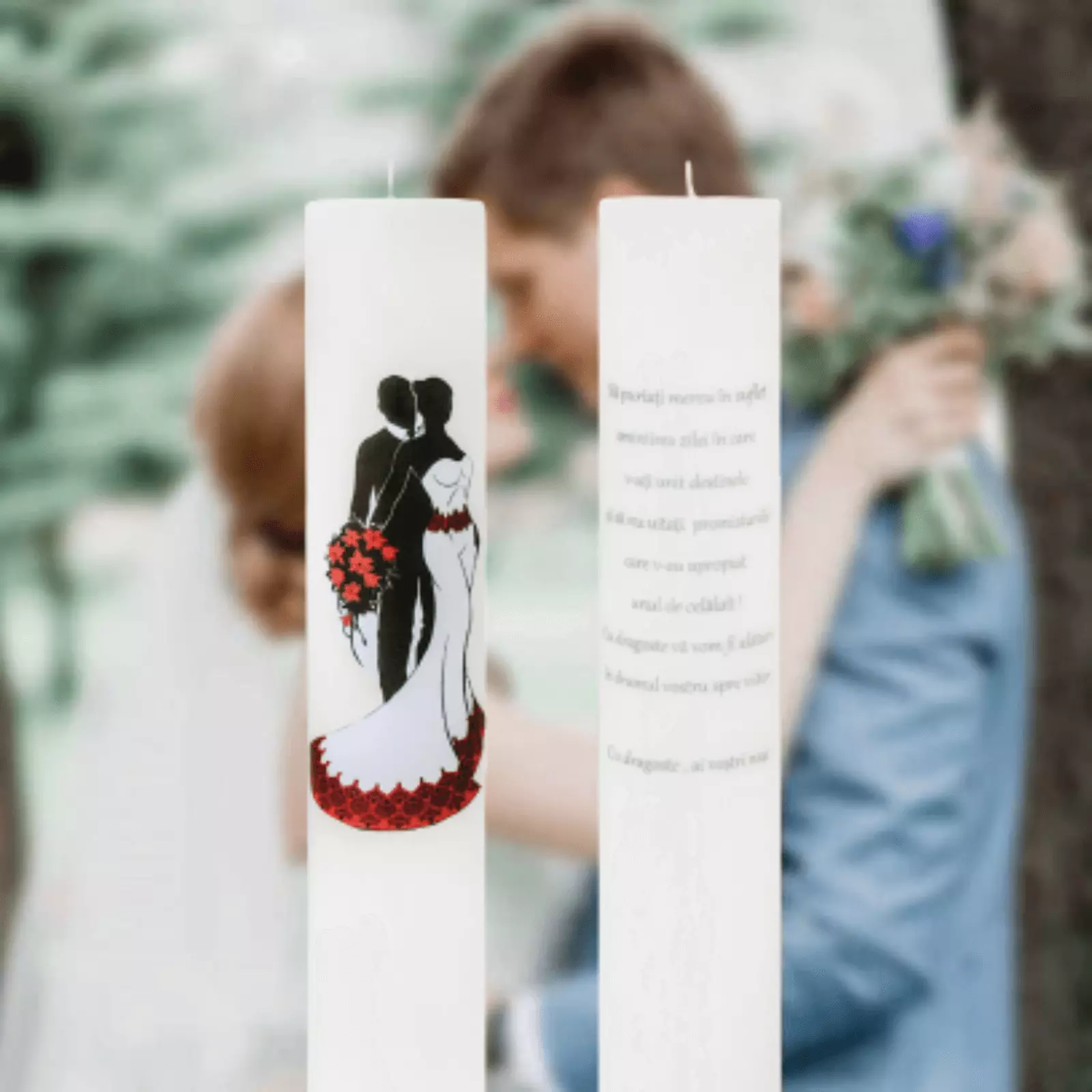
In finished products we use paraffin, palm stearin, soy wax and beeswax, depending on the model, and what’s in a particular set is written on its page. The models that can be personalised with your names and the date are the ones with a smooth surface. The criterion is the relief, not the material: on a body with relief the text doesn’t sit straight.
The combination of paraffin and stearin isn’t there for reasons of cost, it’s there for behaviour. Paraffin is the fuel, while stearin gives hardness and an opaque white, and changes the way the blend burns — we calibrate the wick on the final composition, not on one of its components. What comes out is a dense, predictable candle, which is exactly what you want at a ceremony and on a trip with the courier.
The beeswax honeycomb models are something else: beeswax rolled, not poured, and their relief doesn’t let the text sit, so they’re ordered as they are. If you like the honeycomb and the ceremony is outdoors, ask us beforehand, because I have no measurement on them in the wind and I don’t want to give you an answer that sounds sure.
What’s up to you on the day of the ceremony
The right choice does half the job. The other half happens in ten minutes in which nobody can change anything any more, and there what matters is where you stand and when you light.
I’ll tell you where the advice below comes from, so you know how far to rely on it: not from the workshop, because in the workshop the wind doesn’t blow. From the mechanism explained above, taken all the way through.
How do you light it so you don’t have to fix it afterwards?
Under shelter and early. You light the candles in a sheltered place, let them burn for a few minutes to form their melt pool, and only then carry them to where the service is held.
Before that, look at the wick. If it’s longer than half a centimetre, trim it to about 5 mm. A long wick gives a large, unstable flame, which leans over at the first breath of wind and runs down one side, which is exactly what you’re trying to avoid.
If it goes out during the service, don’t relight it in the wind. Turn your back to the wind and light it there, in the shelter your body makes for you, but with the flame away from clothes, hair and the veil. You need a few seconds without a draught, not a better lighter.
Where do you stand with the candle, if the wind is blowing?
With your back to the wind, and the candle in front of you, held steady and away from clothes, hair and the fabric decorations. Your body is the screen you already have there, it costs nothing and it doesn’t show up in the photos as a foreign object.
On the church steps there’s almost always a corner of wall that cuts the draught. It’s worth finding five minutes beforehand, not during the service. If the ceremony is in an open garden, on a hill, with nothing around, then the discussion is no longer about the candle.
What doesn’t help: a hand cupped over the flame. You block the warm air rising, and the hot wax ends up on your fingers. The screen goes at the side, never on top.
What no choice of candle solves
Strong wind. Above a certain threshold, there’s no open candle that stays lit, and whoever promises you otherwise is selling you something they can’t deliver. I don’t know where that threshold is, because I haven’t measured it, and I’d rather tell you that than give you a nice figure.
What I know for certain, because it’s our written rule: the Nu-i Bai guarantee covers what gets damaged in transport and handling, and we replace the product. It doesn’t cover the weather. It isn’t a loophole, it’s the real boundary of a promise we keep, and promises that are kept have boundaries.
If your ceremony is in an exposed place, tell us when you order. We’ll tell you which diameter has the most to give and, if need be, we’ll tell you that for that place you need a lantern or a sheltered corner, not a different candle. It’s a smaller sale and a customer who doesn’t phone us upset on Monday morning.
Where you start
You look first at where the ceremony is held, then at the models. Almost everyone does it the other way round, chooses the model they liked and only at the end remembers it’s in the courtyard, when the diameter has already been set by the model.
If it’s outdoors, the order is: the place, the diameter, then the model that exists in that diameter. It sounds dry for a day you’ve been thinking about for a year, but it’s the only order that doesn’t end with the lighter taken out in front of the guests.
What you check the day before
You take the candles out of the box and look at the wick: if it’s longer than half a centimetre, you trim it to about 5 mm, then, at home, not on the wedding day with scissors borrowed from someone.
The second thing, also the day before: decide who lights and where. One person, one sheltered place, decided in advance. It’s a thirty-second conversation that happens anyway, only it usually happens in the last thirty seconds.
What do you ask before you order?
Four things in a single message, so you get an answer in one go:
- Where the ceremony is held, indoors or outdoors, and whether the place is exposed.
- The date, for the personalisation and courier calendar.
- The model you like, or its link.
- The names and the date, exactly as you want them printed, with diacritics.
Message us on WhatsApp or call us on +40 726 162 810 (we answer in English), Monday to Friday, between 8:00 and 16:30 (Romanian time). You’ll get back which diameter I recommend and what I can’t guarantee you, in the same conversation.
One last thing, so it settles properly: in the reviews we receive, the word "ardere", burning, appears twelve times, and "fitil", wick, ten. Promptness appears more than two hundred times. Nobody writes about burning because, indoors, the burning simply happens. A ceremony in the courtyard is the only day on which you see it wasn’t a given.