 EN
EN  Romana
 Magyar
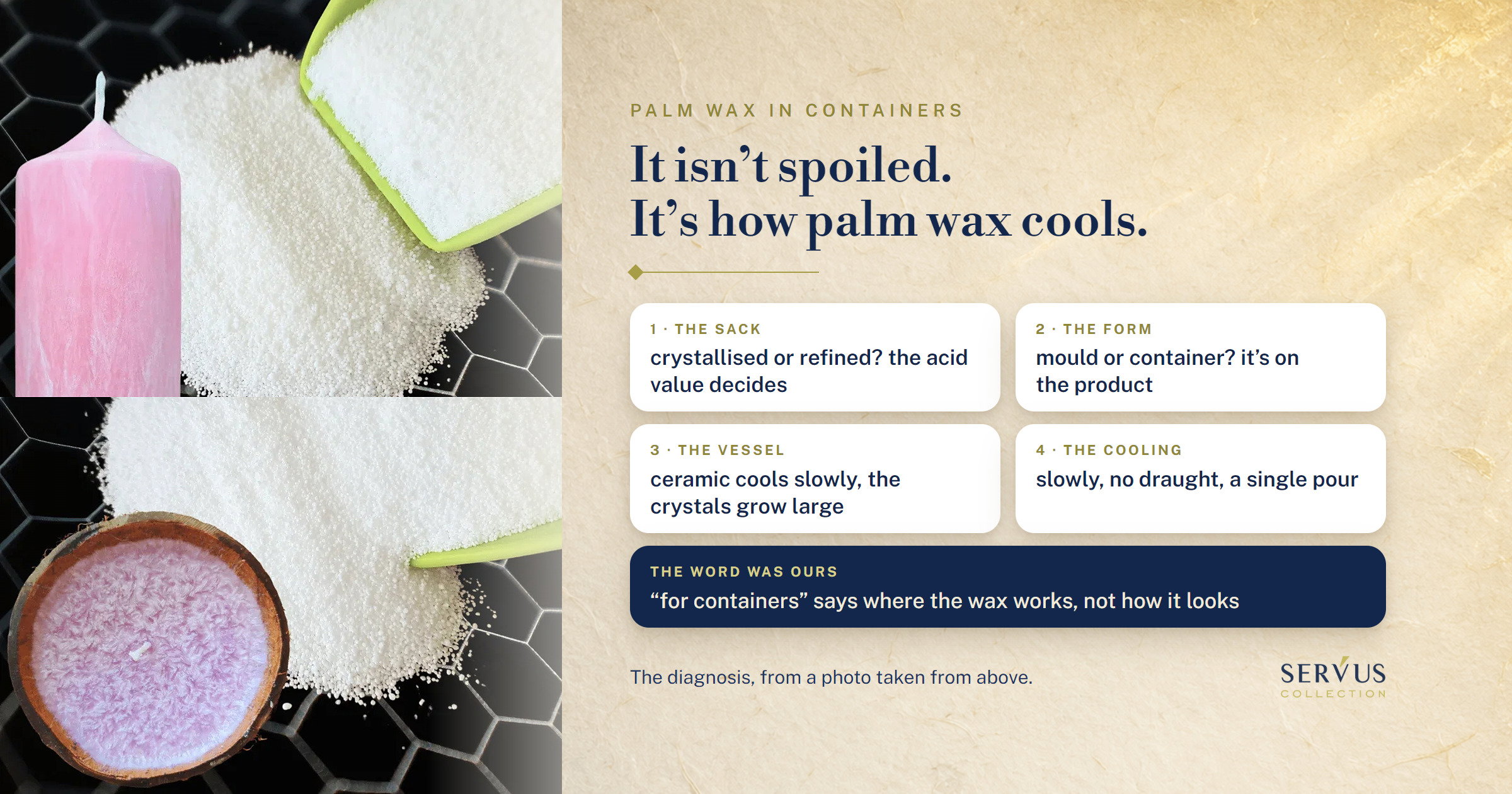
You opened the jar the next morning and the surface isn’t smooth. It’s grainy, with whiter patches that get denser towards the edge, like a window where the steam has frozen. You bought palm wax for containers, and its page said it was perfect for that. The complaint that reached our support said exactly that, word for word: "the website says it’s perfect for containers, it should look perfect, not like this" (translated from Romanian).
Palm wax is grainy because it sets into crystals as it cools, and large crystals show up as graininess. How large they grow depends on three things: which palm wax you poured, how slowly it cooled and in what vessel. With a crystallised palm wax, the graininess is the product itself. With a refined one, it’s the sign to check the pour and the cooling first.
Below: why it crystallises and why not every palm wax does, why it comes out grainier in ceramic, what "perfect for containers" means on our page, how to read the surface and what to change in the next batch.
I’m Sînziana. We’ve been pouring candles in our workshop in Maramureș, Romania, since 2010, and we poured the crystallised palm wax for containers ourselves before putting it on the shelf, and saw what it does in ceramic. What follows is the diagnosis I make at support when I get a photo taken from above: the wax isn’t spoiled, but what you poured and what you poured it into aren’t the same thing either.
Why is palm wax grainy?
Palm wax is grainy because, as it cools, it draws together into crystals, and the crystals that have had time to grow are visible to the naked eye. It isn’t a batch accident and it isn’t spoiled wax. It’s the way a plant wax made from palm oil hardens when it’s given time.
The crystals form during cooling, not at the moment of pouring. It’s the first rule we write on the pages of our crystallised palm waxes, and it’s the reason two candles from the same sack, poured the same way, can look different if one cooled by the window and the other on the table in the middle of the workshop. A 2013 study on palm oil fractions, the material the wax also comes from, measured the same thing at laboratory scale: slow cooling gives the molecules more time to bond with each other, and those bonds produce the crystals you see.
The part people forget when they buy palm wax for the first time is that not all palm wax does this. There are two families, and only one crystallises visibly.
What is crystallisation and why don’t you see it in every palm wax?
Crystallisation is the way melted wax returns, as it cools, to an ordered structure, and in palm wax you see it in the crystallised family, not in the refined one. In our range, the two families are also clearly separated by acidity: of the six palm waxes on our shelf, three are crystallised, and the certificates of analysis of the two mould waxes show the acid value at 155 and at 175; the other three are refined, with the acid value below 0.2, and stay smooth. For our products, that number is an indicator of the family, not a rule for every palm wax in the world. We wrote how to read it in our guide to wax families; here I’ll only tell you what it means for your jar.
The pattern itself comes from the composition of the wax and the way it settles as it cools; acidity, in our range, goes hand in hand with the family. The two mould waxes, with the highest acidity on the shelf, also make the most visible pattern: star-shaped in one of them, white, ice-like feathering in the other; the one made for containers gives an ice-like texture. The refined palm wax on our shelf, with an acid value close to zero, is made to stay smooth, and that’s how it’s sold.
Don’t confuse it with the white patches on soy. Those are a crystallisation too, but a different wax and a different pattern: frost flowers on the walls of the glass, which we wrote about in our article on frosting. In crystallised palm wax the pattern covers the whole surface, from the wick to the edge, and it isn’t a defect to keep in check. It’s the pattern the wax was made for. It’s what you bought.
Why does it come out grainier in ceramic than in glass?
In the thick ceramic containers we worked with, cooling took longer and was less even than in glass, and the crystals came out larger and more irregular. It’s a workshop observation, on our vessels, not a law of ceramics.
That’s how we explain what we saw, with the mechanism above taken to its end: a vessel that cools quickly and evenly freezes the pattern while it’s still small and regular; a thick vessel, which holds heat longer, lets it grow, and doesn’t cool the same everywhere. An American materials supplier writes the same thing from the other side, in its guide to textured palm wax candles, updated in 2024: to get crystals, you slow down the cooling and warm the mould before pouring. Ceramic does the first of these on its own, without being asked: it holds heat and lengthens the cooling.
So neither the vessel nor the wax is faulty. The vessel did what any thick vessel did for us with a wax that crystallises. In what we poured, glass gave a smaller, more regular pattern, and thick ceramic gave it large and uneven. If you want ceramic and a calm surface, it’s the wax that has to be different, and I’ll get there.
What our page says and what "perfect for containers" means
The page of our crystallised palm wax for containers says, in the third bullet point, "elegant decorative finish, translucent and glossy, perfect for container candles", and in the last line, "visual perfection". The word is ours. "Perfect for containers" means the wax is made for the container: it sticks to the walls, burns steadily, holds. It doesn’t mean smooth. For someone looking for smooth, the two meanings are opposites, and the person who wrote to us read the second one.
On the same page, two bullet points higher, the truth is written too: "natural crystallisation effect, every candle becomes a unique piece of art, with a different organic pattern". The two sentences sit side by side and tell different things to someone who doesn’t yet know what crystallisation is. His annoyance was with the word, not with the wax, and the word was ours. We wrote this article so it no longer depends on which line you read.
It isn’t the only time we’ve been told. "It would be good if the product description specified this", a customer wrote to us in a review from December 2025 (translated from Romanian), about another limit of palm wax, in moulds. She was right too. The pages of the two crystallised mould waxes now have a section called "What this product does NOT do"; there it says "not suitable for container candles", and for the one with the star-shaped pattern also "does not give a smooth or even surface". On the page of the crystallised wax for containers that section is still missing. Until it gets there, it’s here.
How do you read the surface to tell whether it’s the product, the form or the pour?
You look at three things, in this order: which palm wax it says on the sack, what form it’s made for, and how it cooled. Those three explain almost all the grainy surfaces that reach our support, and the diagnosis is made from above, from a photo, before any advice.
The mistake isn’t that someone pours crystallised palm wax into a glass. It’s that the glass gets a crystallised wax made for moulds, or a refined one poured cold, into a cold vessel, then left in a draught. The surface looks just as bad in both cases. The cause and the fix are completely different.
How do you find out which palm wax you poured?
From the order and from the product page, not from the surface. The product code tells you what you bought, the page tells you what form it’s made for, and the batch’s certificate of analysis tells you the acidity, that is, whether it’s from the family that crystallises.
- The product code. It’s on your order, on the invoice and printed on the 25 kg sack. With us, the two crystallised mould waxes are BWC07 and BWC09, the crystallised one for containers is BWC16, and the refined ones for containers are BW10110 and BW10610.
- The form it’s made for. It’s written on the product page. On the two mould waxes it’s there in black and white, under "What this product does NOT do": not suitable for container candles, the wax pulls away from the walls. The one for containers is listed on the container wax shelf, next to the two refined ones.
- The acidity. You find it in the batch’s certificate of analysis, on the acid value line; it isn’t printed on the sack label. For ours, the high values, 155 and 175, belong to the crystallised waxes, and those below 0.2 to the refined ones, which stay smooth. For a wax from someone else, the number is read next to what the manufacturer says about the family, not on its own.
If the three say "crystallised, made for containers", what you see in the jar is the product. If they say "crystallised, for moulds", it’s the wrong form, and it can’t be fixed through the process. If they say "refined", the cause is in the pour, and it can be fixed in the next batch. A crystallised wax made for glass isn’t our invention: an Australian supplier describes it as having the same pattern as its mould cousin, but made for glass, not for free-standing candles.
What you see on the surface and what it usually is
Every grainy surface has a sign you can see from above, and the sign leads to one of the three causes. We’ve put them in a table, with what to change in the next pour, because with a candle already poured the levers are few and worth knowing exactly.
| What you see | What it usually is | What you change |
|---|---|---|
| a crystal pattern over the whole surface, stuck to the walls, in glass | crystallised palm wax made for containers; it’s the product | nothing; if you want the pattern more pronounced, slower cooling and light shades, which let it show |
| the same pattern, but with large, uneven islands, in ceramic | most likely the vessel and the cooling: slow and uneven, the crystals grew large | glass instead of ceramic, or acclimatised ceramic and cooling without a draught |
| crystals and wax pulled away from the walls, in a glass | crystallised mould palm wax, poured into a container | the wax, not the process; this form can’t be fixed through temperature |
| pronounced graininess, with a crater in the middle, after you poured a second layer | most likely the second layer, which shrank and crystallised separately from the first | a single pour; if it needs a top-up layer, thin and at a temperature close to the first |
| a "curdled", grainy texture, in a palm and soy blend | two waxes that behave differently as they set, in the same vessel | container soy as the base, palm only for effect, at a percentage set on a test batch |
| a matt or rough surface, with no pattern, in refined palm wax | possible causes: pouring too cold, a cold vessel or a draught | the temperatures on your wax’s page, the vessel acclimatised next to the melting pot, cooling without a draught |
| streaks instead of a pattern, in crystallised palm wax | usually cooling that’s too fast | slow cooling, at room temperature, no fridge |
Read the middle column first: some rows come from the wax you chose, others from the vessel and the process, and often from both. That’s why the question at support doesn’t start with "what temperature did you pour at", but with "what code is the wax and what vessel did you put it in". Temperature comes third.
Why does a palm and soy blend come out "curdled"?
Because the two waxes behave differently as they set: palm settles into crystals, container soy into a creamy texture, and the blend can crystallise unevenly. The result is a grainy surface, which customers describe to us as "curdled", and it isn’t a defect of either wax. It’s the clash between two ways of cooling.
The case we learned it from also came to support, with a photo: half palm, half container soy, poured into ceramic vessels. The vessel cooled slowly, as we’ve seen thick ceramics do, and the blend had time to crystallise unevenly. Have you poured the blend into a thick vessel too? Then you have two causes on top of each other, and the first one to remove is the vessel.
In the case we saw, the ratio between the waxes was the variable to test first; temperature and cooling stay in play as well. The base remains container soy, which gives the creamy texture, and palm goes in only for effect, at a small percentage. I won’t give you the percentage, for the same reason as in the guide to wax families: until I pour that batch myself, any figure would be plausible, not measured, and you’d believe it. You set it on a small batch, of 500 grams, changing a single ratio per batch, as we wrote in our article about the first lost batch.
What do you do at the next pour?
You change a single thing per batch and write it down. In our diagnosis, with palm wax we check the vessel first, then the cooling, and only then the pouring temperature. What changed compared with the batch before, the one that came out well? Usually one of those three. And if a smooth surface is what you want, you change the wax, not the process.
This isn’t an article about temperatures. The melting, fragrance and pouring temperatures are on your wax’s page, and you confirm them on a small test, because no number holds the same in every vessel and at every thickness. What follows are the things that aren’t on the page, and that spoil the candle even when the temperature was right.
Why don’t you pour a second layer over the first?
Because the second layer shrinks differently from the first and crystallises separately, and the graininess comes out more pronounced, often with a crater in the middle. The case came to us at support with the customer’s explanation in it: "I poured more on top of it" (translated from Romanian). The photo showed the pronounced texture and the crater in the middle.
Palm wax sometimes needs a top-up layer, because it shrinks as it cools and can leave a thin skin or a dip on the surface. The American supplier’s guide above says the same: the second layer is needed only when a thin film forms on top after cooling. What matters is how you pour it. Thin, just enough to cover, and at a temperature close to the first layer, not with wax reheated well above it. A thick, hot layer over a cold one is a second candle, poured on top of the first.
Our house rule is simpler than it looks: a single, controlled pour, and patience until it has cooled completely. If a dip is left, you top it up thinly. If graininess is left, don’t cover it with another layer, because the new layer crystallises too.
How do you cool it so you get the pattern, not the graininess?
Slowly, at room temperature, without a draught, with the candles next to each other and the vessel acclimatised before pouring. The pattern forms during cooling, not at the pour, so cooling is the one step you can’t rush without losing it.
- The vessel acclimatised. Not cold from the shelf. You keep it next to the melting pot while the wax melts; for crystallised palm wax, our page asks for clean containers, slightly preheated, because a warm vessel starts the pattern evenly.
- The temperatures on your wax’s page, confirmed on a small test, not borrowed from another wax. A refined container palm wax melts ten to fifteen degrees below a crystallised mould one; the same figures on both spoil one of them.
- A single pour, as we wrote above. The top-up, if needed, thin and close in temperature.
- Slow cooling, without a draught, side by side. Not by the window, not in the path of the door, not under the radiator. In our workshop, placed next to each other, they cool more slowly and more evenly, and the pattern came out more regular.
- No fridge. The pages of our crystallised mould waxes say why: the fridge and a direct draught destroy the crystal pattern, and can leave cracks too. What you gain in time you lose in the candle.
Five rules, and none of them needs a better thermometer. They need time and a place without a draught. And how the candle burns you judge only at the first burn, not by the surface: a pronounced pattern on a wax made for containers burns just as well as a subtle one.
When a smooth surface calls for another wax
When you’ve poured crystallised palm wax and you want smooth. Then you don’t have a process to fix, you have a wax to change: with the crystallised waxes in our range, the pattern is part of how the wax behaves, it doesn’t come out smooth in a container however correctly you work, and ceramic makes it even more visible.
You have two routes, both on the container shelf. The first is refined palm wax: in our range, those with an acid value below 0.2 are made for a smooth surface and adhesion to glass, the extra-soft version and its firmer sister. The second is container soy, with its creamy texture, where palm goes in only for effect. It isn’t a demotion of palm wax. It’s the wax put in its proper form.
The limit, even if it costs us a sale: if a shop-window surface is your number one criterion, don’t buy crystallised wax for jars, however beautiful it looks in the product photo. That photo was taken by someone who wanted the pattern and cooled it slowly. You want it only if you want it.
Where you start
With a photo from above and the code from the order. Almost everything can be read from them, before any temperature.
What do you ask the seller before ordering palm wax?
Two questions. The first: is it made for moulds or for containers? The second: in my vessel, does it come out smooth or crystallised? The first is written on the product, with any supplier who knows their goods. The second is rarely written, and it’s the one the complaint at the start of this article came from.
The criterion I leave you is easy to apply anywhere: "for containers" says where the wax works, not how it looks. Adhesion, burn, stability in the glass, yes. A smooth surface, not necessarily. If the answer to the second question is an adjective instead of "crystallised" or "smooth", ask once more. On our container shelf both families sit side by side, the crystallised one and the two refined ones, precisely so you choose by surface, not by the word "perfect".
What to send us so we can tell you exactly what happened
The wax code, the vessel you poured into, the temperature you poured at and a photo taken from above, in daylight. From that photo we read the crystallisation, the form and, most of the time, the vessel, before we ask you anything.
Write to us on WhatsApp or call us on +40 726 162 810 (we answer in English), Monday to Friday, between 8:00 and 16:30 (Romanian time). If the wax is ours, we tell you which family it’s in and what form it was made for, without sending you to the certificate. If it’s from someone else, we tell you what to ask.
Graininess isn’t a defect. It’s the wax saying what it is. We should have said it first.