 EN
EN  Romana
 Magyar
You have the little bottle of fragrance in your hand, the wax is nearly at temperature, and in the next room there’s a child, a cat, or both. And before you pour, you find yourself asking the question people send us at support, word for word: "are fragrance oils for candles natural? how safe for animals and children?" (translated from Romanian)
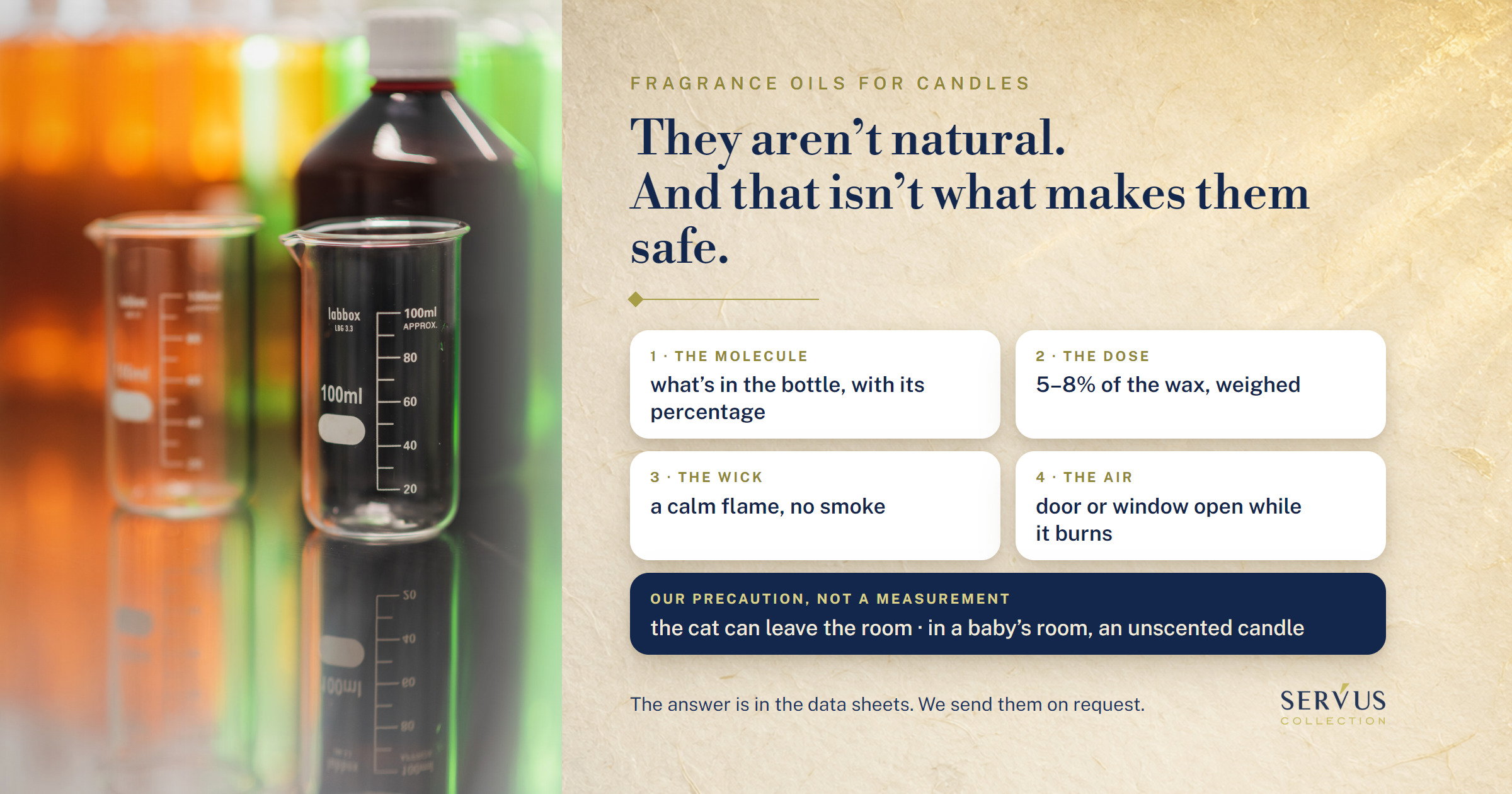
They aren’t natural. A fragrance oil for candles is a composition made to stand up to heat: dozens of molecules in one bottle, some taken from plants, others made in a laboratory. And safety in the home doesn’t come from the word "natural". It comes from which molecule is in the bottle, how much of it ends up in the wax, how well the wick burns and how much air the room has.
Below I’ll show you what the data sheets of the fragrances we sell say, why the orange bottle has a different word on its label from the vanilla one, what IFRA says and what it doesn’t, what we know about cats and children, and the house rules that let you pour with peace of mind.
I’m Sînziana. We’ve been pouring scented candles in our workshop in Maramureș, Romania, since 2010, and for a few years now we’ve been selling artisans the same fragrances we use ourselves. The question about "natural" is the one where it would be easiest to answer "yes" to make a sale. I don’t answer that way. I answer with the data sheets open on the table.
Are fragrance oils for candles natural?
No. Fragrance oils for candles are compound blends, made of both materials taken from plants and manufactured molecules, put together for a particular smell and for the uses declared by the manufacturer, candles among them. No bottle on our shelf can be correctly described by the word "natural", and that’s why we don’t use it.
The word that correctly describes a candle fragrance is "composition". A perfumer built it, molecule by molecule, for a scent profile. What we do is the next step: from these compositions we pick the ones that behave well in wax, not the ones that smell lovely in the bottle. An essential oil is something else: a volatile extract from a plant, with dozens of molecules too, except that they all come from that plant, not from a built formula. We’ll come to it below, because it doesn’t automatically mean "safe" either.
What is actually in a bottle of candle fragrance?
The ingredients that have to be declared, with their concentration ranges, in section 3 of each scent’s safety data sheet. It isn’t the full recipe of the fragrance: the sheet includes what the law requires to be declared, not everything the perfumer put in. We opened three data sheets from our shelf, all from our manufacturer, French Color & Fragrance International in Germany, and here’s what’s in them.
In the orange fragrance, Orange, the ingredient with the largest share is orange oil itself, the one taken from the peel, at between 8.7% and 17.4% of the bottle, followed by cinnamaldehyde, the molecule that gives the smell of cinnamon, at 10.4%. In Lavender, lavandin oil, from a plant related to lavender, is between 7.5% and 15%, with eucalyptus oil next to it and a synthetic musk, galaxolide, at 1.3% to 2.5%. In Vanilla, the dominant ingredient is benzyl benzoate, up to 38.9% of the bottle: a molecule that also exists in natural balsams, but which in perfumery is manufactured, and which in our notes we record as the anchor, the heavy, stable part of the scent.
So the same bottle holds an oil from orange peel and a laboratory musk, and neither is there to put something on the label. On the fragrance page we write which documents you get on request: the IFRA certificate, the safety data sheet and the allergen report. We don’t write "natural", because it would be false for all three bottles above.
Why we don’t write "natural" on the fragrance page
Because none of our scents is an essential oil, and because a good candle fragrance is good partly thanks to its built part. The anchor in Vanilla, benzyl benzoate, is the very molecule we give as an example of a heavy base, the one that stands up to heat, in the article on scent throw, and it is manufactured. A fragrance made only of the notes that evaporate first smells lovely in the bottle and disappears in the first minutes of burning.
What we write instead is what can be checked. Every scent comes with its IFRA certificate and its safety data sheet, tied to the real batch, with our customer code on the label. How to read the certificate, and why "100% permitted" for candles doesn’t mean "put in as much as you like", is in our article on IFRA.
And we also write which allergens they contain, because they do contain them. Vanilla has coumarin and veratraldehyde declared on its sheet, Orange has limonene and cinnamaldehyde, Lavender has linalool. None of the scents we opened for this article is free of declarable allergens, and anyone who tells you they sell one owes you the report that proves it.
What changes if you pour with essential oil instead of fragrance?
Two things change, and neither is the extra safety you’re hoping for. Essential oil is the natural option: the volatile extract of a plant, with many molecules too, all from that plant, with nothing built around them. You can pour with it. But first, two things to know.
The first is about cats, and it’s documented by others, not by us. The list of oils that Pet Poison Helpline says have poisoned cats is a list of essential oils: citrus, pine, peppermint, cinnamon, clove, eucalyptus, tea tree. All natural. I come back to it in the chapter on animals, with the source.
The second is about burning. A lemon or orange essential oil is made almost entirely of top notes, the ones that evaporate first. In a candle fragrance, someone has put a heavy base next to them to hold them in the flame. In an essential oil, that base doesn’t exist, so the scent goes in the first minutes of burning. The mechanism, with the thirty-second spoon test, is in our article on why your candle has no scent when it burns. If you still want to pour with essential oil, the rules below stay the same: a weighed dose, a matched wick, air in the room.
How toxic is candle fragrance, according to its own data sheets?
The concentrate in the bottle is a chemical with a hazard label, and a candle with 5–8% fragrance in the wax is a different exposure, one the data sheet doesn’t describe. The two are often confused, and the confusion goes both ways: some treat the bottle like a cupboard essence, others treat the candle like the open bottle.
The safety data sheet talks about the bottle. On it are the classifications for handling, storage, skin contact, swallowing. What happens to the fragrance once it’s at 6% in a kilogram of wax, under a flame, in a room of twenty square metres, is another question, and the data sheet doesn’t answer it.
Why does the orange bottle say "Danger" and the vanilla one "Warning"?
Because the natural part of Orange, the oil from the peel, carries a statement that the benzyl benzoate in Vanilla doesn’t. On its sheet, orange oil has "May be fatal if swallowed and enters airways", the statement that raises the label to the word "Danger". Lavender has the same statement, for the same reason: lavandin oil and eucalyptus oil. Vanilla, with its manufactured anchor, stays at "Warning".
We’ve put the three scents in a table, with what their data sheets say and what the IFRA certificates we have on file say, the 2024 and 2025 editions.
| Scent | The ingredient with the largest share | Where it comes from | The word on the label | IFRA limit in baby products | IFRA limit for candles |
|---|---|---|---|---|---|
| Orange #EU22769F | orange oil, 8.7–17.4% | orange peel | Danger | 0.134% | no limit |
| Lavender #EU24194F | lavandin oil, 7.5–15% | plant | Danger | 11.84% | no limit |
| Vanilla #EU24195F | benzyl benzoate, 19.5–38.9% | manufactured | Warning | 0.18% | no limit |
Read the table by columns, not by rows, and you’ll see that none of the columns splits into "natural" and "synthetic". The word on the label comes from the two scents with plant oil. The tightest limit on a baby’s skin comes from orange, again the one with plant oil, while lavender, just as natural, is allowed nearly ninety times more in the same products. For candles, all three have the same figure. What decides, in every column, is the molecule and its percentage, and nothing else.
It works the other way too. On the data sheet of the Egyptian Musk scent, galaxolide, the synthetic musk, is at 5.4% to 10.75% of the bottle, and at that percentage it brings the statement "Suspected of causing cancer". The same galaxolide is also in Lavender, at 1.3% to 2.5%, where the statement no longer appears, because it’s below the threshold that triggers it. The same molecule, two data sheets, two verdicts, and the difference is the quantity.
What the classification means for the bottle and what it means for the candle
For the bottle it means gloves, a closed cap, a high shelf and a box kept apart from anything to do with food. For the candle it means that the orange oil, the one with the "Danger" statement, ends up in the wax at under one and a half percent of the weight of the candle, and that from then on you don’t handle it any more, you burn it.
The sum is simple and you can do it for any scent. In the orange fragrance, the peel oil is at most 17.4% of the bottle. If you put the fragrance in at 8% of the weight of the wax, the top dose we recommend for containers, the orange oil is 1.4% of the candle. At 5%, the dose you start with for your first scented candle, it’s under 0.9%. The figure isn’t a safety certificate. It’s the real proportion, so that you don’t read the bottle’s data sheet as if it were the candle’s.
The kitchen rule that follows is the one in our article on pouring safety: the fragrance goes into the wax after you’ve taken the pot off the heat, with the window open and no flame nearby, and the pouring box isn’t mixed with the cooking cupboard. The bottle is a chemical. The candle is the product, and for it the other rules follow.
Why does IFRA leave candles without a limit?
Because, in the IFRA classification, candles are in category 12: "Products not intended for direct skin contact, minimal or insignificant transfer to skin", and for this category the limit is no longer calculated. The reasoning, in their document: for candles of all types, "Due to the expected negligible skin exposure from such products the risk of induction of dermal sensitization through the normal formulation and use of such products is considered negligible. As such, the concentration of fragrance ingredient is not restricted in the finished product." It’s written in the guidance for the use of IFRA Standards, the 51st Amendment, the one in force as I write, in the table of categories.
Look once more at the baby column in the table above. The same orange bottle is allowed at 0.134% in a baby cream and without limit in a candle. The difference between the two figures isn’t that the candle is safer. It’s that the candle isn’t put on the skin, and the IFRA limits are calculated from what ends up on the skin: both for contact allergy and for what enters the body, where it’s again absorption through the skin that’s counted, as their chapter on systemic toxicity says.
I searched the whole guidance, 73 pages, for the word "inhalation". It doesn’t appear. The document itself says, in its own words, that observing the standards "may not be sufficient to ensure regulatory compliance and the safety of fragrance mixtures or ingredients". So "100% permitted in category 12" is a limit for the skin, not an assessment of the air in your room. The real limit for candles comes from the specific wax and its data sheet: with KeraSoy 4130, the container soy in our recipe for the first candle, above 10–12% the fragrance migrates to the surface and the burn is spoiled; in our container formulas we usually work at 6–8%, in moulds at 5–6%.
Is candle fragrance safe for children and pets?
I don’t have a measurement of the air in your room, and nobody who sells you fragrance has one. What I do have is what the data sheets say, what a veterinary emergency line has documented on cats, and the rules we’ve poured by since 2010. With those three, the question can be answered honestly, piece by piece.
The short answer, so you don’t have to look for it at the end: the cat is a special case, with a source; with a child there are two kinds of risk, the physical one (the flame, the hot wax, a wick that smokes), which you can see and prevent directly, and the one in the air, for which I have no figure; and for a small child’s room, as a precaution of ours, the unscented candle exists and burns just as well.
Why is the cat a special case?
Because a cat’s liver doesn’t break down some of the molecules in plant oils, and that is documented. Pet Poison Helpline, the American poison emergency line for animals, writes that "Cats lack an essential enzyme in their liver" and that they are "very sensitive to phenols and phenolic compounds, which can be found in some essential oils". The list of oils they say have caused poisonings in cats is on their page on essential oils and cats:
- citrus oil (d-limonene)
- pine oils
- peppermint oil
- cinnamon oil
- clove oil
- eucalyptus oil
- tea tree, ylang-ylang, wintergreen, birch and pennyroyal oil
All of them are natural, and three of them appear as ingredients in our fragrances: the orange oil in Orange, the eucalyptus oil in Lavender, the clove leaf oil in Into the Woods. The fact that an ingredient comes from a plant doesn’t make it safe for a cat. And the manufactured part hasn’t been tested on cats by anyone in the sources I have either, so I don’t declare it safe. What you can do in practice is look on your scent’s safety data sheet to see whether any of the oils on the list appears, and how much: in a pure essential oil, the oil on the list is the whole bottle; in a compound fragrance, it’s at a few percent. It’s a difference in quantity, not a safety verdict.
What the same source says about exposure through the air: with passive diffusers, where the oil doesn’t get onto the cat’s fur, the main hazard "is respiratory irritation". A candle isn’t a diffuser, and I have no figure for it. That’s why our rule is common sense, not laboratory: the room where a scented candle is burning has its door open, the cat can leave, and you don’t light scented candles in a room where the cat is shut in. If the cat sneezes, coughs or withdraws when you light one, that’s your measurement, and you take it seriously.
What risks does a child face in a room with a scented candle?
Two kinds. The physical risk, the open flame and the hot wax, which you can see and prevent directly, and what they breathe from the air, where I have no measurement to give me a threshold. Fragrance is in the second category, with one clarification: with a candle, contact with the skin is negligible, what’s left is the air.
Melted wax burns the skin, and while you’re pouring you have no free hand for the child who walks into the kitchen. That’s how the article on pouring safety begins. The wick also belongs with the risk you can see: a tall flame that flickers and gives off smoke is usually a wick too thick for that diameter, and its trace is the soot on the wall of the glass. That smoke is in the air of the room, with or without fragrance in the wax. How to match the wick to the diameter and the wax is in our guide to choosing the wick, and you can see with the naked eye that it’s well matched: a calm flame, no smoke.
The fragrance, and here the honest answer has two halves. On the skin, the IFRA standard considers the exposure from a candle negligible, and I showed above why. In the air, there’s no figure I can give you, not from IFRA, not from the data sheets, not from us, and ventilation is the only tool you have. Have you ever wondered why a scented candle smells "too strong" in a small room and can barely be noticed in a large one? That’s the concentration in the air, and you adjust it with the window, not with the data sheet.
How to pour for a small child’s room
Unscented for your first candle, and for the room where a baby sleeps, as a precautionary rule of ours, unscented as well. It isn’t a medical limit, it’s what we recommend for as long as we have no air measurement. The same wax, the same wick, the same flame, with nothing to ask. The unscented candle burns just as well, and in the recipe for your first soy wax candle the first pour is unscented anyway, so you can see how the wax behaves on its own.
If you want fragrance for the rest of the house, you weigh the dose. You start at 5% of the weight of the wax, the starting point of our soy recipe: 25 grams for a 500 gram batch, weighed, not counted in drops. You burn the candle, see how present the scent is in the room, and only in the next batch do you go up, if needed. In our container formulas we usually work at 6–8%. The ceiling is set by the specific wax and its data sheet: for KeraSoy 4130, the soy in that recipe, it’s 10–12%, above which the fragrance migrates to the surface and the burn is spoiled.
What you don’t do is make up for a weak scent with more fragrance. If the scent doesn’t come through at a dose that’s already right, the cause is elsewhere: the structure of the fragrance, the temperature you added it at, the wick, the curing time after pouring, or how well it suits that wax. More fragrance means more oil on the surface and a dirtier burn, in the room where you wanted clean air in the first place.
Where to start
With the data sheet of the scent you already have, not with a new scent. Ask the seller for the IFRA certificate, the safety data sheet and the allergen report, open them, and only then weigh the dose.
The five house rules for fragrance in a candle
These are the rules we pour by, and none of them depends on the word "natural".
- The bottle is a chemical. Gloves, a closed cap, a high shelf, a box kept apart from food. The fragrance goes into the wax with the pot off the heat, with air in the room and no flame nearby.
- The dose is weighed. 5% of the weight of the wax to start, 6–8% in our container formulas, and the ceiling comes from your wax’s data sheet, not from a general figure.
- The wick is matched to the diameter and the wax. A calm flame, no smoke. A flame that smokes is put out and the wick is changed; you don’t just open the window.
- The room has air. The door open or the window ajar while the candle burns. In a small room, a small candle.
- The cat can leave, the baby gets an unscented candle. No scented candles in a room where the cat is shut in or where a small child sleeps. It’s our precaution, not a measurement.
You can apply them to any fragrance, from anyone. If you keep all five, the question "is it natural?" loses its weight, because everything that word used to cover is covered by a rule you can check.
What do you ask for, whoever you buy your fragrance from?
Three documents, for the exact scent, with its code: the IFRA certificate, the safety data sheet and the allergen report. If you get them, you have everything I used in this article. If you don’t get them and get the word "natural" instead, you’ve been given a word.
With us, you can have them on request for every scent on the fragrance oils page, with the scent code on the label, because each batch is made to order by French Color & Fragrance International, with our customer code. The document belongs to the real batch, not to the scent "in general". And if you already have a scent from us at home and want to know what’s in it, send us the code on the label on WhatsApp or by phone, at +40 726 162 810 (we answer in English), Monday to Friday, between 8:00 and 16:30 (Romanian time). We’ll send you the data sheets, not an adjective.