
 EN
EN  Romana
 Magyar
This year you want your family to get candles you poured yourself for the holidays: ten glasses, maybe twelve, with the fragrance you’ve chosen. You haven’t poured one yet, or, as some of the messages we get at support begin, "it’s the first time" (translated from Romanian). Or you poured one, it came out beautiful on the shelf and you’ve never lit it.
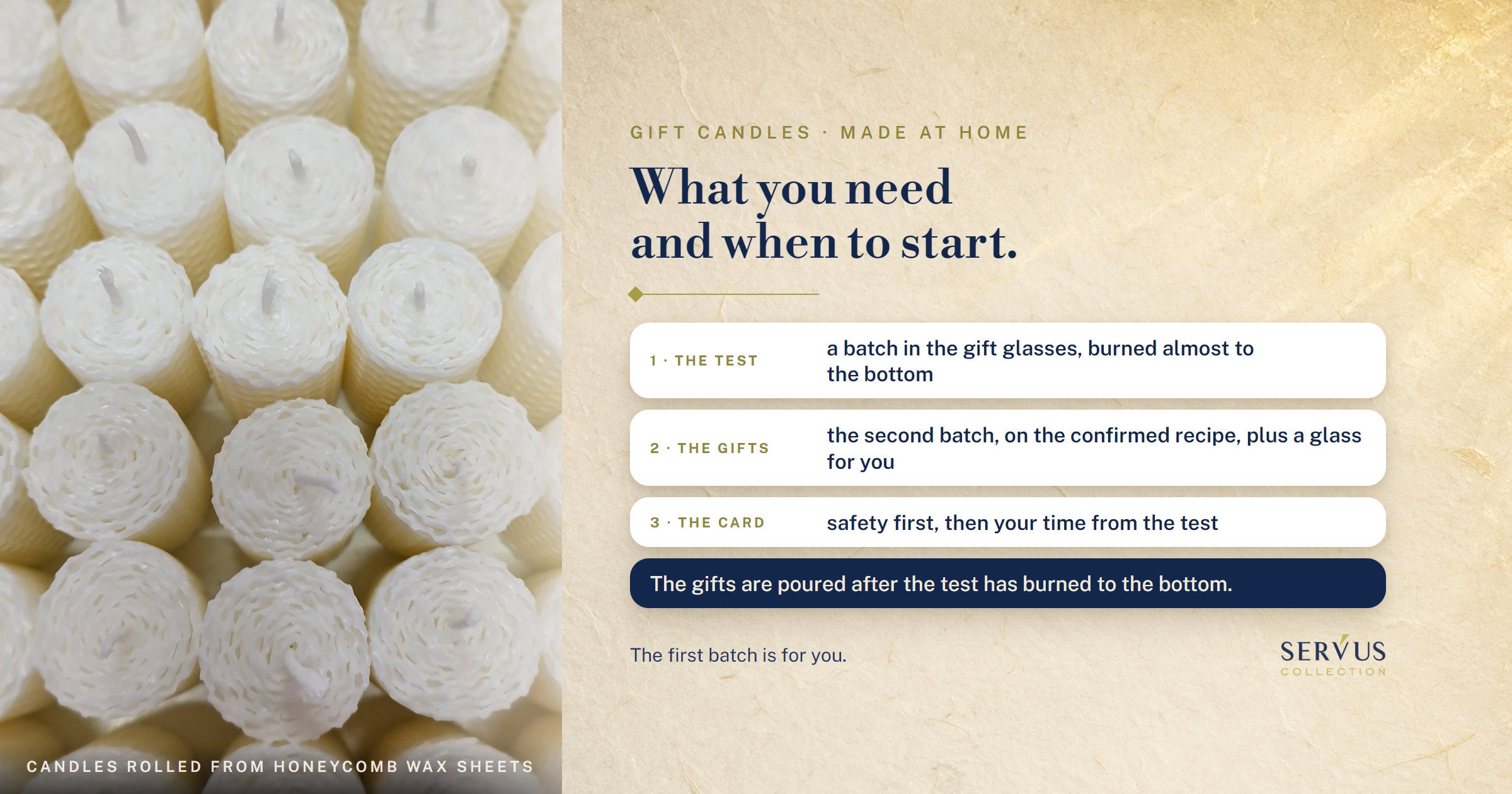
The candles you give as gifts are poured in the second batch. The first is the test: it tells you which wick suits your glass, with your fragrance, and you pour the gifts on the same recipe only after a test candle has burned almost to the bottom. How long that takes depends on a figure you find out at the first burn: how many evenings your glass needs to get to the bottom. As a planning benchmark, you want the materials on the table at least three weeks before the day you give the candles: for Christmas, by 4 December; for St Nicholas’ Day, by around mid-November.
You can pour often just for your own home and your family. Some of the eight loyal customers we talked to at length in July make candles only for themselves and for people they know, and they have between 10 and 19 orders with us.
Below: the stages, from the order to the box, and when you move from one to the next; the test batch and what you read in it; the sums and the shopping list for ten gifts; what you write on the card that goes with the candle; and where to get the materials. The step-by-step recipe for a candle in a glass is in our article on your first soy wax candle.
I’m Sînziana. We’ve been pouring candles in our workshop in Maramureș, Romania, since 2010, and the wax in this article, KeraSoy Container 4130, is the one we use for scented jars and table glasses. The pouring temperature, the 48 hours of waiting and the fragrance ceiling come from the wax manufacturer’s data sheet; where it says "our kit" or "our benchmark", it’s our recipe and our workshop practice. How many gifts you’ll get and which wick you put in them I can’t tell you from here. I’ll show you how to find out, on your own glass.
When to start your homemade candles for the holidays
As a benchmark, at least three weeks before the day you give them, counted from when you have the materials on the table. The fixed part of the road is short: one evening of pouring and 48 hours of waiting after each pour. The part that varies is burning the test candle almost to the bottom, and you find that out at the first burn, with the scales.
What are the stages, and when do you move to the next one?
Each stage has a condition. You move on when it’s met, not when a number of days has passed:
| Stage | How long it takes | You move on when |
|---|---|---|
| The order | as long as the delivery date shows when you order | you have everything on the table, including the wick in two sizes |
| The test batch | one evening, plus 48 hours in which the glasses stay still | the 48 hours required by the wax’s data sheet have passed |
| The first burn | two hours, with the glass weighed before and after | you know which wick you’re following and how many more evenings the glass needs |
| Burning almost to the bottom | evening after evening, no more than four hours at a time | the glass has burned down to the last centimetre with no smoke, no tunnel and without getting hot |
| The gift batch | one evening, plus 48 hours | your glass from the batch burns like the test glass |
| Packing | — | — |
If a bad sign shows up at the first burn, you change the wick and start again from the test batch: three extra days, if the next wick is already with you. If it shows up near the bottom, you start the whole road again, long burn included. That’s why you order everything at once: the wax for the test and for the gifts, the fragrance and the wick in two sizes. A wick ordered only after the test adds the delivery time too. You read the estimated delivery date on the pages of the wax and the wick on the day you order.
If you don’t have time to wait for the burn down to the bottom, you can pour the gifts after the first burn, alongside it. Then you pack them only after the test glass has passed the last centimetre, and if it fails, you remelt the batch. The wax’s data sheet allows remelting, but a scented candle that’s been remelted no longer has a fragrance percentage you know.
How long before 6 and 25 December?
You count back from the day you give the candles, which isn’t always the day of the holiday. If you hand them out at the Christmas table, that day is 25 December. If you take them to your colleagues beforehand, it’s the last working day. Three weeks from when you have the materials means 15 November for St Nicholas’ Day and 4 December for Christmas; the order goes out before that.
The benchmark holds if the test glass gets to the bottom in no more than two weeks of evenings and you have nothing to correct. If the sum from the first burn gives you more, or if the first burn sends you to another wick, you start earlier. Burning down to the bottom isn’t a formality: towards the end, the melt pool is at its widest and the flame gets closest to the bottom of the glass, so that’s where you see whether the glass gets hot. It’s the part of the candle that the person who receives it burns, after you’re no longer there.
What do you do if you’ve started late?
Switch to honeycomb wax sheets. A rolled candle isn’t melted or poured, so it doesn’t have the 48 hours of waiting: you warm the sheet for two to four seconds with hot air and roll it around the wick. We timed one, with everything prepared beforehand: 98 seconds of rolling.
The diameter comes from the number of layers, and the height you cut yourself from the 41 cm side of the sheet. The candle we timed was made from a sheet cut into four strips, rolled one over the other: 5.5 cm in diameter and 10 cm high. At 4.5 cm in diameter, a 10 cm candle takes three strips, so ten gifts and one trial candle take 33 strips, about nine sheets. If you have no other wax to soak the wicks in, you melt the tenth: that’s the whole kit, with nothing to spare. If the first rolled candle doesn’t come out, you warm it, unroll it and start again; the wax isn’t lost. You’ll also need a heat gun, which we don’t sell. Here too, you burn one before you give them: two rolled candles of the same diameter can burn differently, depending on how tightly you rolled each one. How to roll it without it coming apart is in our article on the first candle from honeycomb wax sheets.
You pour the first batch for yourself
The first batch is the test, and you pour it into the glasses you’ll give as gifts, with the fragrance you’ll give. It gives you three answers you only get by burning: the right wick for your glass, how strongly the fragrance comes through in the room and what the candle looks like after it has burned. The wax’s data sheet says it directly: every combination of glass, wax, colourant, fragrance and wick has to be burn-tested.
What do you pour for the test?
A kilogram of wax is enough for the test: two batches of 500 g each, that is, between four and six 200 ml glasses. You pour them the same evening, so you don’t lose two days:
- The plain batch, just wax and wick. It shows you how soy behaves in your glass when nothing else comes into it.
- The scented batch, at the percentage you want in the gifts. Start from 5%, that is, 25 g of fragrance to 500 g of wax. Fragrance is weighed; drops don’t tell you how many grams you’ve put in.
You choose the wick by the inside diameter of the glass: the wick’s burn diameter the same as the glass, and on soy, the wick page says to consider one size up. The wick in our kit, Schreiber SHW 50/7.5, is for low glasses, with an inside diameter of around 5 cm. That’s why, in the scented batch, you put one glass with 50/7.5 and one with 60/7.5, the size above, and on the bottom of each you note which wick it has. With wider or taller glasses, the pair changes; the table is on the wick page.
The 45–55 °C for pouring and the 48 hours in which the glasses stay still, at room temperature, come from the wax’s data sheet. The rest is the recipe from our kit: you melt in a bain-marie at 70–75 °C, without keeping the wax much above 85, and pour into glasses that feel warm to the hand. No fridge. The steps in full are in our article on your first soy wax candle.
What do you read at the first burn?
48 hours after pouring you weigh the test glasses, then light them all at once, away from draughts. For the first hour you leave them alone. Then you look down on them every twenty minutes and note, for each glass, after how long the melted wax touched the glass all the way round: that’s the figure you write on the card. At two hours you look for these signs:
- Signs that the wick is the right size: the melt pool touches the sides all the way round and is no more than half a centimetre deep, the benchmark we work with for glasses. The flame stands straight, with no smoke.
- Signs of a wick that’s too small: the melt pool is still a circle around the wick, with untouched wax at the edge. Some recipes reach the edge more slowly, so you let the glass burn on and look every twenty minutes. If even at four hours, the ceiling, the ring hasn’t gone, you move to the next diameter; otherwise, that’s where tunnelling starts.
- Signs of a wick that’s too large: the melt pool is deeper than half a centimetre and the glass gets hot, even if the flame looks fine. The wax’s data sheet says a wick that’s too large can produce soot and can speed up the burn.
Look at the tip of the wick too. The data sheet calls it a "mushroom": the carbon that collects on the end, spoils the burn and can cause soot and a bad smell. If it appears, you try another wick.
What you see at the first burn is a hypothesis about the wick. You confirm or rule it out by burning on the glass that looked best, evening after evening, down to the last centimetre. To know how many evenings you need, you weigh it again when you put it out: the grams burned, divided by the hours of burning, are how much it burns per hour. The wax left, divided by that, tells you roughly how many hours it has left to the bottom; at no more than four hours an evening, you find out how many evenings. It’s an estimate, and it tends to come out long, because in the first hour the candle is only warming up and burns less.
You compare the scented glass with the plain one. If the plain one burns well and the scented one doesn’t, the fragrance, or the colour, if you added any, has changed the burn: the data sheet says that fragrance, colour and the shape of the candle weigh heavily in the choice of wick. The signs of tunnelling, in full, are in our article on candle tunnelling.
Why all the gifts in the same glass and with no more than two fragrances?
Because every new glass and every new fragrance means a new test, with another 48 hours of waiting and another burn down to the bottom. Three glass models and three fragrances make nine combinations, and the wax’s data sheet asks for all of them to be burn-tested. With a single glass model and a single fragrance, one test covers the whole batch. With two fragrances you do two tests, poured the same evening. Beyond that, we wouldn’t go for a first batch of gifts.
You buy the glasses all at once, all the same: the same inside diameter, the same height. If you add colour, you add it in the test too, with the same number of drops on the same amount of wax.
How much wax, how many wicks and how much fragrance for ten gifts
For ten glasses plus one for yourself you need, on top of the test kit, around 1.8 kg of wax, so two more kilograms, one pack of wicks and, at 5%, about 90 g of fragrance. The figures are a guide, for a glass that takes 162 g of wax. On your own glass you estimate them with water, and you find the exact amount at the test batch.
How much wax fits in a glass?
Fill the glass with water up to where you want the wax to come and weigh the water. The grams of water multiplied by 0.9 give you, roughly, the grams of wax: enough to know what to buy. The figure comes from the safety data sheet of the 4130 wax: a cubic centimetre of wax weighs between 0.89 and 0.92 g, and one of water, a gram. For example, if the water up to the line you want weighs 180 g, the glass takes around 180 × 0.9 = 162 g of wax. After the trial, dry the glass well: the data sheet asks for clean glasses, and our kit wants them dry too.
You find the exact amount at the test batch. You weigh the empty glass, pour the scented mixture up to the line you want and weigh it again: the difference is how much you pour into each gift glass. The fragrance takes up room in the glass too, so the figure from the test beats the water estimate.
The sums for the whole batch
A guide example, for the glass with 162 g of wax and the fragrance at 5%:
| Gifts | Glasses, with yours | Wax | Wax to buy | Wicks | Fragrance at 5% |
|---|---|---|---|---|---|
| 6 | 7 | 1,134 g | 2 kg | 7 | 57 g |
| 10 | 11 | 1,782 g | 2 kg | 11 | 89 g |
| 15 | 16 | 2,592 g | 3 kg | 16 | 130 g |
Melt a little more wax than the sum, because some stays on the sides of the pot. The percentage in the gifts is the percentage from the test: if you tested at 5%, you pour the gifts at 5%. The wax’s data sheet allows up to 10–12%, but a percentage you haven’t burned at the test you only find out about through the person who receives the candle.
What do you buy, in total, for ten gifts?
For the example above, with Lavender:
- The container kit: 1 kg of 4130 wax, 20 SHW 50/7.5 wicks, a 50 ml bottle of Lavender and the colourant. That’s the test batch.
- Another 2 kg of 4130 wax, for the gifts: 3 kg in total.
- Two more bottles of Lavender: three in total. With Lavender, 50 ml weighs about 46 g, and the test and the gifts take 25 + 89 = 114 g.
- One pack of 20 SHW 60/7.5 wicks. With the 20 50/7.5 wicks from the kit, it covers the test and the 11 glasses, whichever size wins at the test.
- 11 matching glasses, for the gifts and for yours, plus four to six for the test. You don’t count the test glasses among the gifts: one burns down to the bottom, and a test glass can take the place of a gift only if it has the chosen fragrance and wick and hasn’t been lit.
Fragrances have different densities, so the same 50 ml bottle weighs differently from one fragrance to another. The grams for 17 fragrances, the ones whose density is given on the safety data sheet, are in our article on how much fragrance you need for 1 kg of wax; for the others, you find out on the scales.
What to write on the card, so the candle burns well for the person who receives it too
On the card you first write how to burn the candle safely, then how to burn it so it doesn’t spoil: how long the first burn lasts, how short the wick is kept and when to put it out for good. The person who receives it wasn’t at your test, and a well-poured candle can be spoiled on the first evening if it’s put out too early.
What do you write first?
The three messages that the European candle labelling standard, EN 15494, requires on every indoor candle:
- Never leave it burning unattended.
- Keep it away from things that can catch fire.
- Keep it away from children and pets.
Plus a line of our own: light it on a stable surface that won’t catch fire, away from draughts, sunlight and radiators. For a candle rolled from wax sheets, which has no glass, the surface is a holder or a small plate that won’t catch fire.
The first burn, with your time from the test
The first time, the candle burns until the melted wax reaches the sides all the way round, but for no more than four hours. Put out earlier, it’s left with a ring of untouched wax at the edge, and that’s where tunnelling starts. On the card you write after how long your glass reached the sides at the test: it’s your figure, measured on the glass and the wax in the gift. For our candles in glass, the test benchmark is two hours. Why the first evening matters more than all the others we wrote in our article on the first burn of a candle.
The wick, the end and the fragrance
The rest of the card:
- Before each lighting, trim the wick to about 6 mm, a quarter of an inch, as the wax’s data sheet asks.
- Burn it for no more than four hours at a time.
- When a centimetre of wax is left at the bottom, put it out and don’t light it again.
- Put it out with a candle snuffer. Blowing sends smoke into the room and can splash wax, and water is never used.
- The name of the fragrance, so whoever lights it knows what scent it brings into the room.
As for you, keep the whole batch in a notebook: the wax and its batch number, if it’s written on the packaging, the wick, the fragrance and the percentage, the pouring temperature, how long the test glass took to reach the sides and how many evenings it needed to get to the bottom. Next year, when you want to repeat the gifts, the recipe is written down.
Where to get the materials
For the test batch, our container kit. For the gifts, the wax, the wick and the fragrance bought separately, in the amounts from your sums and in the same order as the kit. The glasses, the thermometer, the scales and the melting pot you bring yourself.
The container kit, for the test batch
The beginner container candle kit has 1 kg of KeraSoy Container 4130, from Kerax, in the UK, 20 Schreiber SHW 50/7.5 wicks, PURPLE liquid colourant and 50 ml of Lavender fragrance oil, both from French Color & Fragrance. The kilogram is exactly the test batch in this article: 500 g plain and 500 g with 5% lavender, between four and six 200 ml glasses. It doesn’t include glasses, a thermometer, scales or a melting pot.
The wax, the wick and the fragrance for the gift batch
KeraSoy Container 4130 is sold by the kilogram. The SHW wick comes in packs of 20, by burn diameter: on top of the 20 50/7.5 wicks from the kit, you take a pack of 60/7.5 from the start, so you can test both sizes without a second order. You choose the fragrance from our fragrance oils. If you’re giving a fragrance other than lavender, you pour the test batch with the gift fragrance, so the test is on the final recipe.
The wax sheets, for rolled candles
The honeycomb candle kit has ten sheets of natural wax and two wicks, Special no. 5 and no. 7, five metres of each: the number of sheets gives you the diameter, and the diameter decides the wick. The heat gun isn’t in the kit.
If after the holidays someone asks you for candles for money, the sums change. The compliments at the Christmas table tell you the candle was liked; whether it comes out the same a second time you only find out by pouring again. What to check before your first paid order we wrote in our article on when it’s time to sell the candles you make.
If the test glass doesn’t burn the way it should and you can’t tell why, send us the inside diameter and the height of the glass, the wax and its batch number, if you have it, the wick, the fragrance and the percentage, the pouring temperature and how many hours it burned. Plus two photos, one from above and one from the side. Write to us on WhatsApp or call us on +40 726 162 810 (we answer in English), Monday to Friday, between 8:00 and 16:30 (Romanian time).
The candle you give for the holidays is the second one you poured. The first stayed with you and gave you the figures on the card.