 EN
EN  Romana
 Magyar
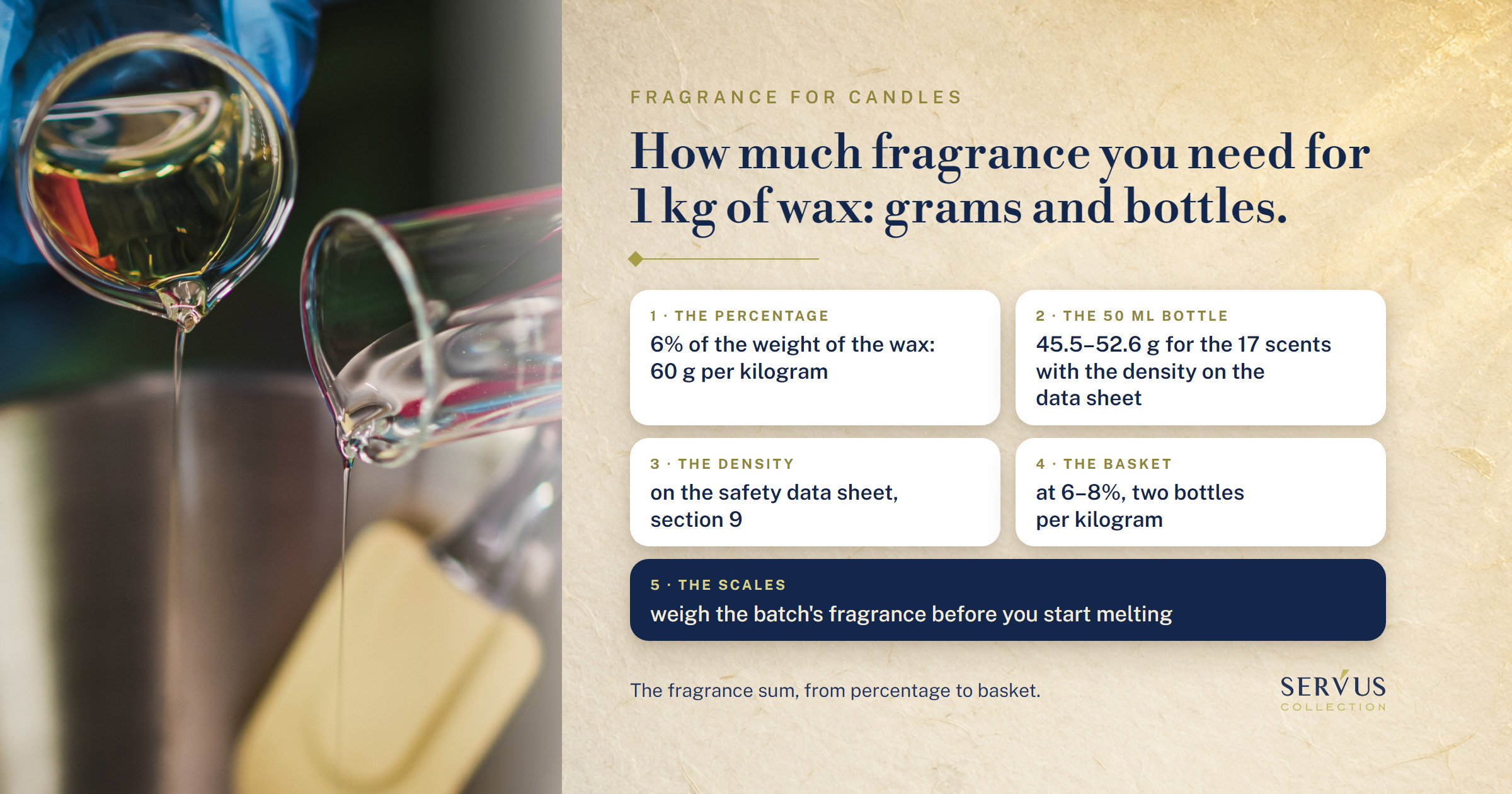
You’ve chosen the wax, you’ve chosen the scent and you’ve read that in a container you put in 6%. There’s one line left to fill in your basket: how many bottles of fragrance. One seems enough for a kilogram, because 50 ml sounds like 50 grams, and that sum only shows itself on the scales, with the wax already melted in the pot.
At 6% of the weight of the wax, the fragrance for a kilogram of wax means 60 grams. A 50 ml bottle holds between 45.5 and 52.6 grams, across the 17 scents on our shelf whose safety data sheet gives the density. So you need between 1.14 and 1.32 bottles, about a bottle and a quarter, and for any of them you put two in your basket.
Below: what the percentage is worked out from and how much fragrance our waxes hold, how many grams are in a bottle of the scents on our shelf, how many candles you get from one bottle and how many bottles you take for 5 kilograms. How much you put in a candle, and why, is in our article on fragrance oil for candles; here is the sum that comes after it, the one for the basket.
I’m Sînziana. We fill the 50 ml bottles on our shelf by volume, and in the workshop we’ve weighed fragrance since 2010 on the same scales as the wax. The densities below are from the safety data sheets of the scents, which French Color & Fragrance International makes for us. The rest is arithmetic, and you can redo it with a pencil.
How much fragrance for a kilogram of wax?
A kilogram of wax takes 50 grams of fragrance at 5%, 60 at 6%, 80 at 8%, 100 at 10% and 120 at 12%. You get the grams by multiplying the weight of the wax by the percentage, with no other correction.
In bottles, at 6% and at 8% a kilogram needs two 50 ml bottles, whichever scent from the table below it is. A single bottle is enough for a kilogram only at 5%, and only for the three scents in the table that are heavier than water: Egyptian Musk, Cashmere Kush and Champagne Rose. At 10%, two bottles are still enough for those three; for the others you need a third.
If you take a single bottle for a kilogram at 6%, you’re 7 to 15 grams short. If you still scent the whole kilogram with it, the batch comes out at 4.6–5.3% instead of 6%, and the figure in your notebook no longer says what’s in the candle. At the burn, you judge the candle by a recipe you didn’t pour.
Is the fragrance oil percentage worked out from the wax or from the whole candle?
The fragrance oil percentage is worked out from the weight of the wax: 6% means 6 grams of fragrance for every 100 grams of wax. That’s how we work it out, and that’s also how two workshop guides from this year define it: the calculation page of the American supplier Lone Star Candle Supply, from June 2026, and the Craftybase guide, from March 2026, which separates the percentage of the wax from the share of fragrance in the finished candle.
The wax data sheet doesn’t say what the ceiling is worked out from. For KeraSoy Container 4130, Kerax only writes that the wax can take fragrance "up to 10–12%". If a recipe works out the percentage from the whole candle, 10% means 111 grams of fragrance for a kilogram of wax, that is 11.1% of the wax. On a wax with its ceiling at 10%, like KeraSoy Pillar 4120, you’ve gone past it without changing a single figure in the recipe.
In this article, we read the ceiling on the data sheet as a percentage of the wax: it’s the reading with less fragrance, so the one that stays under the limit however the manufacturer meant it. Only the wax manufacturer can confirm the exact basis of a ceiling.
The fragrance ceiling of the waxes on our shelf
The fragrance ceiling comes from each wax’s technical data sheet, and for the soy, olive and coconut waxes we sell from Kerax, its upper end sits between 10 and 12%. Above it, the fragrance can separate from the wax: it comes up to the surface as a greasy film, and the burn can go wrong. The table has the waxes for which we read the percentage on the manufacturer’s own data sheet:
| Wax | For | What the manufacturer’s data sheet says | Fragrance for 1 kg, at the upper end |
|---|---|---|---|
| KeraSoy Pillar 4120 | moulds | 5–10% | 100 g |
| EcoSoya Pillar Blend | moulds | 5–10% | 100 g |
| EcoOlive Pillar Blend | moulds | 5–12% | 120 g |
| EcoCoco Pillar Blend | moulds | 5–12% | 120 g |
| KeraSoy Container 4130 | containers | up to 10–12% | 120 g |
| EcoOlive Container Blend | containers | 5–12% | 120 g |
| EcoCoco Container Blend | containers | 5–12% | 120 g |
The third column is the manufacturer’s limit, and your recipe stays below it: we work at 6–8% in containers and at 5–6% in moulds, as we wrote in the article on fragrance oil. At the upper end, a kilogram needs three bottles at 12% and two or three at 10%, depending on the scent. For the waxes on our shelf that aren’t in the table, you open their technical data sheet and look for the line about fragrance; how to read a data sheet without being a chemist is in our article on the wax technical data sheet.
How many grams of fragrance are in a 50 ml bottle?
A 50 ml bottle holds between 45.5 and 52.6 grams of fragrance, depending on the scent, across the 17 scents on our shelf that have the density on their safety data sheet. Millilitres tell you how much room the oil takes up, grams how much it weighs, and what links them is density: 50 ml multiplied by the density on the data sheet gives the grams in the bottle.
Because we fill the bottles by volume, the same bottle shows a different figure on the scales from one scent to another. At 6%, the bottle of Chanel Coco scents 758 grams of wax, and the one of Champagne Rose, 877. If you count 50 ml as 50 grams, you count more fragrance than you have, for almost every scent: of the 17 in the table below, only three go over 50 grams.
What density does each scent on our shelf have?
The scents on our shelf that have the density on their safety data sheet range from 0.91 to 1.05. Most are between 0.93 and 0.99, and three are heavier than water.
| Scent | Relative density, from the safety data sheet | Grams in a 50 ml bottle | Wax scented at 6% | Wax scented at 8% |
|---|---|---|---|---|
| Chanel Coco | 0.91 | 45.5 g | 758 g | 569 g |
| Wild Jasmine & Bamboo | 0.92 | 46 g | 767 g | 575 g |
| Lavender | 0.93 | 46.5 g | 775 g | 581 g |
| Opium | 0.93 | 46.5 g | 775 g | 581 g |
| Orange | 0.93 | 46.5 g | 775 g | 581 g |
| Hot Wine | 0.95 | 47.5 g | 792 g | 594 g |
| Magnolia | 0.95 | 47.5 g | 792 g | 594 g |
| Cinnamon | 0.96 | 48 g | 800 g | 600 g |
| Frankincense & Myrrh | 0.96 | 48 g | 800 g | 600 g |
| Rose | 0.96 | 48 g | 800 g | 600 g |
| Prosecco Rose | 0.97 | 48.5 g | 808 g | 606 g |
| Strawberry Slush | 0.97 | 48.5 g | 808 g | 606 g |
| Jasmine | 0.98 | 49 g | 817 g | 612 g |
| Vanilla | 0.99 | 49.5 g | 825 g | 619 g |
| Egyptian Musk | 1.03 | 51.5 g | 858 g | 644 g |
| Cashmere Kush | 1.05 | 52.5 g | 875 g | 656 g |
| Champagne Rose | 1.052 | 52.6 g | 877 g | 658 g |
You read the table on your scent’s row: for Lavender, the bottle holds 46.5 grams and scents 775 grams of wax at 6%, so for a kilogram you take one more. The last two columns are arithmetic on the density from the data sheet. On the scales they come out a little lower, because some of the oil stays on the walls of the bottle, so when it’s tight you count down. Cashmere Kush is in the table for those who already have it on their shelf; on the site it’s currently out of stock.
Where is the density of a fragrance oil written, and what do you do when it’s missing?
The density of a fragrance oil is in section 9 of the safety data sheet, "Physical and chemical properties", and it’s given on two lines, one under the other. In the English-language data sheets we receive from the manufacturer, the "Density" line may say "Not available", and the figure sits right below it, at "Relative density": that’s how the Opium, Prosecco Rose and Magnolia data sheets look. In the Romanian-language data sheet of Wild Jasmine & Bamboo, the pair is "Densitate: Nu este disponibil" (Density: not available), then "Densitatea: ≈ 0,92" (The density: ≈ 0.92). If you stop at the first line, you think the data sheet has no density.
For seven scents on our shelf, the data sheet really doesn’t give it: Black Cherry, Blue Sage & Hinoki, Coastal Neroli, Eucalyptus Bamboo, Fresh Cut Peony, Into the Woods and Weed Out. For them, and for the scents that aren’t in the table, you can’t get the grams in a bottle from the data sheet or from the table: the lightest of the 17 scents above isn’t necessarily the lightest on the shelf. You find them out on the scales: you put the pot on the scales, tare it, pour in a whole bottle and read the grams.
On the scales, density no longer matters: 60 grams are 60 grams for any scent, and that’s why you weigh the dose straight from the bottle into the pot. You need the density beforehand, to know how many bottles to put in your basket.
How many candles do you get from a bottle of fragrance?
With a 50 ml bottle you scent four or five candles made from 200 grams of wax each at 5%, three or four at 6% and two or three at 8%, depending on the scent. In the examples here, 200 grams is the weight of the wax; the fragrance is added on top of it, so the finished candle weighs more, 212 grams at 6%.
What’s left in the bottle after the last whole candle isn’t enough for another one at the same percentage. If you pour it anyway, you pour it at a different percentage, and you note it down as such, otherwise at the burn you compare it with its sisters and draw the wrong conclusions about the scent.
How many candles of 200 grams of wax do you scent with one bottle?
At 6%, 200 grams of wax take 12 grams of fragrance, so a bottle of Lavender, with 46.5 grams, scents three whole candles and leaves you 10.5 grams. Vanilla, with 49.5 grams, reaches four, just: 48 grams for four candles and 1.5 grams to spare, which you easily lose on the walls of the bottle and the pot.
At 5%, 200 grams of wax take 10 grams. Lavender then reaches four candles, with 6.5 grams left over, and Champagne Rose five.
When you start from the shape you’re filling, the sum turns around: you divide the fill weight of the shape by 1.06 and get the wax for 6%. A round mould of 6 by 8 centimetres, from our guide to your first candle in a mould, holds about 200 grams, so at 6% it takes 189 grams of wax and 11 of fragrance. A 200 ml glass holds about 180 grams of KeraSoy Container 4130, which has a density of around 0.9: at 6%, 170 grams of wax and 10 of fragrance, and a bottle of Lavender is enough for four glasses.
How many bottles do you take for a 5 kilogram batch?
For 5 kilograms of wax you take five or six bottles at 5%, six or seven at 6%, eight or nine at 8% and ten or eleven at 10%, depending on the scent.
| Percentage | Fragrance for 5 kg of wax | Bottles, for the heaviest scent in the table (Champagne Rose) | Bottles, for the lightest scent in the table (Chanel Coco) |
|---|---|---|---|
| 5% | 250 g | 5 | 6 |
| 6% | 300 g | 6 | 7 |
| 8% | 400 g | 8 | 9 |
| 10% | 500 g | 10 | 11 |
For your scent, you divide the grams in the second column by the grams in its bottle and round up. For Vanilla at 6%, 300 divided by 49.5 gives 6.06, so seven bottles; six are enough only for the three scents in the table that are heavier than water. The production kit for moulds has 5 kg of KeraSoy Pillar 4120 and 1 kg of Kerawax 1150 vegetable flakes, and you work out the percentage on the whole blend, that is on 6 kilograms: at 5%, 300 grams of fragrance, six or seven bottles; at 6%, 360 grams, seven or eight bottles, depending on the scent. The kit has no fragrance in it, so you add the bottles yourself.
You weigh the fragrance before you melt the wax
You weigh the fragrance for the batch before you start melting: if it isn’t enough, you find out while the wax is still in the bag. The checks, in order:
- the grams of fragrance for the batch are written in your notebook, as the weight of the wax multiplied by the percentage;
- the bottles are weighed in the pot you pour the fragrance into, with the tare done on the empty pot;
- if the grams aren’t enough, you melt only the wax covered by the fragrance you have: at 6%, 45.5 grams cover 758 grams of wax;
- the batch keeps a single scent.
With the wax already melted and not enough fragrance, you have three ways out, and only the first keeps the recipe. You scent only the wax covered by the fragrance you have and pour the rest unscented, for another batch. You lower the percentage across the whole batch, and then you have a different recipe, which you note down and burn as a new one, because you don’t know in advance how it will come through. Or you top up with another scent, and then you’ve poured a new scent: the blend has its own limit, different from that of each scent, and the burn is retested from scratch, wick included, as we wrote in the article on fragrance oil.
The kit for your first candle in a glass has a kilogram of KeraSoy Container 4130 and a bottle of Lavender, for the recipe with one plain batch and one scented: 25 grams for 500 grams, that is 5%. If you want both batches scented, you need 50 grams, and the bottle holds 46.5. You put the second bottle in your basket from the start.
Before you put the bottles in your basket
The sum fits on one notebook page and you do it once per recipe: the wax, the percentage, the scent. The right percentage for your candle comes from the burn test, and the sum here starts from it.
The sum in three steps
The number of bottles comes out of three lines of arithmetic, which you can do on your phone, next to the basket:
- The grams of fragrance. The weight of the wax, multiplied by the percentage. For 1,000 grams and 6%, that’s 60 grams.
- The bottles. The grams, divided by the grams in your scent’s bottle: from the table or, for scents with no density on the data sheet, from the scales. For Lavender, 60 divided by 46.5 gives 1.29.
- Rounding. Always up. At 1.29 you take two bottles, and you note the 33 grams left over in your notebook, for the next batch.
The steps are the same for a glass, for a mould and for a batch of 30 candles; only the weight of the wax in the first line changes. If you have a wax or a percentage that doesn’t appear here, send us the wax, the percentage and the scent, and we’ll do the sum for you. Write to us on WhatsApp or call us on +40 726 162 810 (we answer in English), Monday to Friday, between 8:00 and 16:30 (Romanian time).
The percentage belongs to the recipe. The number of bottles belongs to the scent, and you find it on its data sheet, before the basket.