 EN
EN  Romana
 Magyar
You poured last night, the surface has set, and the question comes on its own: can I light it? Or, if you sell, when can I put it on the shelf? The answer you find online is a single number, and the number differs from one guide to the next: two days, a week, two weeks.
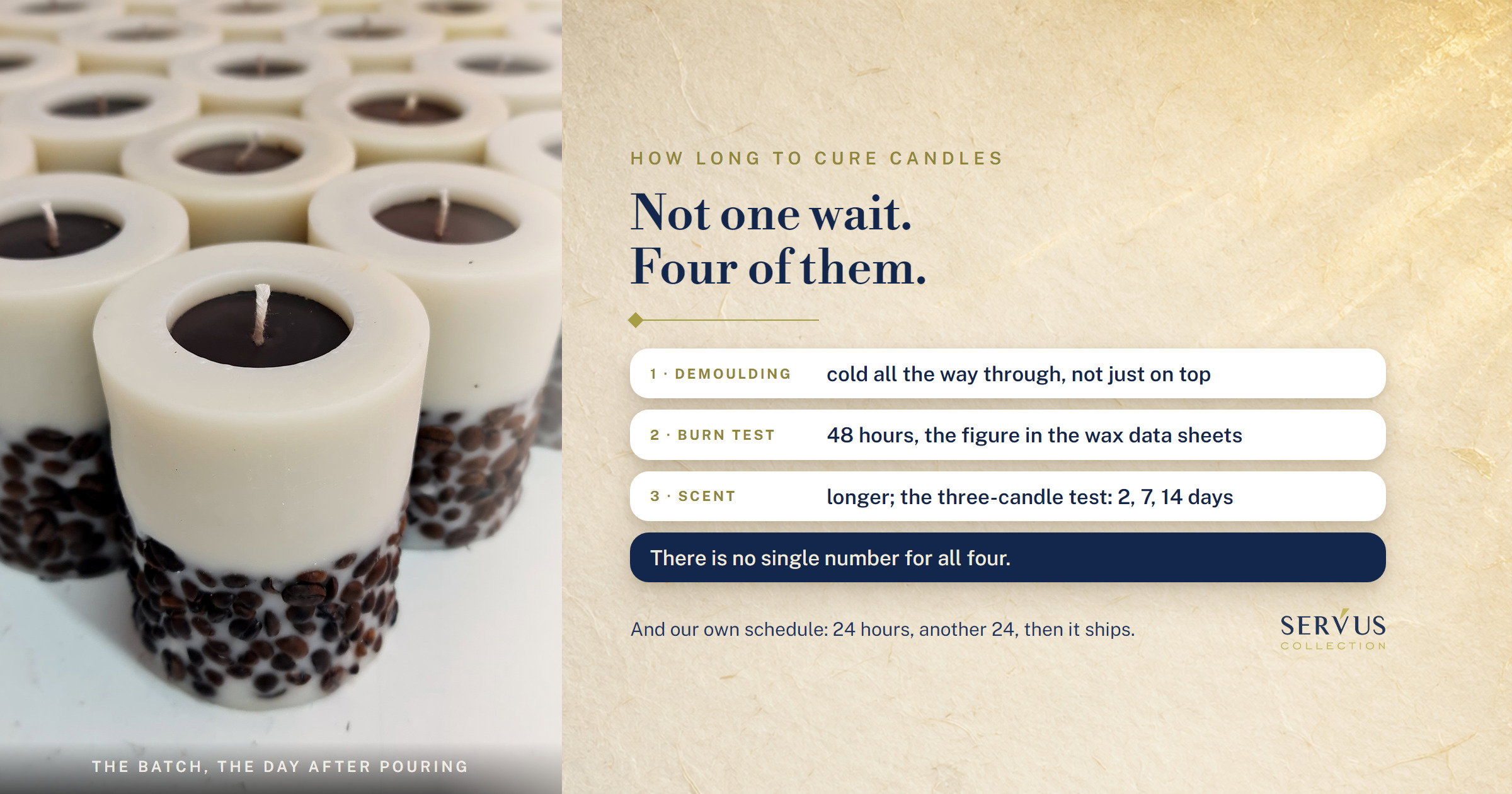
The short answer: it isn’t one wait, it’s four, and each has a clock of its own. Until you take the candle out of the mould, as long as it takes to be cold all the way through. Until you light it for the burn test, 48 hours, the figure from the data sheets of our waxes. Until you judge the scent, in our observations longer: a candle lit at twelve hours smelt weaker than after a week. Until it leaves for the customer, it depends what candle it is; on ours, poured from paraffin with stearin, I tell you below exactly how long. This waiting time after the candle has set is what the data sheets and the guides call curing; that’s the word I use for it here, and, in plainer words, how long the candle stands.
| What you’re waiting for | The benchmark | The condition |
|---|---|---|
| demoulding | cold all the way through, not just at the surface; at our end, on pillars, 24 hours | undisturbed cooling, at room temperature |
| the burn test | 48 hours from pouring | the figure from the data sheets, on the waxes that give one; on the others, our comparison protocol |
| judging the scent | 48–72 hours minimum; in our observations, better after a week | same room, same hour, the three-candle test |
| shipping | as long as your test showed you; at our end, on unscented pillars, the day after demoulding | recipe and model already validated |
Below: what the data sheets say and what they don’t; why the scent can come later than the setting; the three-candle test, through which you make a benchmark on your recipe, not on someone else’s; and how these days fit into your calendar, if you sell.
I’m Sînziana. In our workshop in Maramureș, Romania, we’ve been pouring candles since 2010, and we sell on the waxes, wicks and fragrances we work with. The figures here come from the manufacturers’ data sheets, from our pages and articles and from the way we work ourselves; where a figure is only someone else’s, I tell you it’s theirs.
How long to cure candles before burning them for the first time?
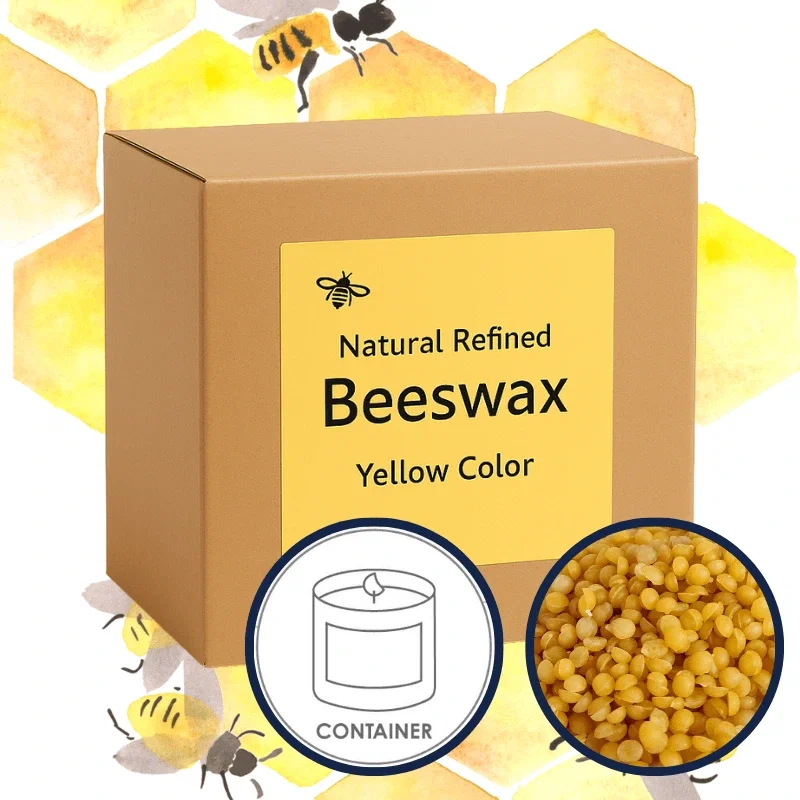
48 hours, on those of our waxes that give a figure. The data sheets for the KeraSoy 4130 and KeraSoy 4120 soy waxes, for the EcoCoco coconut waxes for containers and for moulds, and for the EcoOlive olive waxes say the same thing: the candle is left to cool undisturbed, at room temperature, and the burn test is done after 48 hours; you’ll find the data sheets under Download, on each wax’s page. None of them makes a distinction between a scented batch and a plain one, so I don’t make one either. On the waxes where the data sheet says nothing about it, beeswax, paraffin, stearin, 48 hours is our comparison protocol, not a manufacturer’s requirement: I wait for them just the same, so I can put the candles side by side under the same conditions.
What happens in the wax after the surface has set
The surface sets in a few hours; the candle doesn’t. Under the crust, the wax goes on cooling, shrinking and settling its structure, and if it’s scented, the mix of wax and fragrance goes on stabilising after the top looks finished. The data sheets don’t describe the process, they only give the 48 hours, without separating the burn from the scent; what you see is its effect: the hollow by the wick that appears overnight, the white patch that comes out on soy the next day, the shade of the dye that darkens compared with the evening you poured. A burn test done two hours after pouring tells you about a wax that’s still settling, not about your candle.
Demoulding isn’t curing
They’re two different waits, and the first is the shorter one. You take the candle out of the mould when it’s at room temperature all the way through, not just at the surface: you put your hand on it and on the base and it feels no warmer than the table. For our candles of paraffin with stearin that means 24 hours from pouring, during which the shrinkage hollow also gets topped up; only then are they taken out, finished and trimmed. The wax data sheets don’t give a demoulding time, they give undisturbed cooling and the 48 hours until the first burn test, which is something else. So the candle can be out of the mould, finished and beautiful, and still not be ready to light.
Why 48 hours on the unscented candle too
Because the burn test measures the wick against the wax, and the wax has to be in the state it will burn in at the customer’s, not the one it’s in a day after pouring. On our wick pages we write the same thing for every wax: with a new batch, one test piece, lit at 48 hours. If you light it earlier and the melt pool comes out wider or narrower than on the candle from a week later, you don’t know whether it was the wick or the unsettled wax. How the test piece burns and what you note down on it is in the article on the burn test.
How long to cure scented candles: why does it smell stronger after a week?
Because, in what we’ve seen, the scent settles more slowly than the wax. The 48 hours are the data sheets’ threshold for the burn test; for the scent, our minimum protocol is 48–72 hours, and we saw the difference later: at our end, a candle lit at twelve hours smelt weaker than the same candle a week on. It’s a workshop observation, not a controlled comparison: between the two lightings both the days changed and the fact that the candle had already burnt once, so I can’t put the difference down to the days alone. We don’t have a measurement in days for every wax and every fragrance; we have this observation, repeated, and that’s why we don’t judge a new fragrance the next day.
The case of the candle lit the next evening
You weighed the fragrance, you kept to the temperature on the wax’s page, you left the candle overnight and lit it the next evening. In the room you can barely smell it, while the shop-bought candle, with the same scent on the label, could be smelt from the hallway. Someone who has ordered from us more than ten times told us so in an interview this summer: “I haven’t found the right percentages”, and the candles “aren’t as dense”. The first suspicion is always the percentage. Before you follow it, you check a cheaper hypothesis: the days. A candle judged the next day may not be ready yet, and then the percentage had no way of showing its measure. The other places where the scent gets lost, the glass, the scales, the melter, the wick, are in the article on fragrance oil for candles.
What the American guides say and why we don’t copy their figure
They say more than we do. An American workshop guide from August 2026 gives one to two weeks for soy, three to seven days for coconut and 24–48 hours for paraffin. Those are the ranges the author works with, not a report of measurements, and he gives nothing for beeswax. The direction is the same as ours: soy asks for more than paraffin. The figures we don’t copy, because they belong to their waxes, their fragrances and their rooms. Your benchmark you make on your recipe, and the test is below.
Lid on or lid off, during the waiting days
We don’t know. It’s a question I often see from makers abroad and we have no measurement of our own on it, so I won’t give you an answer I haven’t checked. What we do: the candles stand at room temperature, away from the sun and the radiator, with no draught, as the data sheets ask for cooling. If you want to find out, put it into the test below as the second variable, but not in the same test as the days.
The three-candle test: the candle cure time of your own recipe
You pour three identical candles from the same batch and light them at two days, at a week and at two weeks from pouring. The difference between them gives you a benchmark for your combination of wax, fragrance and glass: not the exact threshold, but the best of the three moments tried. It costs three pieces from the batch you were making anyway and three evenings; if you make your production lead time out of it, you repeat it on the next batch before you write it in the calendar.
How you do it so you can compare
Three pieces from the same pour, the same wick, the same glass or the same mould, with the pouring date written on the base. They all stand in the same place, at room temperature. You light them in turn, in the same room, at the same hour of the evening, one at a time, so that the scent of one doesn’t mix with another’s: the first at 48 hours, the second at seven days, the third at fourteen. Before each lighting you trim the wick to the same length, 1 cm at most, so you’re not comparing two different wicks. Each burns for two hours with the door closed; the two hours are the window in which you watch it, not the validation of the burn to the bottom. The lit candle isn’t left alone: either you stay by it and the scent is judged by a second person who comes into the room after an hour, or you go out for ten minutes and someone stays by it while you’re out. What you note: how much you can smell it on entering the room, what the melt pool looks like at two hours and what you saw in the flame. The sheet to note it on, with the line you write at each lighting, is the one in the article on the burn test; here you add a single column to it, the day since pouring.
One thing only changes between the three: the day. If you change the wick and the dose as well, you no longer know where the difference comes from, the rule from all our wick articles.
How you read the result
If the second smells clearly stronger than the first, and the third the same as the second, your benchmark is a week: among the three moments tried, that’s where you gained nothing more by waiting. If the third is stronger still than the second, your combination is still gaining after a week and a later moment is worth trying. If all three smell the same, on the scent of this test you gained nothing beyond 48 hours; the burn to the bottom you still check separately. If none of them smells, extending to fourteen days didn’t solve the problem in this test, and you look at the percentage, the wick and the temperature you added the fragrance at, in the article on fragrance oil. The benchmark belongs to the combination of wax, fragrance and glass: with a new wax, a new fragrance or a new batch of wax it’s done again, as we wrote in the article on the recipe that no longer works with a new batch.
How the days go into the calendar, if you sell
The waiting days aren’t added at the end, they’re put at the start, in the calendar. A burn test taken to the bottom, on our 5.5 cm candles, takes about eight days from pouring: 48 hours of rest plus the evenings of burning, as we worked out in the article on Christmas fragrance. If your recipe asks for a week for the scent, the test batch is poured two to three weeks before the day you want to sell it, not two days.
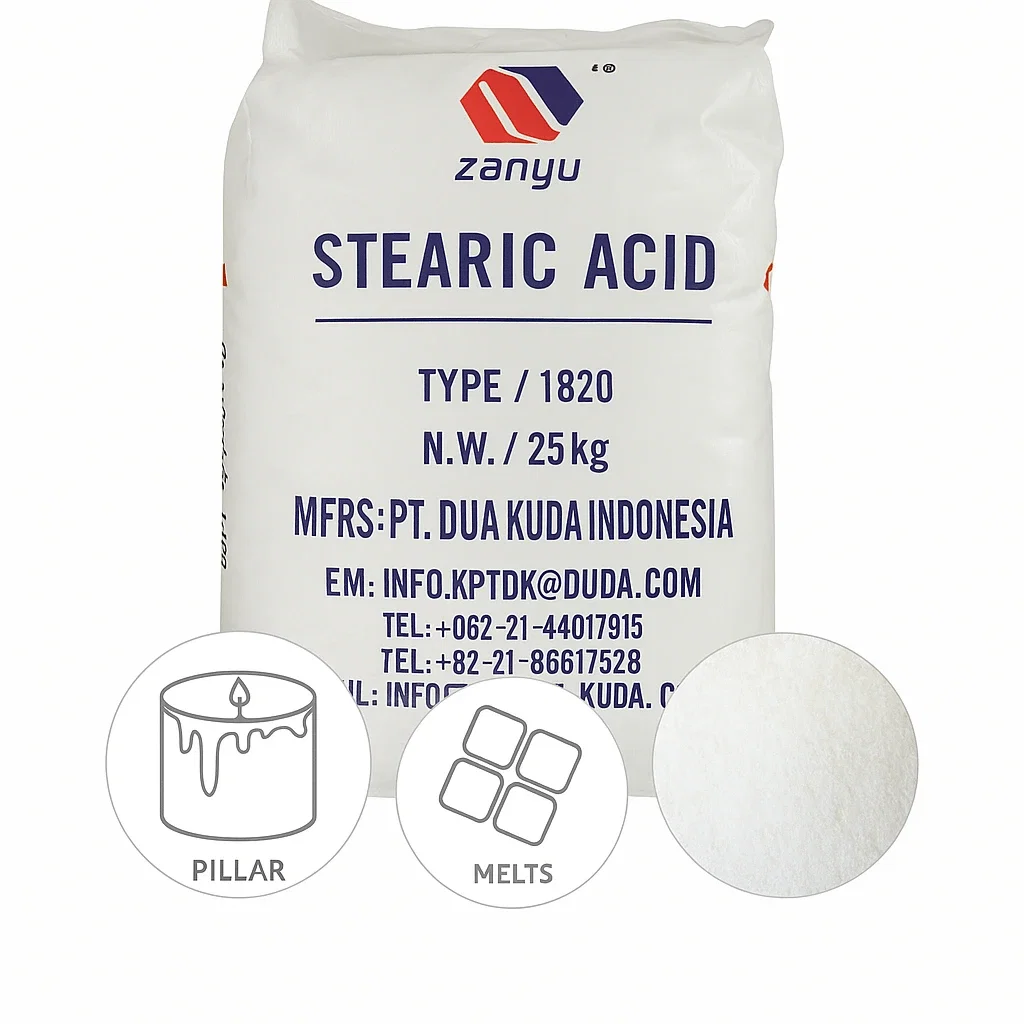
At our end, on candles poured from paraffin with stearin, unscented, on models and recipes we’ve been pouring for years, the calendar is short and fixed: 24 hours from pouring for topping up and setting, then they come out of the mould, are finished and trimmed, and after another 24 hours they leave for the customer. That is, two days from pouring to shipping. It’s the execution time of a validated recipe, on paraffin with stearin, without fragrance; it isn’t the time in which a new recipe is worked out, and don’t carry it over to scented soy. There, between pouring and shelf, put as long as the three-candle test showed you, repeated, not as long as would suit you.
If you’ve done the test and still aren’t getting what you want, write to us on WhatsApp or call us at +40 726 162 810, where someone who speaks English answers, with the wax and its batch, the fragrance and the percentage, the wick, the glass or the mould, and the three lines from your sheet, and we’ll look at it together.
The candle is ready when it’s ready for what you want from it: for demoulding when it’s cold all the way through, for the burn test after as long as the wax data sheet asks, for the scent after as long as the test showed you. A single number for all four doesn’t exist, and whoever gives you one hasn’t lit your candle.