 EN
EN  Romana
 Magyar
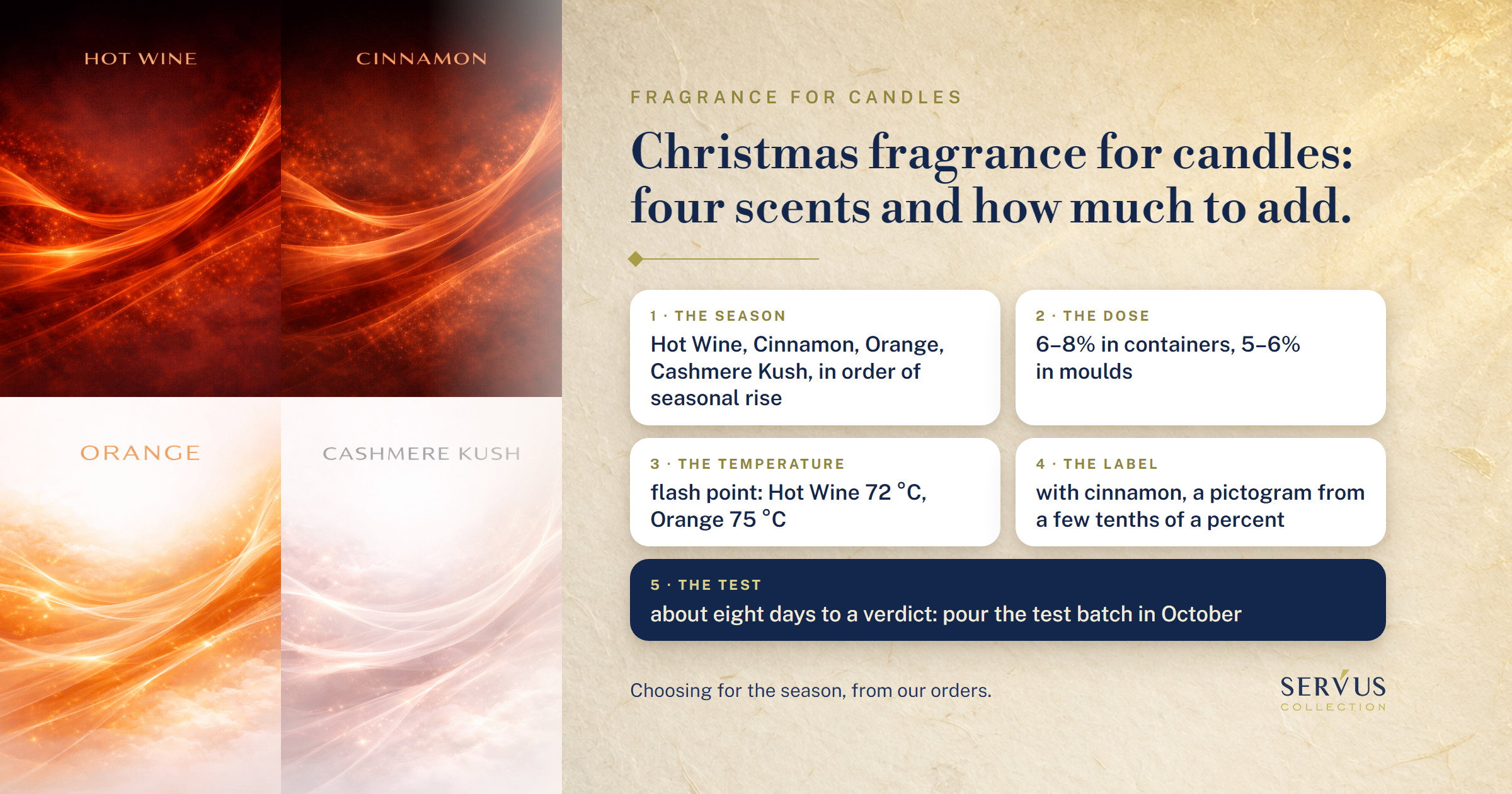
You’re getting your Christmas batch ready and you have the list of scents in front of you. They all sound wintry by name, and you order the bottle once, for the whole season. If you choose wrong, you find out in December, with the candles already poured.
In our orders from last year, four scents on our shelf clearly rose in season: Hot Wine, Cinnamon, Orange and Cashmere Kush. In a container you use them at 6–8% of the weight of the wax, in a mould at 5–6%. Three of them need a pictogram on the candle label from a few tenths of a percent, and a burn test taken all the way down can take about eight days, so the test batch is poured in October.
Below: how much the scents rose in season and what’s in each one, how many grams and how many bottles you need, at what temperature you add them, what goes on the candle label and when you start the test. How the percentage is worked out and how much fragrance each wax holds is in our article on fragrance for a kilogram of wax; here is the choice for the season.
I’m Sînziana. We sell fragrance oils from French Color & Fragrance International, and we’ve been pouring candles in our workshop in Maramureș, Romania, since 2010. The seasonal ranking below is counted from our orders, the composition and the limits are from the safety data sheets and the IFRA certificates of the scents, and the label thresholds come from our CLP label calculator.
Which Christmas fragrance for candles sells in the season?
In October–December 2025, compared with the months of this year, Hot Wine rose the most in our orders, followed by Cinnamon, Orange and Cashmere Kush. Lavender and vanilla, the scents that sell all year round, rose much less in the same months.
| Scent | The profile, from the components on the safety data sheet | Place in the seasonal rise |
|---|---|---|
| Hot Wine | mulled wine: cinnamon, orange peel, cloves, a sweet note of coumarin | 1 |
| Cinnamon | gingerbread cinnamon, with cloves, caramel and cardamom | 2 |
| Orange | warm orange, with cinnamon, vanilla and musk | 3 |
| Cashmere Kush | soft and woody: ambery wood, cedar, sandalwood, vanilla, musk | 4 |
Three have spice in them, one is wood. If you’re making a winter collection from two scents, you already have the two directions our customers chose last year.
How we counted the season
We added up the millilitres of fragrance oil sold for each scent, month by month, leaving out cancelled or returned orders. Then we set the monthly average for October, November and December 2025 next to the monthly average for January–September 2026, on the same product.
We compare with this year, not with spring 2025, because Hot Wine and Cinnamon only reached our shelf in September 2025. October–December was their first season. Lavender and vanilla, which sell all year round, give us a benchmark. The much bigger difference for the four scents shows seasonal interest in our orders, but it doesn’t separate the season from the launch, from stock or from promotions. And the rise isn’t the volume: in millilitres sold in the season, the order was Orange, Hot Wine, Cinnamon, Cashmere Kush.
Why does Orange smell of winter?
Orange smells of winter because it has cinnamon in it: cinnamaldehyde, the cinnamon note, is at 5.2–10.4% of the composition, next to orange oil, at 8.7–17.4%. Eugenol adds the cloves, and vanillin rounds it off. It isn’t a dry orange, all peel, but the spiced orange on the Christmas table.
We poured Cinnamon in the workshop on 16 June, in a production pour, and in the notebook we wrote, at pouring, "strong smell of cinnamon or gingerbread". The composition gives a possible explanation: eugenol, the clove note, is at 5.15–10.8%, above cinnamaldehyde, at 2.35–4.85%, and ethyl maltol adds a burnt sugar. The higher percentage doesn’t tell you on its own which note you smell first, but it fits the gingerbread in the notebook.
Cashmere Kush is the only one without spice. The ambery wood comes from OTNE, which is 30.4% of the scent, and cedar, sandalwood, vanilla and musk give it its base.
When did the seasonal orders come in?
For Cinnamon, the peak was in October, for Hot Wine in November. In December, both dropped sharply. Orange held until December, and Cashmere Kush until January.
Read from the workshop side: the orders for cinnamon came one or two months before the holidays, as long as you need to pour, wait and sell. If you start in December with a recipe not yet validated, the time for tests, adjustments and selling shrinks a lot.
How much winter fragrance oil do you put in a candle?
In our formulas, winter fragrance oil goes in at 6–8% of the weight of the wax in containers and at 5–6% in moulds, and for your first scented candle you start from 5%. You start from the same percentage for all four: the IFRA certificate sets no limit for candles for any of them, so the ceiling comes from the wax, and the final dose comes from the test.
What dose do we use in containers and in moulds?
In containers we work at 6–8%, in moulds at 5–6%, the percentage worked out from the weight of the wax: for a kilogram of wax at 6%, you put in 60 grams of fragrance. Above our formulas sits the ceiling on your wax’s data sheet, which differs from one wax to another: 5–10% for KeraSoy Pillar 4120, for moulds, up to 10–12% for KeraSoy Container 4130, for containers.
A fragrance put in above what the recipe can carry changes the burn too, not just the scent, as we wrote in our article on what fragrance changes in a candle. Start from 6% in a container, raise the dose only if the test shows a scent that’s too weak, and confirm the new dose with a burn as well.
At what temperature do you add Hot Wine and Orange?
You add them at the fragrance-adding temperature on your wax’s data sheet, with the pot off the heat, like any fragrance. The difference is in the flash point: Hot Wine has it at 72 °C, Orange at 75 °C, and Cinnamon and Cashmere Kush above 93 °C.
The flash point is safety information for handling, not the fragrance-adding temperature. Many recipes add the fragrance between 65 and 75 °C, so for Hot Wine and Orange the figure on the safety data sheet falls right inside that range. The rule stays the temperature on the wax’s data sheet. For these two we also check, on the thermometer, not by eye, that the temperature chosen from the data sheet is below the scent’s flash point.
How many bottles do you take for the seasonal batch?
At 6%, a kilogram of wax needs two 50 ml bottles of any of the four scents, and 5 kilograms need seven bottles, or six of Cashmere Kush. The difference comes from density: we fill the bottles by volume, so the grams in a bottle differ from one scent to another.
| Scent | Density, from the safety data sheet | Grams in a 50 ml bottle | Bottles for 1 kg of wax, at 6% | Bottles for 5 kg of wax, at 6% |
|---|---|---|---|---|
| Orange | 0.93 | 46.5 g | 2 | 7 |
| Hot Wine | 0.95 | 47.5 g | 2 | 7 |
| Cinnamon | 0.96 | 48 g | 2 | 7 |
| Cashmere Kush | 1.05 | 52.5 g | 2 | 6 |
Five kilograms at 6% means 300 grams of fragrance. Divided by 47.5 grams, what a bottle of Hot Wine holds, that gives 6.3, so you take seven bottles and note the rest in your notebook. At 8%, the sum works the same way, with 400 grams.
The candle label for winter scents
A candle scented with Hot Wine, Cinnamon or Orange needs on its label the exclamation mark pictogram, the word "Warning" and statement H317, "May cause an allergic skin reaction". For Hot Wine and Orange these lines already appear at 0.1% oil in the candle, the lowest percentage our calculator accepts, so their threshold is at 0.1% or below. For Cinnamon they appear from about 0.21%, and Cashmere Kush needs them only from 3.3%.
Why does cinnamon need a pictogram from the first gram?
Cinnamaldehyde and eugenol, which give the cinnamon and the cloves, are skin sensitisers, and in these scents they’re at high percentages. Diluted in wax, they still cross the threshold from which the candle gets H317, at a few tenths of a percent. In a kilogram of candle, 0.1% means one gram of oil.
| Scent | First percentage in the calculator at which H317 appears, with the pictogram and "Warning" | First percentage in the calculator at which the environment pictogram appears | At 6% of the wax, that is 5.7% of the candle |
|---|---|---|---|
| Hot Wine | 0.1% | doesn’t appear | pictogram, "Warning", H317 |
| Cinnamon | 0.3% | doesn’t appear | pictogram, "Warning", H317 |
| Orange | 0.1% | doesn’t appear | pictogram, "Warning", H317 |
| Cashmere Kush | 3.3% | 7.6% | pictogram, "Warning", H317 |
The calculator goes in steps of a tenth, so for Cinnamon it shows the lines from 0.3%, the first step above the threshold of about 0.21%. The thresholds are a percentage of the whole candle, the way the calculator works them out, not of the wax. For Cashmere Kush, 7.6% of the candle is about 8.2% of the wax, so at our 6–8% formulas the environment pictogram doesn’t appear.
You get the full label, with the precautionary statements and the names of the allergens, from the CLP label calculator: you choose the scent and the percentage and print it from the page. What else you write on the candle, apart from the hazard lines, is in our article on the candle label.
What does "Danger" on the Orange bottle mean for your candle?
Nothing on the candle label: "Danger" on the Orange bottle comes from statement H304, "May be fatal if swallowed and enters airways", the oil’s hazard if it is swallowed and breathed in, and the candle doesn’t take it on. The calculator doesn’t give "Danger" at any percentage up to 20%.
On the bottle, though, H304 stays. The oil is kept in its own container, closed, away from children, and is never poured into a drinks bottle of any kind. The UFI code on our bottle belongs to the oil and isn’t copied onto your candle.
Before the Christmas batch
Choosing the scent is the short part. The long part is the test: the test candle has to burn all the way down before you pour the full batch.
The burn test is done in October
A test candle 10 centimetres high and 5.5 centimetres in diameter, the size of our candles, burns for around 24 hours, plus 48 hours of rest after pouring. A wider or taller glass burns longer. With sessions of no more than four hours, that comes to about eight days from pouring to verdict, as we wrote in our article on the burn test.
Before the test, you choose the wick by the diameter of the glass and by the wax, in the wick calculator. Then you confirm it on the recipe with the winter fragrance in it, not on plain wax. For the seasonal test you note down:
- the scent, the batch number on the bottle and the percentage weighed;
- the wax, the wick and the diameter of the glass;
- the temperature at which you added the fragrance;
- how long each session burned and how the scent came through cold and while burning.
If the test doesn’t turn out as you expected, send us the scent, the wax, the percentage and the wick, and we’ll look at it together. Write to us on WhatsApp at +40 726 162 810 (we answer in English), Monday to Friday, between 8:00 and 16:30 (Romanian time).
You choose the scent by what your customers ask for. You choose the date you order it by how long the test takes.