 EN
EN  Romana
 Magyar
You weighed the fragrance, you kept to the temperature on the wax page, you let the candle cool overnight and you lit it the next evening. In the room you can barely smell it. The shop-bought candle, with the same scent on its label, could be smelled from the hallway. Someone who has ordered from us more than ten times told us as much in two sentences, in an interview this summer: "I haven’t found the right percentages", and the candles "aren’t as dense" (translated from Romanian).
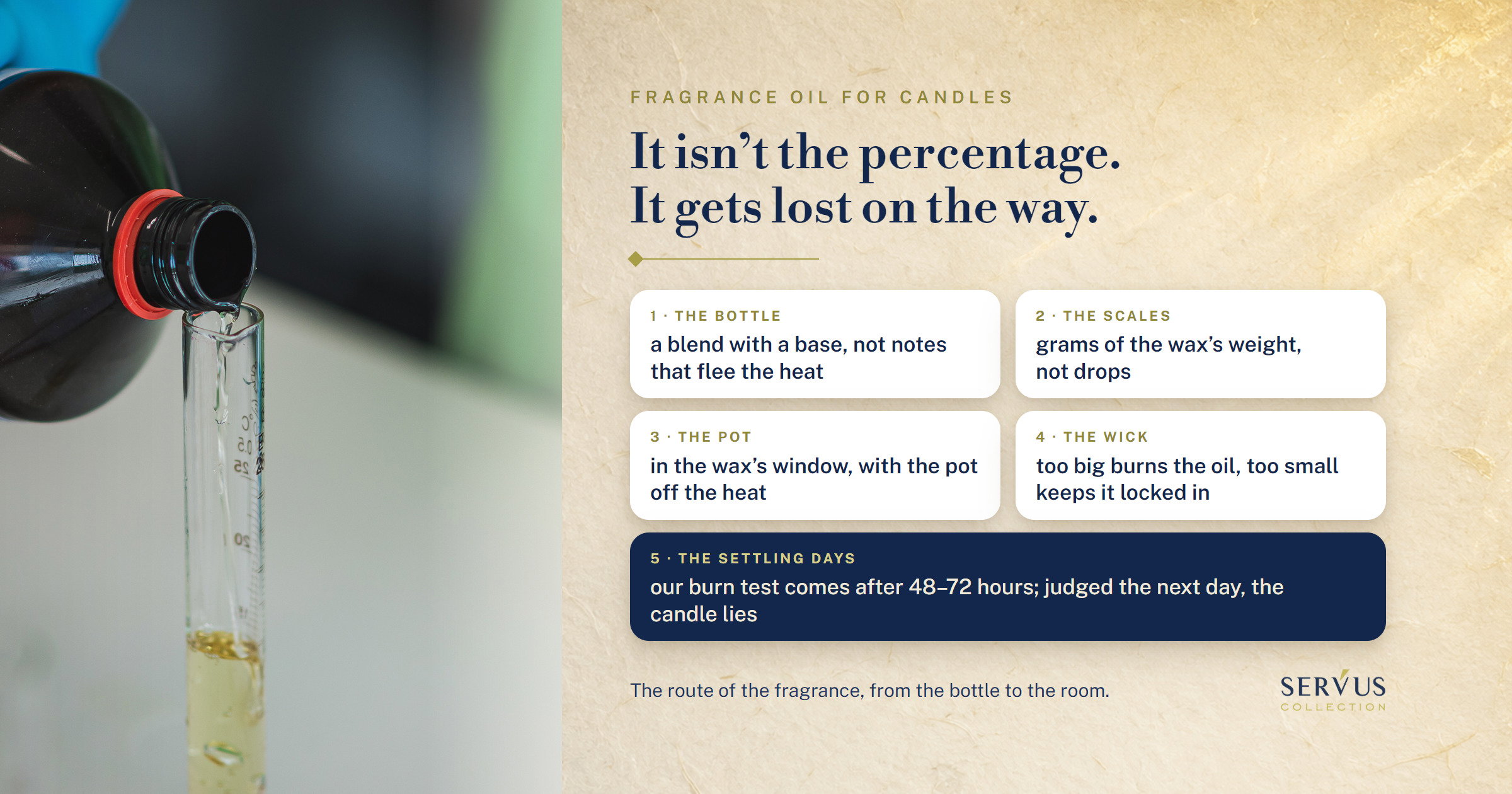
The fragrance in a candle reaches the room if it passes through five places without getting lost on the way: the bottle, the scales, the pot, the wick and the days after pouring. The percentage is only the second of the five. In our container formulas it’s 6–8% of the weight of the wax, and most of the time it isn’t the percentage that’s missing.
Below: how much you put in and how you weigh it, at what temperature and in what order the fragrance goes into the wax, why it doesn’t come through when burning and what you check first, and how safe it is, in the bottle and in the candle. Each chapter has its own longer article; here is the whole route, in the order the fragrance travels it.
I’m Sînziana. In our workshop in Maramureș, Romania, fragrance has been weighed since 2010 on the same scales as the wax, and the scents on our shelf are the ones we pour with ourselves. What follows is what I check, in order, when someone writes to me that their candle doesn’t smell.
How much fragrance oil do you put in candles so it comes through without sweating?
In our formulas, 6–8% of the weight of the wax in containers, 5–6% in moulds and 4–6% in figurines, and for your first scented candle you start from 5%. The ceiling isn’t a general figure: your wax’s data sheet gives it. Above it, the fragrance no longer fits in the wax, comes up to the surface as an oily film, and the burn suffers.
The two limits that matter sit in two different documents, and we’ve put them side by side in our guide to choosing a wax: the wax’s data sheet says how much oil the wax can hold, the IFRA certificate says how much you’re allowed in your product category. As a ceiling, you don’t go past either; your recipe may call for even less. On the waxes we work with, it looks like this:
| Wax | How much fragrance it holds, by its data sheet | In our formulas |
|---|---|---|
| KeraSoy 4130, soy for containers | 10–12% | 6–8%; first candle from 5% |
| KeraSoy 4120, soy for moulds | 5–10% | 5–6%; figurines 4–6% |
| Coconut for containers | 5–12% | 6–8% |
For figurines we go below the data sheet’s minimum because heavy fragrances make the wax brittle and the tips break off when you unmould. The middle column is the manufacturer’s, the right-hand column is ours: what we poured and what worked for us, not a rule for every workshop.
An American materials supplier wrote it too, in a guide from June 2026: wax holds only so much oil, and the surplus separates instead of adding scent. It’s also what we measured on Ginger Cookie, our winter scent: 6% in container soy and coconut, 5% in moulded candles, a tested maximum of 8%, and above 6% we no longer saw a clear gain in scent.
Why doesn’t "100% allowed" by IFRA mean "put in as much as you like"?
Because the IFRA certificate answers a different question. The standard works out its limits from skin exposure, for each kind of product separately, and candles sit in category 12, products not intended to come into contact with the skin, where the limit is no longer calculated, as the guidance for the use of IFRA Standards says. It says nothing about how much oil your soy holds, how the candle will burn or how much smoke the wick makes when the wax is saturated.
How to read a certificate in thirty seconds is in our article on IFRA. Here, just remember the order: IFRA tells you how much you’re allowed, the wax’s data sheet how much it can take, your recipe how much it needs. Three different figures, and only the last one is yours.
And one thing we usually find out after it has happened: a blend of two scents is a new scent. Its limit isn’t the average of the two, and the burn is retested from scratch, wick included.
How you weigh the dose: grams of the wax’s weight, not drops
The percentage is worked out from the weight of the wax, on the scales, not from volume and not in drops. For 500 grams of wax, 5% means 25 grams of fragrance, 6% means 30, 8% means 40. A kitchen scale with one decimal place is enough; drops aren’t, because a drop of vanilla and a drop of orange don’t weigh the same.
A 50 millilitre bottle doesn’t hold 50 grams. The density is on each scent’s data sheet, and for three on our shelf it’s 0.93 for Lavender, 0.96 for Cinnamon and 0.99 for Vanilla, so a bottle holds around 46–50 grams of oil. The sum we do at support: at 6%, one bottle is enough for a batch of about 800 grams of wax; at 8%, for about 600.
House rule: the bottle over the pot, the pot on the scales, the figure written in your notebook before you pour. A batch you didn’t weigh can be neither repeated nor fixed.
Why isn’t your candle as "dense" as a shop-bought one?
Usually not because of the percentage, but because of the things around it. The person at the start of this article puts in the percentage of oil and still finds the candles less dense than shop-bought ones. When we check together, the cause is often somewhere else: the fragrance is built from notes that leave at the first warmth, it was added too hot or too cold, the wick burns the oil before releasing it, or the candle was judged the next day, when the fragrance hadn’t yet settled into the wax.
More fragrance fixes none of the four. The next chapters fix them, one by one. And the shop-bought candle has a part you don’t see: between its pouring and the evening you lit it, weeks usually went by, not one night.
When and how do you add fragrance to the wax?
Between melting and pouring, in the temperature window on your wax’s data sheet, with the pot off the heat, stirred slowly for a minute or two, after the dye and before the test drop on a white worktop. In our container soy, the fragrance goes in at 60–65°C, on the way down to pouring. Added too hot, it loses its delicate notes. Added too cold, it can mix poorly or separate, with oil on the surface.
At what temperature do you add fragrance to wax?
At the temperature in your wax’s table, not one borrowed from another wax. In our table, measured with the probe in the wax, for container soy the fragrance goes in at 60–65°C, and pouring comes after, at 45–55°C for KeraSoy 4130, as the wax page says; for moulding soy, the fragrance goes in at 65–70°C. Each wax’s row is in our temperature guide and on the wax’s page.
The window comes from the wax’s data sheet and your test, not from the fragrance’s data sheet. The flash point on the fragrance’s safety data sheet, around 91–93°C for the three scents above, is a safety figure: the temperature from which its vapours can catch fire from a flame. We add the fragrance with the pot off the heat and below this figure, as the Vanilla scent’s page also says, but it isn’t the adding temperature. You see the other end in the candle: with Ginger Cookie, below 58°C, we saw oil on the surface. The American supplier above works hotter than we do with soy, at about 82°C; we’ve stayed at 60–65, because in our tests, at 80, we lost the delicate notes of the scents we work with. It isn’t a law, it’s our table, confirmed on our batches, with the thermometer in the wax.
In what order do the dye and the fragrance go in?
The dye first, while the wax is hot, at around 70°C for soy, the fragrance after, when the wax has come down into its window, and the test drop on a white worktop at the end, with both in. It’s our working order, the one in our first candle recipe, and it has a reason you only see in the finished candle: fragrance shifts the colour.
Heavy notes, vanilla, caramel, wood, spices, pull the wax towards cream. The Vanilla scent’s page says it in black and white: at 5% in the wax, white wax turns cream-beige. That’s why the test drop goes on the worktop after you’ve added the fragrance too, not before, and the other colour-dosing mistakes are in our dye guide. The order in which you melt two or three waxes is another story, told in our article on melting order.
Why stir for two minutes, not three turns?
Because the fragrance has to be spread evenly through all the wax, not just carried around in it. Our rule, from the article on scent throw, is two minutes of continuous, slow stirring, without working in air. Three turns of the spoon leave the oil in layers, and the layers show the next day: a film on the surface, sometimes droplets on the sides.
The sign is easy to read. For oil on the surface after cooling, the causes we check first are three: wax too cold when the fragrance went in, stirring too short, a percentage above what the wax holds. You rule them out one at a time, on the next batch, not all three at once. And after stirring, five minutes of stillness before pouring, as the temperature guide says: the bubbles rise, the temperature evens out.
Why can’t you smell the fragrance when the candle burns?
For four reasons, which we check in this order: the fragrance is made of notes that leave at the first warmth, the wick burns the oil instead of releasing it, the candle was lit before the fragrance settled, or the room is too big for it. The dose comes only after all four, and it’s rarely the dose.
The smell in the bottle and the smell in the room are two different things, and the customer buys the second. The full mechanism, with the three layers of a fragrance, is in why your candle has no scent when it burns.
The spoon test: thirty seconds before a kilogram of wax
A drop of fragrance on a metal teaspoon, a few seconds of heat, then you smell. A heat gun is safer than a flame next to a concentrated fragrance, and either way, keep your head out of the vapours. The heat drives off the top notes and shows you what’s left, that is, what the room will smell when the candle burns. Four results, the way we read them: sour or plasticky, the fragrance doesn’t hold up to heat; it disappears in a second or two, it has only top notes and will smell weak when burning; it opens up and fills the air, it has a base; it leaves an oily film on the metal, it’s dense and stable, but it needs the right wick.
It’s our rough test, not a safety test and not a lab one: it doesn’t replace the test candle, it shortens the work. Whatever smells burnt or plasticky on the spoon doesn’t go into a candle of ours, with any wax or any wick. That’s why we do it before, not after.
Why does the wick decide how much scent reaches the room?
Because the wick is the engine that releases the fragrance, and a wick that’s too big can overheat the melt pool and changes the way the fragrance leaves it. Our wick guide for containers has the benchmark we work with: if the layer of liquid wax under the flame goes deeper than 0.5 cm, the wick is oversized for that glass, the oils overheat and evaporate suddenly, and the room is left with no scent or with a chemical smell. The customer says "the fragrance didn’t last". The wick burned the fuel too fast.
The other way round, a wick that’s too small doesn’t take the melt pool out to the sides, and the fragrance stays locked in the wax that didn’t melt. How you read the melt pool at the first burn, and why the first hour doesn’t tell you anything yet, is in the first burn of a candle. And the rule everyone forgets: fragrance changes the thermal behaviour of the wax, so when you change the scent you redo the wick test, even on the same wax and in the same glass.
How long do you wait after pouring before you judge the scent?
Our minimum test protocol for a scented candle is 48–72 hours from pouring, not the next day. The blend of wax and fragrance keeps stabilising after the surface has hardened, and in our workshop a candle lit at twelve hours smelled weaker than the same candle a week later. An American workshop guide from August 2026 gives longer intervals than ours: one to two weeks for soy, three to seven days for coconut, 24–48 hours for paraffin.
You find your own figure yourself, and it’s free: you pour three candles from the same batch and light them at two days, at a week and at two weeks. The difference between them is the answer, for your wax and your scent, not for someone else’s.
How safe is the fragrance, in the bottle and in the candle?
The concentrate in the bottle has hazard classifications on its label and in its safety data sheet, and we treat it like any chemical in the workshop: gloves, cap back on, top shelf, nothing to eat nearby. The candle is a different exposure: 5–8% fragrance in a kilogram of wax, burned, not touched. The two are often confused, in both directions, and that’s why we separated them in a whole article, with three data sheets open on the table.
On the route here, safety is a single step: the fragrance goes into the wax with the pot off the heat, with no open flame nearby, with the thermometer in the wax and the window open; its safety data sheet is read before, not after. For the home where the candle burns, with a small child or a cat, the five house rules are in that article.
Are fragrance oils natural, and does it matter?
They aren’t natural, and safety doesn’t depend on that. A fragrance oil is built by a perfumer from plant materials and lab molecules, so that it holds up to heat. An essential oil is something else: a volatile extract from a plant, not a built composition, and it’s precisely essential oils that are on the list of oils that have poisoned cats. What decides, in each data sheet, is the molecule and its percentage, not where it comes from. The whole argument, with Orange, Lavender and Vanilla open side by side, is in are fragrance oils natural.
The same bottle, two limits: candle and soap
Our fragrance shelf is called "candles and soap" because the same bottle goes into both, but not at the same percentage. For candles, for every scent in the table below, the IFRA certificate says "no limit". For soap, category 9, the limit belongs to each scent and differs between them by a factor of tens. We’ve put them in a table, from the 51st Amendment certificates we hold for each scent:
| Scent | IFRA limit for candles (category 12) | IFRA limit for soap (category 9) |
|---|---|---|
| Strawberry Slush | no limit | 2.97% |
| Black Cherry | no limit | 3.58% |
| Opium | no limit | 3.83% |
| Vanilla | no limit | 4.88% |
| Egyptian Musk | no limit | 6.33% |
| Cinnamon | no limit | 10.1% |
| Jasmine | no limit | 30.7% |
| Lavender | no limit | 100% |
Read the third column. A percentage of 5%, common in candles, is under the limit for Cinnamon and over the limit for Strawberry Slush, Black Cherry, Opium and Vanilla. The candle percentage doesn’t carry over to soap. For soap you open the scent’s certificate, at the category 9 row, and in the workshop you work below it: for Vanilla, we stay at 1–3%.
The difference doesn’t come from soap being more dangerous. It comes from the way each product is used and how much of it ends up on the skin: soap sits on the skin and is rinsed off, the candle isn’t touched, and the IFRA limits are worked out from that exposure, category by category.
What documents do you ask for, whoever you buy your fragrance from?
Three, asked for by the scent’s code, not its name: the IFRA certificate, the safety data sheet and the allergen report. From the first you read the limit for each kind of product, from the second the flash point, the classification and what’s declared in the bottle, from the third the declared allergens, which you need when you make the label for your own product. For the scents on our fragrance oil shelf we send them on request; the batches are made for us by French Color & Fragrance International, and the scent code is on the label.
On the label we print for our 50 ml bottles are the signal word, the pictograms, the hazard and precautionary statements and the UFI code, the same as in the data sheet. Whoever gives you none of the three documents isn’t selling you a fragrance you know anything about, however good it smells in the bottle.
Where you start
With a single scent, a single small batch and a notebook. The rest is measured, not guessed.
Your first scented candle, in short
Our recipe for the first soy candle has the fragrance in a single line: 500 grams of KeraSoy 4130, 5% fragrance weighed, that is 25 grams, added at 60–65°C, stirred slowly for a minute or two, poured at 45–55°C, left to settle for 48 hours and lit for the first time for two hours, our test benchmark, until the melt pool reaches the sides.
The scent to start with is one with a base, which passes the spoon test, not necessarily the one that smells strongest in the bottle. Vanilla is the example from our shelf: in our candles the base dominates, it comes through strongly when burning and quietly when cold, and we pair it with a fragrance with a strong top note, so the candle smells both in the hand and lit. A single thing changed per batch, and noted down.
What to send us when the candle doesn’t smell
The scent code from the label, the wax and its code, the percentage weighed, the temperature at which you added the fragrance, the wick and how many days ago the candle was poured. From these six we can usually read the cause before any other question. Write to us on WhatsApp at +40 726 162 810 (we answer in English), Monday to Friday, between 8:00 and 16:30 (Romanian time).