 EN
EN  Romana
 Magyar
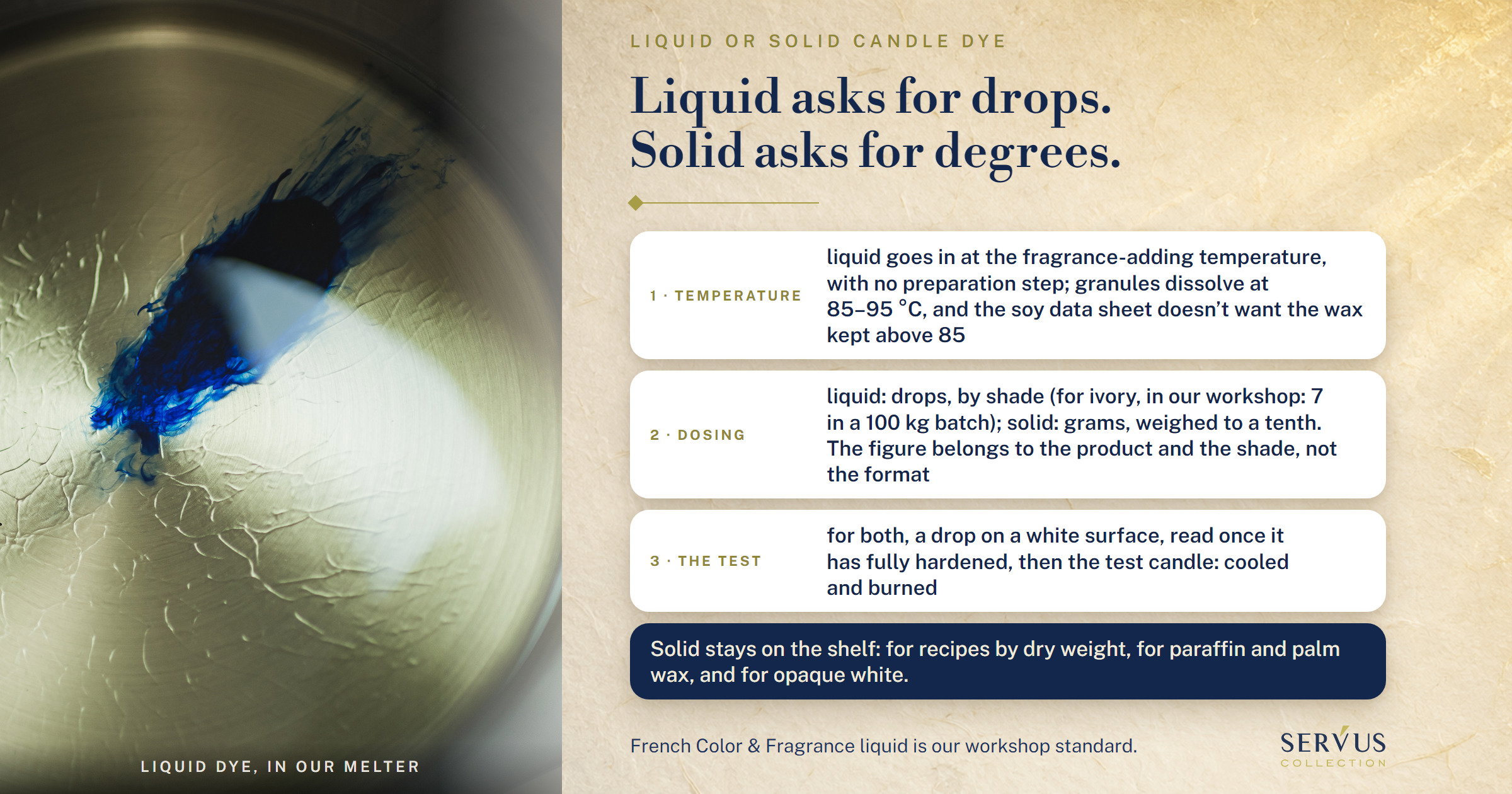
You added the dye, stirred, poured. The next day the candle is darker at the base than at the top, or it has small specks of colour on the bottom, like grains that never got the chance to melt. Or you read the shade in the melter, you liked it, and the cooled candle came out a tone darker than you wanted. We write about the first scene on the page of the solid dye, about the second on both pages, because we’ve seen both, and both come from the same place: the format of the dye decides what steps you have to take before you pour and how many things have to come out the same for you to repeat the shade next time.
Liquid dye is dye already dissolved in oil: you add it by the drop to the scented wax, at the fragrance-adding temperature, stir, and there’s nothing left to stay unmelted. Solid dye is dye held in a wax base or a pigment powder: you weigh it and prepare it first, at the temperature its data sheet asks for, usually separately, in a concentrate with a little wax. That’s why our standard is liquid: for ivory, on our 100 kilogram batch, we went from 87 grams of solid prepared separately and a colour that didn’t always come out the same, to 7 drops for the whole batch and the same shade every time. Solid stays on the shelf for anyone who has a reason to want it. The reasons, the figures and what we haven’t measured yet are below, with the source next to each.
In the order below: what’s different between the two formats in the bottle and in the melter, and why the dye’s temperature window is read next to the wax’s; how each one is dosed and why the figure on the internet isn’t yours; why we switched from solid to liquid, with our figures, and when solid still makes sense; what can go wrong with each and what you check first; what you order for your first test, with the order of the steps for each format.
I’m Sînziana. In our workshop in Maramureș, Romania, we’ve been pouring candles since 2010, and we sell on the wax, the wick, the fragrance and the dye we use ourselves. We coloured with solid at the start, like almost everyone, and we moved to liquid when we wanted the same shade batch after batch, whoever was pouring that day. This isn’t an opinion about a format; it’s what solid cost us at scale, told with the figures from our melter and from the data sheets.
Liquid or solid candle dye: what’s different in the bottle and what’s different in the melter?
In the bottle, the difference is the carrier: liquid is dye dissolved in an oil, solid is dye held in a wax or a pigment powder. In the melter, the difference is one step: liquid has nothing to prepare, it goes in at the temperature at which you add the fragrance, stirred; solid is prepared first, at the temperature on its data sheet, and for colour granules that temperature is higher than you usually work at with soy. Everything else follows from these two things.
What is liquid dye and why doesn’t it have a dissolving step?
The liquid dye we sell, the C series from the manufacturer French Color & Fragrance, is dye already dissolved in a refined soybean oil; on the safety data sheet of the red in the series, code D23191, the oil is half of what’s in the bottle, between 50 and 55 per cent. That’s why it has no dissolving step: there’s nothing left to melt. What remains is the temperature at which you incorporate it and the stirring, and those belong to the wax, not to the dye: the Kerax data sheet of our soy wax asks for 70 °C for liquid dyes, and on the page of the pillar wax we write that we add it after the blend has become uniform, at the fragrance-adding temperature, and stir until the colour is even. So not "at any temperature", but at the one you’re already at with the fragrance, without going up for it.
What you need to know about it apart from the drops are three things from the safety data sheet of the red D23191, not from the packaging; each shade has its own sheet, and we send it on request. It can cause an allergic skin reaction, so you work with gloves; it’s classified as possibly harmful to aquatic life with long-lasting effects; and it’s kept between 4 and 37 °C, out of the sun, for a year at most, not in a metal container that rusts. It isn’t regulated for transport and isn’t classified as flammable; its flash point is above 93 °C. And one thing we repeat on every page: it isn’t for soap, cosmetics or anything that touches the skin. It’s a candle dye, nothing more.
What is solid dye and what temperature does it need?
On our shelf, "solid" means two different products, with two different temperatures. The first are the bekro colour granules, made in Germany: dye concentrated in a wax base, for which the distributor gives the dissolving window at 85–95 °C and the dosage at 1–1.5 grams per kilogram, and says that above that temperature the colour shifts. On the page of the red we wrote what we see when the wax is too cold: below 80 °C the granules only half melt and settle on the bottom of the pot, and the candle comes out darker at the base than at the top. The second are the pigment powders, the opaque white and the solid ivory, with 60–65 °C and 0.1–0.2 per cent written on their pages, which call for "complete mixing, with no lumps": other figures, another mechanism, the same extra step before anything else, preparing them separately.
The temperature figure belongs to the product, not to the format. An American candle supply company, General Wax, in a guide from March 2023, writes that dye blocks and chips melt well between 160 and 180 degrees Fahrenheit, that is between 71 and 82 °C, and that added to wax that’s too cold they leave behind particles of undissolved dye. Other granules, another window, the same mechanics: you read the temperature from your product’s data sheet, not from someone else’s.
Why do you read the dye’s window next to the wax’s window?
This is the thing nobody writes on the dye’s packaging: the wax has a window too, and the two have to be read side by side. The Kerax technical data sheet of our soy wax for moulds, KeraSoy Pillar, in version 6.0 from March 2025, which we have from the manufacturer, says three things in three different lines: that for powder dye you heat the wax to about 75 °C, and for liquid dye, blocks or powder dissolved in fragrance to 70 °C; that it’s best not to heat the wax above 85 °C and not to keep it hot for long; and that high temperatures, up to 90 °C, do no harm if the wax is cooled back down quickly, while above that it can discolour. For the soy wax for containers, KeraSoy Container, the data sheet says the same thing: melting up to 90 °C only temporarily, and above 85 °C for a long time means discolouration.
Lay the two windows one over the other and you see the problem with granules in soy: the dye needs 85–95 °C to melt completely, the wax doesn’t want more than 85 °C except in passing. It can be done, and not with the whole melter: you dissolve the granules separately, in a small pot, with a little wax, and pour the concentrate into the batch; that way only the concentrate works at the edge of the wax’s data sheet, not the whole batch, but it does go into the batch, and it’s an extra step, with its own pot, its own temperature and its own stirring. That’s the temperature argument, and it holds for granules. Our experience with ivory, below, is a different argument, about powder, at 60–65 °C: there it wasn’t the temperature that got in our way, but the extra pot, the amount used and the shade that varied. With liquid, none of these steps exist: the dye goes in at 70 °C or at the fragrance-adding temperature, below everything the wax’s data sheet rules out. With paraffin for moulds and with palm wax the story is different, because those are heated anyway, for melting, to 82–90 °C and 85–95 °C, as it says in our table of temperatures for each wax; there the granules sit inside the wax’s window without any effort. That’s why I say below that solid still makes sense on certain recipes, not that it’s the wrong product.
How is each format dosed and why isn’t the figure on the internet yours?
Liquid is dosed in drops for small batches and can be weighed for large ones, solid is weighed, and for both the starting figure belongs to the product and the shade in your hand, not to the format. Two liquid dyes from two manufacturers can have very different concentrations, and so can two granules, while a pale shade needs hundreds of times less than a full one; what transfers from one product to another is the method, that is, the note of what you put into how much wax, and the test on the cooled sample.
How many drops of liquid dye for 100 grams of wax?
It depends on the shade more than on anything else. The starting point we write on our dye page is 3 to 8 drops per 100 grams of wax; in our 2025 guide to dye mistakes the dosage is written as a percentage of the weight of the wax, and the pages of some shades carry other percentages. They aren’t the same figure written three ways: to link drops to percentages you’d have to weigh the drop, and we haven’t done that yet. Until then, you start from the figure on the page of your shade and go up, with the test below between steps. And with barely coloured shades the figure is something else entirely: for ivory, in our melter, we put 7 drops into a 100 kilogram batch of wax. The 10 millilitre bottle has a controlled-drip cap and is the test quantity, for any shade; the 20 millilitre one comes with a dropper.
How much the figure belongs to the product shows when you put it next to others. An American supplier, on its page of questions about dyes, recommends for its liquids one drop per pound of wax, that is about 450 grams, for light shades, and no more than 7 for dark ones; General Wax writes that one drop of liquid dye is enough for a whole pound. Ours starts, for the colours on the category page, from 3 per 100 grams. Nobody is wrong: they’re different products, with different concentrations, and that’s why you don’t take the figure from the first article you find, you take it from the page of the bottle you have. And you write it down: how many drops, from which bottle, into how many grams of wax, on which wax, at what temperature. Without that note, two batches come out as two shades, even with the same bottle.
How many grams of solid dye per kilogram, and why doesn’t the scale spare you the test?
The distributor of the bekro granules gives 1 gram per kilogram of wax for a medium shade and 1.5 for an intense one, dissolved at 85–95 °C; the ivory powder has 0.1–0.2 per cent on its page, that is 1–2 grams per kilogram. The scale looks as if it solves everything, because a gram is a gram, but for a half-kilogram batch the dose is half a gram, and a kitchen scale that counts in whole grams reads it as zero or as one; you need one that reads tenths. And even with that, the figure is a starting point: on the page of the red we write that the same amount of granules gives a lighter shade on soy than on paraffin, and something in between on blends. Each lot of granules comes with a certificate of colour conformity against the manufacturer’s standard, which means that a small deviation between lots is normal and written down, not that it doesn’t exist.
So with solid you have to keep track of the grams, the temperature on its data sheet and the stirring, for granules down to the last granule, for powder until there are no lumps, and at scale the separate concentrate as well: granules weighed perfectly and melted at 78 °C will still leave the bottom of your melter darker.
How do you do the drop test on a white surface, for both formats?
The test is the same for both formats, and it’s the first thing we trust before pouring: with a rod you take out a drop of wax that’s already coloured, you leave it on a white surface, you wait for it to harden completely, and only then do you read the colour. On our recipes, the warm sample, and even more so the wax in the melter, came out lighter than the cooled candle; the explanation we give ourselves is that the block is compact, while the drop is thin, but that’s our explanation, not a measurement. That’s why the sample is a rough check, and the reference remains the test candle, cooled completely, from the last step. It’s written on both of our dye pages and we put it in the 2025 guide too: if you stop dosing when the melter "looks right", the candle comes out darker. The American suppliers above say the same thing in other words: you drip it onto white paper or a plate and let it cool.
With solid, the sample has one more role: if on the surface you see darker specks of colour in the cooled drop, with granules the first thing to check is dissolving, the wax was too cold when you added them; with powder, the stirring, there are lumps left. With liquid, these specks don’t appear, because there’s nothing that can stay unmelted or unmixed. And when the sample looks right, you write down the dose, the dye, the wax, the fragrance and the temperature, and only then pour the test batch.
Why is liquid our standard, and when does solid still make sense?
Liquid is our standard because on our recipes, on the 100 kilogram batch, with it we repeated the shade from one batch to the next with different people at the melter, with one step and one pot fewer, and, unlike with granules, without taking the wax to the edge of its data sheet. It isn’t a rule about all liquids and all solids; it’s what happened in our workshop, with figures. Solid stays listed and stays a correct choice in three situations I describe below, not to defend it, but because they’re real.
Why did we switch from solid to liquid?
We started with solid, like almost everyone who makes candles at home or on a small scale, and it worked. The problem appeared at scale, and it shows best on a single colour: ivory, a shade we pour in series for our candles, in batches of 100 kilograms of wax. With solid, the ivory powder, about 87 grams went into a batch, almost nine 10 gram packs, which we prepared separately, in a small pot, with 300–500 grams of wax, and only then poured the concentrate into the melter and stirred. And we still had problems with the final colour: the ivory didn’t always come out the same. When we switched to liquid, for the same 100 kilogram batch we put in 7 drops from the bottle, straight into the melter. And the colour came out standard, every time.
The amount used also translates into money, as a rough calculation at the prices of the small packs on our pages, in September 2026, without quantity discounts: the 10 gram pack of solid ivory is 11.87 lei, so the 87 grams of one batch come to around 103 lei of dye; the 10 millilitre bottle of liquid ivory is 12.95 lei, and from one bottle a batch uses 7 drops. I can’t tell you exactly what the 7 drops cost, because we haven’t weighed them; what I can say is that one bottle costs as much as one of the nine packs of solid and lasts for several batches.
What actually changed isn’t "a drop instead of a gram", but the number of things that have to come out the same. With solid: the grams, the concentrate pot, its temperature, how long you stirred, when you poured it into the melter. With liquid: the same bottle with the same cap, the same batch, the drops counted, at the same temperature, stirred. They’re still variables, but fewer, and none of them needs a second pot. What we haven’t done: we haven’t weighed the 7 drops, so I can’t tell you how many milligrams of dye are in our ivory; and we haven’t put two candles side by side, same wax, same shade, one from liquid and one from solid, photographed in the same light. When we do, it goes in here.
Liquid and solid, side by side
The table below puts the two formats we sell side by side, with the figures from their data sheets and with the observations from our pages and from our melter; where the figure isn’t ours, it says whose it is, and on which product.
| What you compare | Liquid (French Color & Fragrance, C series; data sheet of the red D23191 and our pages) | Solid (bekro colour granules; pigment powder, white and ivory, where stated) |
|---|---|---|
| What’s in the bottle | dye dissolved in refined soybean oil, 50–55% of the contents on the safety data sheet of the red | dye concentrated in a wax base, granules or flakes; for white and ivory, pigment powder |
| How you dose it | in drops from the bottle’s cap; at scale it can also be weighed; start at 3–8 per 100 g on the category page, much less for pale shades | in grams; granules 1–1.5 g/kg according to the distributor; ivory powder 0.1–0.2% on its page |
| The temperature at which you prepare it | in our workshop, after the fragrance, at the wax’s fragrance-adding temperature, stirred; the Kerax soy data sheet gives 70 °C for liquids | granules 85–95 °C according to the distributor, dissolved; below 80 they settle on the bottom, above 95 the colour shifts; ivory and white powder 60–65 °C on their pages, mixed with no lumps |
| How it sits against the soy wax data sheet | below the 85 threshold that the Kerax sheet doesn’t want exceeded for long | granules, at the threshold or above, hence the separate concentrate; powder, below the threshold, but still with the concentrate as an extra step |
| What happens if the wax is too cold | there’s nothing to dissolve; stir until the colour is even | with granules, granules on the bottom of the pot, a darker base, specks of colour; with powder, lumps |
| What it adds to the recipe | a small amount of oil, the oil in the bottle | only coloured wax or pigment, nothing liquid |
| Repeating the shade | in our workshop, on ivory: 7 drops per 100 kg, the same colour in every batch, with the same bottle and the same temperature | in our workshop, on ivory: 87 g of powder per 100 kg, prepared separately, and still with variations of shade between batches |
| Test quantity | 10 ml, for any shade | 10 g, for any shade |
| From the safety data sheet | red D23191: may cause a skin allergy, gloves; possibly harmful to aquatic life with long-lasting effects; the other shades, on each one’s sheet | the red and the orange carry an environmental statement on the label; the rest, on the sheets we have, aren’t classified; ivory and white, no sheet in our hands yet |
| What it’s not for | soap, cosmetics, food, anything that touches the skin | the same |
You read the table on the row that’s giving you trouble. If your batch came out with a darker base, the row is temperature. If two batches came out different, the row is repeating the shade. If you pour soy and the wax changed its base colour after a batch kept hot for a long time, the row is the wax’s data sheet.
When does solid dye still make sense?
The first situation is the recipe calibrated on dry weights: if you keep your recipe strictly in grams of wax, fragrance and dye, with no liquid component apart from the fragrance, solid adds nothing to it, while liquid brings a little oil, the oil in the bottle. At a few drops per kilogram it’s a small amount, but it isn’t zero, and for anyone who keeps their recipe that way it’s a legitimate reason. The second is wax that’s heated high anyway: with paraffin for moulds and with palm wax, at 82–90 °C and 85–95 °C for melting, the granules sit inside the wax’s window without you asking anything extra of it, and there the difference between the formats is only one of dosing and steps, not of risk. The third is white: our liquid has no white, it has an ivory; for making plant waxes opaque we have on the shelf an opaque white in solid form, which is a powder, not granules, and has its own dosing rules on its page, different figures from those of the granules.
And there’s one more situation we don’t overlook: if you’ve been working with solid for years, you have your own ratio of grams per kilogram and your shade comes out the same every time, don’t change because we say so. Our standard is what we recommend to someone choosing now, not a bad mark for what already works in your workshop. A British supplier writes, in its comparison of liquid and chips, that liquid can be messy to work with and that a bottle left unused for a long time can clog or leak; that’s why the bottle is kept closed and used up within the year given on its data sheet.
What can go wrong with each and what do you check first?
Three things, and each one has a first step to check: the darker base or the specks of colour, where with granules you check dissolving first and with powder the stirring; the candle darker than the sample, which in our workshop was a reading taken while warm every time; and the same recipe with a different shade, where the question is what changed, from the dose and the temperature to the batch. In none of them is the fix "more dye".
Why is the candle darker at the base and speckled with colour?
When the candle is darker at the bottom than at the top, or when you see specks of colour on its bottom, with granules the first thing to check is dissolving: the temperature at which you added them, because the distributor asks for 85–95 °C, and on our page it says that below 80 °C they half melt and settle on the bottom. The second is stirring, until you can’t see a single granule, not until it "looks" even; the third is pouring too early, with the granules still on the bottom, so that they end up in the first container or the first mould. With powder, the same specks mean lumps: you check the stirring of the concentrate, at the temperature on its page.
What you don’t do is keep soy well above 85 °C to be on the safe side: the wax’s data sheet says that temporarily up to 90 °C is fine if you cool it quickly, and higher and longer means discolouration. So you dissolve the granules separately, in a concentrate with a little wax, down to the last granule, pour it into the melter and bring the temperature down. Or, if your recipe is on soy and this happens to you often, that’s exactly why we switched to liquid, and there’s no shame in it.
Why did the candle come out darker than the sample on the surface?
If you stopped dosing while looking into the melter or at a drop that was still soft, the candle comes out darker; in our workshop that’s how it went with both formats. The colour is read on the sample once it has hardened completely, on a white surface, and even that came out a little lighter for us than the final block. The fix is on the next batch, not on this one: you reduce the drops or the grams, redo the sample, write it down. On the batch already poured, the only honest thing is to sell it as the shade that came out, not as the one in the photo.
This is also where the complaint we read in reviews comes in, word for word: "mismatch between the colour on the website and the product received" (translated from Romanian). The review doesn’t say where the difference comes from, and we can’t tell from it either: it could be the light in the photo, it could also be this mechanism, a sample read warm and a photo taken warm, while the customer receives the cooled block. What you can control is the second part: the candle is photographed once it has cooled completely, in daylight, so that you don’t promise a shade the block doesn’t have.
Same recipe, different shade: what changed, and in what order do you look?
When the same note gives a different shade, one of five things has changed, and you check them in this order: the dose, that is whether the note was actually followed, with the same bottle and the same cap; the temperature and the stirring, especially with solid, where a half-melted concentrate changes everything; the wax, because the same dose gives a lighter shade on soy than on paraffin, as we write on the page of the red, and a new blend or a new batch of the same wax can have a different base colour, which you’ll find on its data sheet, on the "Colour" line; the fragrance, because in the 2025 guide we wrote that heavy notes, vanilla, caramel, wood, spices, can "eat" the pigment, that is, change the shade, so the colour is read on the final blend, with the fragrance in it, whenever the dye went in according to its data sheet; and the batch of dye, because with solid the deviation between lots is written in its certificate, while with liquid any new bottle is tried first on your recipe, on a small amount, before a series.
You don’t change two variables at once: if you have a new wax and a new bottle on the same day, you do one sample with the new wax and the old dye, then the other way round, and only then the batch. It’s the same discipline as reading the data sheet of a new batch: you change one thing, measure, write it down.
Where you start
You start with the format your recipe gives you, with its test quantity and with a sample on a white surface before the first batch. For anyone choosing now, without a recipe in dry grams and without paraffin or palm wax in the melter, our answer is liquid: no separate preparation step, fewer things to keep the same, and the wax’s data sheet left alone.
What you order for your first test
You order the test quantity of your format and nothing more until you have the note written down: 10 millilitres of liquid or 10 grams of solid, for any shade, plus the things you don’t buy from us. Our order of steps, for any colour we haven’t poured before, with the steps that differ by format written separately:
- You get the white surface and the notebook ready. A white ceramic tile, a plate, a thick sheet of paper; and a place where you write down the wax, its quantity, the dye, the dose, the fragrance and the temperatures, for each sample.
- You melt the wax at the temperature on its page. If you work with solid, this is its step: you weigh and prepare the concentrate separately, in a small pot with a little wax, at the temperature on your product’s data sheet; you dissolve the granules down to the last one, you stir the powder until it has no lumps; you pour the concentrate into the melter, stir, then let the temperature come down. If you work with liquid, there’s nothing to do here.
- You bring it down to the fragrance-adding temperature and add the fragrance, at your recipe’s percentage, as the wax’s data sheet asks: after melting, before pouring. You add it before reading the colour, so that the sample shows the final recipe, with the fragrance in it.
- With liquid, now you add the drops, at the fragrance-adding temperature, starting from the figure on the page of your shade, and stir until the colour is even. With solid, the colour is already in the melter from step 2.
- You do the sample on the surface, one drop, left until it has hardened completely. You read it in daylight, not under the bulb above the melter. Too light: with liquid you add more drops and repeat; with solid you don’t put granules or powder into a batch that has already cooled, you prepare a small extra concentrate and incorporate it, or you write it down and correct the dose on the next batch. Too dark: you don’t dilute with clean wax, because you’d change the fragrance percentage; you write it down and redo the sample on the next batch with a lower dose, or, if you do add wax, you recalculate the fragrance for the new quantity and write down the final figures. Darker specks in the drop, with solid: the granules weren’t fully dissolved or the powder was left with lumps.
- You write down the ratio that worked, pour the test batch and read it the next day, cooled completely, next to the sample. If the block is darker than the sample by more than you expected, the correction goes in the notebook, for the next batch.
- You burn the test candle, with the wick chosen on the coloured recipe. The Kerax data sheet says that the fragrance, the colour and the shape of the candle change the choice of wick and that each combination is burn-tested; our burn protocol is in the article on the first burn. A colour is ready when it has passed this test too, not when it looked right on the surface.
And when you’re torn between the two formats without one of the three reasons above, liquid: it has no unmelted granule, and it’s where our kits and our recipes start.
What to send us if it doesn’t work
Send us the wax and its quantity, the dye and its format, how many drops or how many grams you added and how, what temperature the wax was at when you added it, the fragrance and its percentage, and two photos in daylight: the sample on the surface and the cooled candle. From these we can see whether it’s the dose, the temperature, the warm reading or the batch; without them we’d give general advice, and general advice doesn’t fix your batch. Write to us on WhatsApp or call us at +40 726 162 810 (we answer in English), Monday to Friday, between 8:00 and 16:30 (Romanian time).
You don’t choose a dye by how nice it looks in the bottle, and you don’t dose it by the figure in the first article you find. You choose it by the steps it asks of you next to your wax’s window, you dose it by your note, and you read it on the cooled sample, then on the test candle. Liquid took one step and one pot out of our way, on our recipes, and with ivory it gave us the same colour in every batch; the sample and the burn remain yours, whatever the format.