 EN
EN  Romana
 Magyar
You’ve downloaded the data sheet, opened it and stopped at the first row of the table: "Congealing Point, ASTM D938, 43–52, 47.0". Four things for a single temperature, a code you don’t know, and on a shop’s page the same wax appears with "melting point 60". The messages we get often begin with "the website says…", and websites usually say different things. Which one do you believe?
A wax technical data sheet, the TDS in the download tab, is read across three columns and a code. The row says what was measured, the code next to it says by which method, the specification is the range the manufacturer promises, the typical figure is the usual value, and the figure for your bag is on the batch certificate. Two figures can be compared directly only if they have the same method, that is the same code next to them, and the same test conditions. The rest is translation, and I do it below.
Below: what each row means, why two data sheets give different figures for the same wax, what the data sheet doesn’t say and where you find the rest, and the seven rows you copy into your notebook before your first batch.
I’m Sînziana. In our workshop in Maramureș, Romania, the manufacturer’s data sheet sits next to the melting pot, and this year it corrected me on a table I had written myself. What follows is how I read it, row by row, with the data sheets of the waxes on our shelf open on the table.
What does a wax technical data sheet say, and what does each row mean?
Three kinds of rows: at what temperature the wax sets or flows, how soft it is at room temperature and how fluid it is when melted, plus the colour, on a laboratory scale. On the data sheet for our soy wax for moulds, KeraSoy Pillar 4120, version 6.0 from the manufacturer Kerax, revised in March 2025, the table has four rows and four columns: test, method, specification, typical. This is what it looks like, with our translation in the right-hand column:
| The row on the data sheet | Method | Specification | Typical | What it means in the workshop |
|---|---|---|---|---|
| Congealing point | ASTM D938 | 43–52 °C | 47 °C | the temperature at which melted wax, as it cools, stops flowing |
| Viscosity @ 100 °C | ASTM D445 | 7–10 cSt | 8.4 cSt | how fluid the melted wax is: a low figure, it flows like thin oil |
| Penetration @ 25 °C | ASTM D1321 | 25–40 dmm | 32 dmm | how soft the cold wax is: a low figure, a firm wax |
| Colour | ASTM D1500 | 1 max | 0.7 | the colour of the material, measured on a laboratory scale, not how the candle looks |
The "specification" column is the manufacturer’s commitment: the material delivered under this name has to fall within the range. The "typical" column is the usual value. The column you don’t see here, the figure for your bag, is on the batch certificate, in the next chapter. The rest of the data sheet, two pages out of three, is process, and I take it separately.
Why aren’t the congealing point and the melting point the same thing?
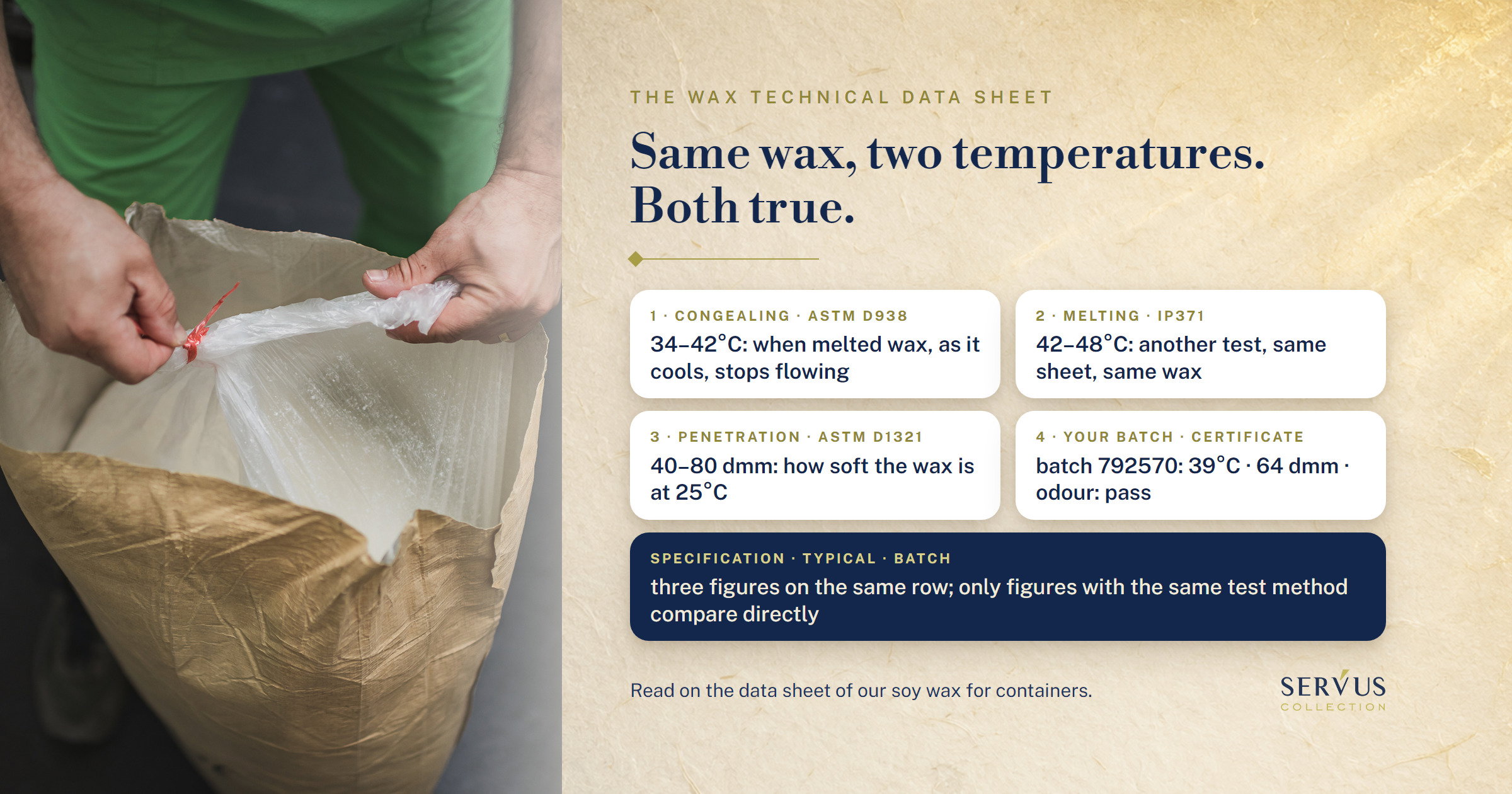
Because they are two different tests, done from opposite directions. The congealing point is measured by cooling the melted wax: the American standard ASTM D938 defines it as the temperature at which the sample, as it cools, develops resistance to flow, that is, starts to set, as the text of the standard puts it. The melting point is measured with another test, most often by heating the solid wax until a drop falls away or the sample flows. The same wax gives two temperatures, and the congealing one is usually lower. The standard says so itself: results obtained by D938 are usually lower than those obtained by the drop method.
You don’t have to take my word for it, you can see it on a single data sheet. On KeraSoy Container 4130, our soy wax for containers, the table has two temperature rows, one under the other: "Congealing Point, ASTM D938, 34–42, typical 39" and "Melting Point, IP371, 42–48, typical 45.5". Six and a half degrees between them, on the same sheet of paper, for the same wax, both true. For EcoSoya Pillar, the data sheet in Italian from December 2025 gives "punto di coagulazione, ASTM D938, 51" and "punto di fusione, DP70, 55". Anyone who reads only the word "melting" and compares 45.5 with 47 is comparing two tests, not two waxes.
When pouring and cooling, the congealing point is the one you run into, because it describes exactly the moment the candle starts to set. The 4130 data sheet asks for pouring "close to the congealing point", around 45–55 °C, precisely so that the wax grips the side of the glass while it’s still moving. Why it’s different with moulds, I wrote in mould wax or container wax.
What do penetration, viscosity and colour tell you about your wax?
Penetration tells you how soft the wax is at 25 °C, viscosity how fluid it is at 100 °C, and colour is a standardised reading of the material, on a scale that has nothing to do with how white the candle is. They are the three rows most people skip, because their units, dmm and cSt, say nothing on their own.
Penetration is a standard needle allowed to sink into the wax, and the figure is the depth in tenths of a millimetre. On our shelf: 18 for EcoSoya Pillar, 32 for KeraSoy 4120 and for the coconut wax for moulds, 60 for 4130. In our range, the low figures are on the firm mould waxes, which stand on their own, and the high figures on the soft container waxes, which hug the sides; how you choose your shelf by it, with the mould and container pairs set side by side, is in the article above and I won’t repeat it here. The ASTM D1321 standard puts it simply: a measure of hardness.
Viscosity at 100 °C is how thinly the melted wax flows, at a temperature you don’t pour at. For our coconut wax for moulds it’s 8.6 cSt, for 4120 it’s 8.4, for 4130 it’s 9.7: almost the same, so that’s not where the difference between them comes from. It’s a reference point for comparing materials, not a pouring figure: it doesn’t translate into degrees. How the wax flows at 60 is read on the data sheet, in the pouring row, and seen in your own test. You can’t measure it at home, but you can read it.
Colour is the most misleading, because it looks simple. "0.7 on the ASTM D1500 scale" doesn’t mean "almost white"; it’s a laboratory reading of the colour of the material, which sometimes reflects the degree of refinement, and the standard itself warns that the figure isn’t always a reliable guide to quality. What I see in it: a figure that jumps from one batch to another is a sign that something changed in that batch, sometimes contamination with another product, as the standard also says, and then I look at the rest of the certificate.
The process rows are recommendations, not properties
The table of measurements takes up a third of a page; the rest of the data sheet is process, and the manufacturer itself writes it as a starting point. On the 4120 data sheet: fragrance between 5 and 10%, clean moulds, preferably preheated to 45–50 °C, pouring at around 55–65 °C "although it depends on the size and shape of the candle", undisturbed cooling at 25 °C and 48 hours before the burn test. On the same data sheet there are two figures for heating, 85 °C for a long time and 90 °C temporarily; they’re two situations, not a contradiction.
The row I read first is the one in small print, above the table, on every page: users must make their own tests to establish whether the product is fit for their purpose, and the manufacturer guarantees only that the material meets the specification. In other words, the paper promises the figures in the table. Your candle is your own promise.
We took the data sheet’s pouring range, 55–65, and narrowed it to 58–62 for figurines with fine detail, after we’d broken off wings; it’s in the article on figurines. Our band sits inside the manufacturer’s range, not in place of it. When a page gives you a single pouring figure, with no range and no "it depends", what you have in front of you is someone’s recipe, not a property of the wax.
Why don’t the figures on two data sheets match, and which one do you believe?
Because most of the time they don’t measure the same thing with the same method. I put the data sheets and certificates of nine waxes from our shelf on the table and looked only at the temperature row. It appears under six names, with five families of methods, and on one of the papers with no method at all.
What does the code next to the figure mean: ASTM, IP, AOCS, GB/T, Eur. Ph.?
The code names the recipe the test was done by, and its family tells you who wrote the recipe: ASTM is the American standards body, IP are the methods of the British petroleum institute, AOCS are the methods of the oil and fat chemists, GB/T are the Chinese national standards, Eur. Ph. is the European Pharmacopoeia. The plant waxes on our shelf start from hardened vegetable oils and fats, as the safety data sheet for the soy wax says in section 3, which is why fat methods appear on their data sheets next to petroleum wax methods. Here is the temperature row, as written on each document:
| The wax on the shelf | What the row is called | Method | The figure |
|---|---|---|---|
| KeraSoy Pillar 4120, soy for moulds | Congealing point | ASTM D938 | 43–52 °C, typical 47 |
| KeraSoy Container 4130, soy for containers | Congealing point and Melting point | ASTM D938 and IP371 | 34–42 and 42–48 °C |
| EcoSoya Pillar, soy for moulds | Punto di coagulazione and punto di fusione | ASTM D938 and DP70 | 51 and 55 °C |
| EcoCoco Pillar, coconut for moulds | Congealing point | ASTM D938 | 52 °C |
| NatureWax C3, soy for containers | Melting point | AOCS Cc 18-80 | 51–55 °C |
| SM2000 palm, batch certificate | Slip melting point | AOCS Cc 3-25 | 55–59 °C, the batch 56 |
| BWC07 crystallised palm, batch certificate | Melting point | no method written | 60–66 °C, the batch 60 |
| Kerafine 58/60 paraffin | Melting point | GB/T 2539 | 58.7 °C |
| White beeswax | Drop point | Eur. Ph. | 61–66 °C |
Read the third column before the fourth. A "slip melting point" for palm is the temperature at which a column of fat in a tube starts to slide; a "congealing point" for soy is the temperature at which melted wax stops flowing as it cools; a "drop point" for beeswax is the temperature at which the first drop falls away. Three tests, three moments of the same transition, and their figures can’t be subtracted from one another. The same goes for colour: on our shelf it appears on the ASTM D1500 scale for the Kerax soy, on the Lovibond scale for palm and, with another method, for the Cargill soy, and on a Saybolt-type scale for paraffin, where "+30" is the lightest step. Three scales, four methods, figures that don’t fit in the same table.
Our working rule: a figure is compared with another only when they have the same code next to them. When the code is missing, as on the certificate for the crystallised palm, the figure stays with that document and that batch, and I ask the supplier which method it came from. 56 and 60 for the two palms above look like four degrees between two waxes; how much of the difference is material and how much is method, you can’t tell from the paper.
Specification, typical, batch: the three figures on the same row
Three figures sit on the same row, and each answers a different question: the specification, what the manufacturer promises for any bag; the typical figure, what usually comes out; the figure on the batch certificate, what came out of your bag. For 4120, the three are 43–52, 47 and, on the two batches we have certificates for, 49 and 50. For 4130: 34–42, 39 and 39 on the September 2025 batch.
The certificate is the document where you see how the actual batch sits within the specification on the data sheet: the same manufacturer, the same rows, usually the same methods. On the three Kerax certificates I have in front of me it says exactly that: the result, the method, the unit, the minimum and maximum of the specification, then "Odour, In House, Pass". The smell is tested by someone’s nose in the laboratory, honestly written down as an in-house method. From two certificates you can also read how far apart two batches are: ours of 4120, made two weeks apart, differ by one degree in congealing point, one dmm in penetration and six hundredths in viscosity. That’s how much "the same wax" is.
A surprise you’ll find too: on the certificate, penetration has a different code from the data sheet, BS EN 1426 instead of ASTM D1321. The same needle, the same temperature, a different standard written down. When you compare the certificate with its data sheet, you compare 33 with the 25–40 range and move on; when you compare two suppliers, with two codes, you ask before you draw a conclusion. And on the last row of the certificate, under the signatures, it says that the tolerance of the results is that of the test methods. One degree more in congealing point may be the batch or may be the method. That’s why a new batch is tested in the melting pot, not judged from the certificate.
When the shop page and the manufacturer’s data sheet disagree, which do you believe?
The manufacturer’s data sheet, with its name, version and date on it, beats any page, ours included. I say it with some embarrassment, because I paid for this rule with my own table. In our temperature guide, published in December 2025, the coconut row said pouring at 48–55 °C, and in the notes column, on the same row, "below 50 °C = sandy". The data sheet for the coconut wax for moulds says it congeals at 52 and recommends pouring at 65. My range started below the temperature at which the wax stops flowing, and contradicted my own note next to it. I found the mistake in August, reading the data sheet, and corrected the table.
On a shop page in another country, the same soy wax for moulds that we use is listed with "congealing 41 °C", "melting 60 °C", "penetration 27", with no code next to the figures. On the manufacturer’s data sheet, version 6.0, congealing is 43–52, penetration 25–40. The figure 41 doesn’t even fall within the range. I’m not saying the page is lying; I’m saying I can’t find out what it measured, because it didn’t write down with what. The page tells you the category and the price; the data sheet tells you the material.
What to ask for, so you don’t have this discussion every time, I wrote in the article on eco wax and documents: the manufacturer’s data sheet, with its letterhead. Here I add one line to that list: with the method code next to every figure. A figure without a method isn’t necessarily false, but it’s hard to compare: it stays with its document.
What doesn’t the technical data sheet tell you, and where do you find the rest?
The technical data sheet is silent on three things: how safe the material is and how it’s stored, what came out of your bag, and how it behaves in your recipe. The first two have their own document. The third has only the melting pot.
What do you read in the safety data sheet, beyond the pictograms?
Figures the technical data sheet doesn’t have: the flash point, the density, the storage window and what the material actually is. The safety data sheet for 4120 wax, version 5.0 from April 2025, says in section 2 that the material isn’t classified as hazardous and doesn’t require a hazard label, and in section 3 what it’s made of, as far as the sheet requires it to be declared: vegetable lipids, mainly triglycerides, with synthetic additives. It isn’t the full recipe, but it’s more than the word on the bag: at its base is hardened vegetable oil, something other than paraffin from petroleum, and "wax" is the trade name.
Section 9 is the safety data sheet’s table of figures, and it’s worth opening next to the wax technical data sheet, because it completes it:
- melting or congealing point around 47 °C, the same typical figure as on the technical data sheet;
- flash point above 150 °C, with the ASTM D92 method written next to it;
- relative density 0.89–0.92 at 15 °C, meaning a litre of wax, by volume, weighs under a kilogram;
- viscosity around 8.4 cSt, the same as on the technical data sheet.
And in section 10 sits the storage window, 5–39 °C, which on the technical data sheet you only find as "a cool, dry place". Wax left in the car in summer goes outside this window.
For fragrance, the safety data sheet is actually the main document of figures: the flash point, 91 °C for Vanilla, and the density, 0.99, meaning 50 millilitres aren’t 50 grams. How you use them when dosing is in the article on fragrance oil, and what the pictograms on the bottle mean, in the one on how natural fragrance oils are.
What do you compare on the certificate of analysis when a new batch arrives?
The certificate for the new batch, set next to the certificate for the old batch, row by row, before the 300–500 gram test. What moved from one batch to the other? That row is the first variable you check in the melting pot. The new-batch protocol, with the control from the old batch and the one-variable rule, is in the article on the batch variable; here is only the step before it, the one with the paperwork.
With us, on the September batch of 4120 compared with the August one, the congealing point went up from 49 to 50. One degree. For a figurine with thin wings, poured at 58, one degree in congealing point can be enough to make the pouring temperature worth retesting; that’s why with a new batch the first test is done at the old temperature, and if the tips come out incomplete, I go up by two degrees and change nothing else. Someone with more than ten orders with us told us in an interview, about a batch, "I just couldn’t get on with it" (translated from Romanian). Most of the time, the new batch had been poured with the figures of the one before.
The certificate is requested by the batch number on the bag, not by the name of the wax. We send it for the batch in stock, on request, and you photograph the batch number on the label before you open the bag, so you have it when the candle comes out differently a month later.
What do you do when you only have a certificate and no data sheet, as with palm wax?
You read what’s on the certificate, note what’s missing, and your pouring temperature comes from your own test, not from a page. For the BWC07 crystallised palm wax we have a batch certificate and no technical process data sheet: melting point 60–66, the batch 60; acid value 165–185 mg KOH/g, the batch 175; colour on the Lovibond scale; moisture and impurities under 0.25%. With no method written next to any of them. For the refined SM2000 palm, the same kind of certificate has the methods: "slip melting point, AOCS Cc 3-25, 55–59, the batch 56" and acidity under 2, the batch 0.049.
From the certificate you read the indicator that, in our range, most clearly separates the crystallised palm waxes from the refined ones: the acid value. 175 against 0.049 is the difference between the palm that crystallises into a star and the one that comes out smooth, and why, I wrote in the article on crystalline palm wax. What you don’t read from it: what temperature you pour at, how much fragrance it carries, how much you preheat the mould. Those aren’t on any paper from the manufacturer, so you work them out on a small batch, with the thermometer in the wax, and write them in your notebook with the batch number next to them.
And one thing I want to say myself before you discover it: on our shelf there are waxes for which we only have the certificate, not the process data sheet. We know which they are and we’re asking for them. Until they arrive, the process figure you can rely on is the one from your own test, not the one on a page, ours included.
Where to start
With the wax technical data sheet open next to your notebook, before the first bag, not after the first failed batch.
The seven rows you copy into your notebook, with their codes
A notebook with seven rows per wax tells you a year from now why the November batch came out differently. You copy them from the data sheet and the certificate, with the method code next to every figure:
- The name of the document, the version and the revision date. "TDS KeraSoy Pillar, v6.0, 25.03.2025." A data sheet without a version and a date is a brochure.
- The manufacturer in the letterhead, not the shop and not the distributor.
- The temperature, with the name of the row and the code: congealing ASTM D938, 43–52, typical 47. The word "melting" on its own doesn’t get written down.
- Penetration at 25 °C, with the code: ASTM D1321, 25–40, typical 32.
- How much fragrance it carries, as the manufacturer’s range: 5–10%.
- The recommended pouring and preheating, marked as recommendations: 55–65 °C, moulds 45–50 °C.
- The batch number on the bag and the figures from the certificate, on the same rows: congealing 50, penetration 34, odour pass.
Rows 3 and 4 are the wax. Rows 5 and 6 are the starting point of your recipe. Row 7 is the bag in front of you. Have you got the batch number written down somewhere for the bag you opened last week? When the candle comes out differently, you open your notebook at row 7 for the old batch and the new one and see what moved, before you change anything in the melting pot.
What to send us when two data sheets don’t match
A photo of the two rows, with their codes, and the batch number on the bag. From that, we can usually tell you in one message whether it’s two different tests or really two different waxes. Write to us on WhatsApp or call us on +40 726 162 810 (we answer in English), Monday to Friday, between 8:00 and 16:30 (Romanian time).
On the website, the manufacturer’s technical data sheet and safety data sheet are uploaded in the Download tab, to download without an account: today on 6 of the 34 wax pages, among them 4120, EcoSoya Pillar and the coconut wax for moulds. The rest we send by email, with the certificate for the batch in stock, as long as you write and tell us which wax you’re interested in.
A figure without a method tells you little. A figure with a method tells you what you’re comparing. The data sheet is read from the code to the figure, never the other way round.