 EN
EN  Romana
 Magyar
You poured a soy wax pillar, it came out of the mould clean, and in July you boxed it up for a customer. It arrived soft, with one side flattened by the journey. Or you wanted a white, milky wedding candle and got one that lets the light through at the edges. Or, most often, you’ve read "stearin" in five articles and "vegetable additive" in three others, you have both products in your basket and you don’t know whether you need either of them, whether you pour for yourself or send out parcels. On the flakes page we write "increase the proportion if you notice the candle softening in summer", on the stearin page we write that it "visibly whitens the blend", and both are true; they just answer two different questions.
You don’t choose the additive by the wax, but by what the candle has to do once it’s out of the mould: stand straight in summer, in the courier’s van; be white and opaque; or stay soy, firm and with its warm tone. There are two on our shelf, both from palm, and we use them in two recipes that don’t mix: stearin, in our paraffin wedding candles, for an opaque, milky white and hardness in the summer heat; vegetable flakes, in our soy candles, for firmness in the heat and because they’re what gives the soy its ivory tone. And often you need neither: the data sheet of the moulding soy wax says it doesn’t call for additives, and in small shapes soy manages on its own.
In the order below: what the two additives are and what each does in a base wax, plus why polymer isn’t here; why our wedding candles have stearin and our soy ones have flakes, and what changes in the colour; when you need neither, even though we sell them; how much you add, in what order it goes into the pot and how you check in the heat before summer; what to order for your first test.
I’m Sînziana. In our workshop in Maramureș, Romania, we’ve been pouring candles since 2010, and we sell on the wax and the additives that go into our own pots. Stearin and the flakes are on the shelf because they’re in our recipes, not the other way round, and that’s also why I can tell you when you don’t need them: in a candle that doesn’t have their problem, an additive is one more variable and, often, a new defect.
Candle additives: what are stearin and vegetable flakes, and what do they do in a base wax?
They’re two materials we don’t pour on their own, but add to a base wax, and they change three things in it: how hard the candle stays in the heat, how opaque it is and what background colour it has. Stearin is a fatty acid in powder form that sets at 55–57 °C; vegetable flakes are a palm fat, in flakes, that melts at around 37 °C. Both go in at small percentages on top of the main wax, between 10 and 20% in our recipes, and every extra percent you add brings you a different defect, not more safety.
What is stearin and why does it whiten wax?
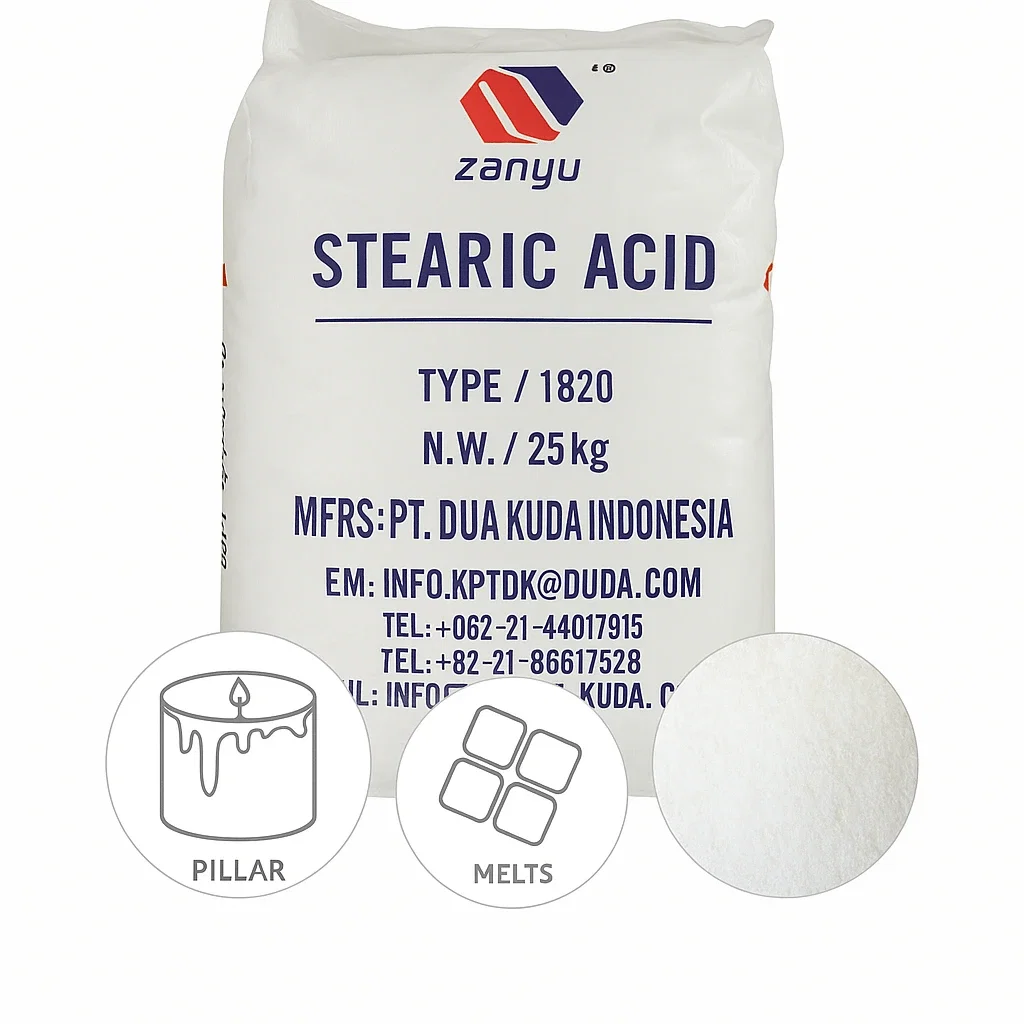
The stearin on our shelf is POFAC 1855, stearic acid in a white-yellowish powder, from ADC, with a congealing point of 55.3–57.5 °C on its technical data sheet. In the candle, it first does what you can see: it whitens the blend and makes it opaque, and more stearin means a whiter candle; on its page we write that light pigments come out cleaner and unwanted translucency disappears. Then it does what you can’t see: it raises the hardness of the piece, helps it come out of the mould and reduces cracking as it cools, and in our wedding sets it’s what keeps the candle standing straight in the heat.
Its limit is written on the page too, from our batches: above 20% in the blend, sudden cooling or a draught leaves fine cracks on the surface; that’s why blends with stearin cool slowly, at room temperature, without a fridge. When melting it has a slight tallow smell, confirmed by the safety data sheet, which disappears as it cools and can’t be smelled in the finished candle. With us it isn’t an ingredient on its own: POFAC poured on its own, in our trials, gave a brittle candle, with an unstable burn and no fragrance held, and that’s what we write under "what it doesn’t do". There are candles made of pure stearin, from other makers, with other recipes and other stearins; we haven’t made one and I won’t tell you how it’s done.
What are vegetable flakes and why does a soft fat harden soy?
Our vegetable flakes are Kerawax 1150, from Kerax, the factory in England that our KeraSoy soy wax also comes from. Their technical data sheet describes them as vegetable lipids, triglycerides, diglycerides and monoglycerides, in white-cream flakes; the safety data sheet gives the melting point as about 37 °C. In other words, a fat softer than the wax it hardens: at 35 °C it has, on the sheet, only 2–5% solid fat left. Both sheets can be downloaded from their page.
And yet, in a blend with KeraSoy Pillar 4120, from 15% upwards, the piece comes out firmer in the heat, with a drier surface to the touch and cleaner out of the silicone; below 15% the effect is minor, and above 25–30% brittleness sets in, with cracks. The figures are from our flakes page and come from what we observed on the blend with 4120, in large pillars and silicone figurines, in our workshop; they’re not an independent measurement and they don’t belong to another blend or another shape. How a soft fat ends up making a wax harder I can’t explain to you from the data sheet, and I won’t invent chemistry to make it sound neat: what we’ve observed, in our recipes, is the effect, not the mechanism.
Polymer: why it isn’t in this article
The third additive you’ll hear about is polymer, a polyethylene wax in micro-granules, which on the certificate we read melts at 96–100 °C and is added at small percentages for hardness and gloss. It’s synthetic, it isn’t on our shelf and it isn’t in either of the two recipes below, so I won’t tell you how much to add or what it does in soy: we haven’t measured it, and a percentage read on a forum isn’t mine to give you. This article stays with the two additives we put in our pots.
Why do our wedding candles have stearin, and our soy ones flakes?
Because the two candles have two different jobs. The wedding candle, made of paraffin, has to be white, milky and hard, so it can get through the summer in the courier’s van and in someone’s car boot all the way to the church without bending: that’s what stearin does. The soy candle has to stay firm in the heat and have the warm, ivory tone that soy with flakes has: that’s what the flakes do, and stearin wouldn’t give it that, because it whitens. We don’t put stearin in soy and we don’t put flakes in paraffin.
What does stearin do in a wedding candle that spends the summer in the courier’s van?
It keeps it white and straight. Our poured wedding sets are made of fully refined paraffin with stearin and palm wax, and we write the composition on their pages. Paraffin is the fuel and gives the even surface; stearin, at 15–20% in the blend on the page of our Type 1 paraffin, gives the opaque, milky white and the hardness; palm adds hardness too. Stearin also changes how the blend burns, so we calibrate the wick on the final composition, not on paraffin alone.
From the summers since 2010 we’ve been left with a rule that we also wrote in our article on shipping: in summer we increase the dose of stearin and paraffin in our wedding candle recipes, so they hold their shape at temperatures at which the winter recipe would soften on the road. Our parcels travel all over the country in summer, in courier vans, and we don’t get candles sent back deformed in transit. That’s our experience, not a guarantee that nothing ever deforms, and it covers the candle in its parcel, not one taken out of the box and left on the dashboard, in the sun.
Why vegetable flakes, and not stearin, in moulding soy wax?
So the candle stays what it says it is. When a customer with more than ten orders told us, in our July interviews, "soy is softer, they break if I don’t combine it with paraffin" (translated from Romanian), they were describing a recipe that works for them, but that takes the piece out of vegetable. In the workshop we arrived at another one: KeraSoy 4120 with vegetable flakes, a palm fat on top of a soy wax, so still vegetable, without paraffin. Stearin is also from palm, so it isn’t the origin that separates the two; what separates them is what they do in the piece. We don’t put stearin in soy for two reasons: the stearin recipe is our paraffin recipe, and we don’t move it onto soy just because it could be done; and because stearin whitens, while in soy we want its warm tone, not white, and the flakes give us that along with the firmness.
Our fluted baptism candle, 6 centimetres in diameter and 30 to 40 tall, is exactly this blend: soy wax with a vegetable hardener, because soy on its own was, as we write on its page, too soft for pins and decorations and too vulnerable to high temperatures. At 6 centimetres and 40 tall, a baptism candle doesn’t stay on a shelf: it’s held in hands, it travels, it puts up with the summer heat and with the pins its flowers are fastened with.
What changes in the colour: opaque white or natural ivory?
The additive picks your background colour before any dye does. Stearin whitens: our paraffin wedding candle with stearin is white and opaque without any dye, and the shades, when we want them, come from liquid dye, in drops, with the dosing we wrote about yesterday. The flakes do the opposite on soy: moulding soy wax is natural white on its data sheet, and with the white-cream flakes in it, it takes on the warm tone we call ivory. The fluted baptism candle is "Ivory Natural" from the blend, not from a dye, and on its page we write that it isn’t optical white and doesn’t try to be.
The practical consequence goes two ways. If you want a soy candle as white as paper, the flakes take you in the opposite direction, and you’re left choosing between soy without an additive, softer, and a white pigment added to the blend; we haven’t poured the second option in series, so I won’t tell you how it turns out. If you want clean pastel shades on paraffin, stearin helps: an opaque wax takes pigment more cleanly, as we write on its page. And a dye added on top of the flakes isn’t visibly changed by them, again from their page: what the flakes change is the background, not the pigment.
When don’t you need an additive, even though we sell it?
When your candle doesn’t have the problem it solves. The technical data sheet of Kerax moulding soy wax says, in the manufacturer’s notes, that the wax doesn’t need additives; the only things to add are fragrance and dye, if you want them. In small shapes, soy manages on its own, and so does paraffin, in a candle that isn’t going on the road in summer. An additive answers softness and colour, not haste when you take the piece out of the mould, and in containers, in our recipes, it doesn’t go in.
What does the soy wax data sheet say about additives?
That it doesn’t ask for them. The KeraSoy Pillar 4120 data sheet, version 6.0, gives a congealing point of 43–52 °C, typically 47, and a penetration of 32, and in the manufacturer’s notes it says the only additions the wax needs are fragrance and colour, if the person pouring wants them. On the page of the fluted baptism candle we write the same from our side: in small shapes, soy wax manages well on its own; the problem appeared at 6 centimetres in diameter and 40 tall. So if you pour shapes a few centimetres across, in a cool workshop, and the candle isn’t going on the road in summer, the flakes solve nothing for you, because you have nothing to solve.
And if you want a firmer soy without adding anything, there’s that route too, we wrote it up in the article on breaking: EcoSoya Pillar is harder on its data sheet (penetration 18, where 4120 has 32) and sets higher, at 51 °C, and in our workshop it comes out of the mould clean, with nothing added. What you pay is the lower melting point, 55 °C: in summer you keep it cool and ship it out of the sun.
Breaks when you take it out, or softens in summer? Two questions, two answers
They’re two different questions, and we’ve separated them in a whole article. With breaking you check the wax first (is it a moulding wax or a container wax?), how long the piece stood, how warm the mould was and at what temperature you poured, and only then the recipe against the shape: an additive helps with release, but a piece taken out too early breaks even with 20% flakes in it. An additive is the answer when the piece comes out but is too soft: it leaves marks on release, softens in the heat, leans when it’s tall. That’s why the flakes page says "if the candle softens in summer or if demoulding leaves marks", not "if it breaks".
Where we don’t put them: in containers and in recipes that work
In containers, in our recipes, neither. On both pages we write the same thing about these additions in our recipes: the shrinkage of a blend with stearin or flakes pulls the wax away from the walls of the glass and leaves gaps; a candle in a glass we make from wax built to hold to the wall, KeraSoy Container 4130, not from a hardened pillar wax. And they don’t go into a recipe that works as a precaution: if the March batch came out well, you don’t add an additive in summer by reflex; you first do the heat test below, on a piece with additive next to one without, and only if the difference shows do you change the recipe. Otherwise you’ve changed two things at once, the season and the recipe, and you no longer know which one it was.
How much do you add and how do you check, without ruining the batch?
You start from the percentages on our pages, worked out from wax plus additive, before fragrance and dye, you add the additive once the base wax is fully liquid, and you check on a test piece, in the heat, next to one without additive, before the batch. "I haven’t found the right percentages," a loyal customer told us in our July interviews (translated from Romanian), and there was no way to find them written down anywhere: there’s no universal percentage, the figures below are from our recipes, and yours are set by testing, as with any wax from anyone.
What percentage do you start with for each additive?
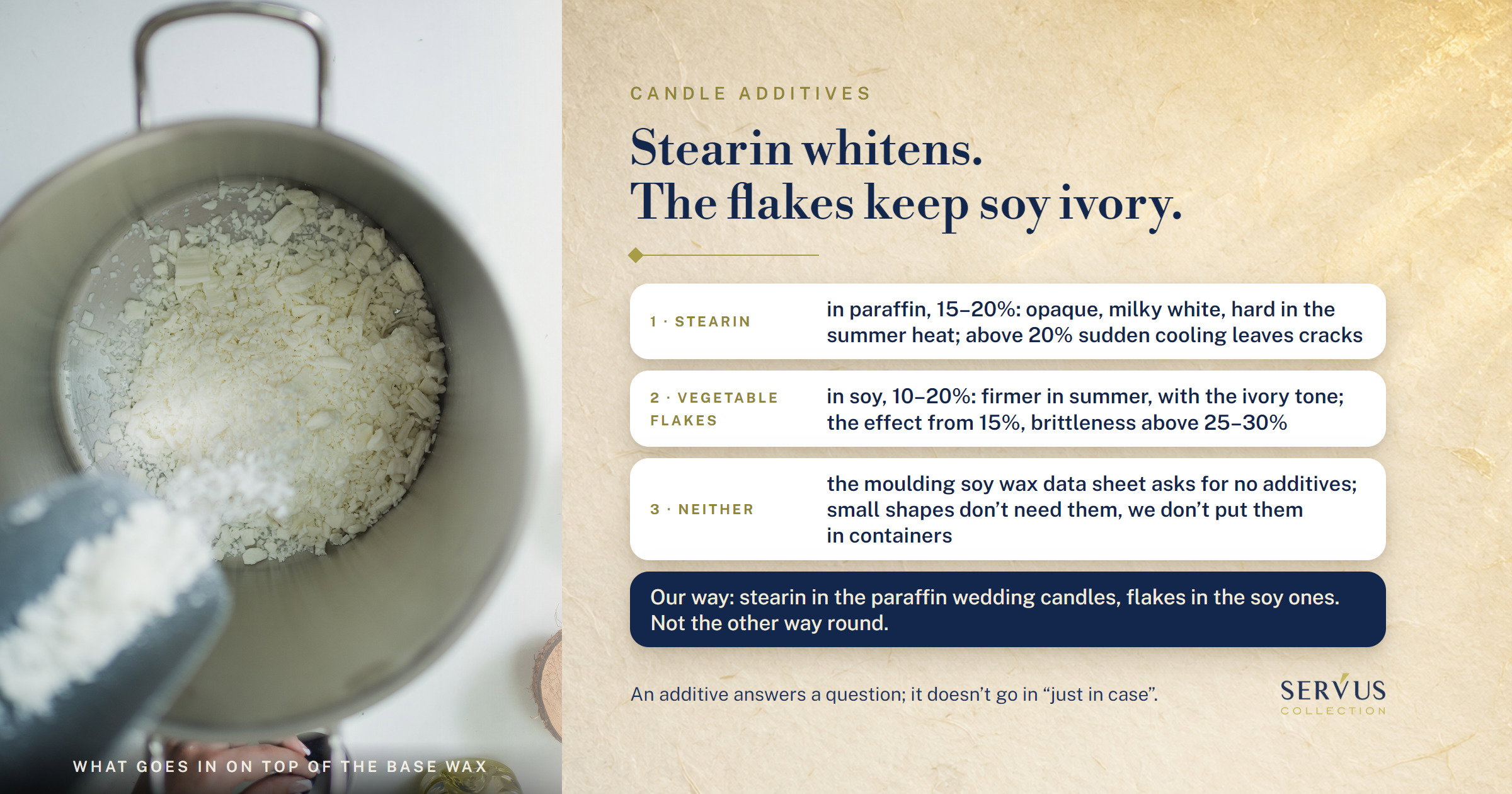
For stearin in paraffin, from 15–20%, which is what we write on the page of our Type 1 paraffin that we put in pillar blends; above 20%, cracks come with sudden cooling. For flakes in soy, from 10–15% in small shapes and 15–20% in large pillars and complicated shapes, with the effect visible from 15% upwards and brittleness above 25–30%. We work the percentage out from wax plus additive, before fragrance and dye, as it’s also written on the pages. In grams, on the scale: in a kilogram of blend, 150 grams of flakes and 850 of soy wax; in a kilogram of paraffin with stearin, 150–200 grams of stearin and the rest paraffin; fragrance and dye then go on top of this blend, at their own percentages. You weigh the additive separately, before you switch on the hob, rather than topping it up by eye in the pot that’s already hot.
In what order does it go into the pot?
Base wax first, until it’s fully liquid; the additive after. Paraffin builds the hot bath, and stearin goes into it and blends in quickly, without sitting for hours in the heat; the other way round, stearin struggles at temperature and risks yellowing and smell, as we wrote about melting order. With soy, we heat 4120 in production to 80–85 °C so it’s fully melted (its congealing point is around 47 °C), the data sheet doesn’t want the wax kept long above 85 °C, and the flakes go into it and dissolve without asking for a temperature of their own. From here on the order is the base wax’s, not the additive’s: the fragrance at the wax’s fragrance-adding temperature, the liquid dye at the same time, in drops, pouring at its pouring temperature, and slow cooling, in the room, away from the window and the fan. In our recipes we’ve kept the base wax temperatures for both additives, and that’s what we write on their pages; with a new blend you don’t take them for granted, you check them on the test piece. What changes for sure is the burn, and so the wick, which you choose on the final recipe, with the burn test.
How do you check in the heat, before summer, whether the candle holds?
With a comparative test, which I’m suggesting the way we would do it, not as a method we’ve already validated. You pour two pieces on the same day, from the same wax, from the same bag, with the same fragrance and the same dye, in the same mould, one after the other: one with additive, one without. The only difference is the additive. You let them cool the same way and stand the same way, in the same place, for at least a day. Then you put them side by side, in the same warm place, with a thermometer next to them, and note the temperature at the start, in the middle and at the end, and how long they stood: 24 hours is an interval you can repeat. At the end you look at the same four things on both: does it stand straight or has it leaned; does your thumb leave a mark when you press or not; has the surface sweated oil or stayed matt; has it stuck to its base or not. You write down what you saw on each, with the temperature and the duration next to it. Only the difference between the two pieces belongs to the additive; one piece on its own only tells you what the day was like. Then you burn the piece with additive, with the protocol in our article on the first burn, because the additive changes the burn.
What we haven’t done so far is exactly this test, written up: the same mould, with and without, at a temperature read on a thermometer, side by side, with a photo. When we do it, the photo goes here. Until then, what we have is the experience of the summers, the wedding parcels that don’t come back and the baptism candle that holds its pins; it’s an observation from production, not a comparative measurement, and that’s how you should read it.
Where you start
You start with the base wax you have and with the question the additive answers: opaque white and hardness in the heat on paraffin, stearin; firmness in summer on soy, without leaving vegetable, the flakes; none of these, neither. The one-kilogram pack is the test quantity for both, and it’s enough for a few small batches.
What to order for your first test
- The base wax you already use, not a new one on the same day: Type 1 paraffin or 4120. If you change both the wax and the additive, you learn nothing; it’s the same discipline as with a new batch.
- A kilogram of the additive that answers your question: POFAC stearin for paraffin, Kerawax 1150 flakes for soy.
- A scale that reads to the gram and a notebook: the percentage, the temperature at which you added the additive, the pouring temperature, the mould, where the piece stood afterwards.
- Pour two pieces from the same mould, with and without, at the same fragrance percentage, and take them into the heat, as above.
- Burn the piece with additive, with the wick you have, and look at the flame and the melt pool: the additive changes the burn, so it may change the wick too.
- Only then the batch, with the percentage written down, not one rounded from memory.
What to send us if it doesn’t work
Send us the base wax and its batch, the additive and the percentage, the fragrance and its percentage, the dye and the dose, the temperature at which you added the additive, the temperature you poured at, which mould you used and where the piece stood afterwards, in what heat, and the wick, if the problem is in the burn; plus two photos in daylight, the piece with additive and the one without. From these we can usually narrow the cause down to the percentage, the melting order, the cooling or a candle that didn’t need an additive; two photos don’t guarantee an answer, but without them we’d be giving general advice, and general advice doesn’t fix your batch. On WhatsApp or by phone, at +40 726 162 810 (we answer in English).
An additive isn’t insurance you put in every recipe just in case. It’s the answer to a precise question: straight in the heat, white and opaque, or firm and ivory, on soy. With us there are two questions and two answers, stearin in the wedding candles, flakes in the soy. The third question, whether you need either of them, stays yours, and your wax’s data sheet asks it first.