 EN
EN  Romana
 Magyar
The word can’t be verified. The documents can.
We’ve been asked ten times. “Do you have eco wax?”
The short answer, so I don’t keep you waiting: there is no certification called “eco wax” that a bag of wax can obtain. It isn’t a test that wax passes or fails. It doesn’t come with a piece of paper. Ecolabels do exist, and I’ll show you below which ones, but they’re awarded to the finished candle or to the origin of the raw material, none of them to the word on the shelf.
What does exist is the documents. The technical data sheet, the safety data sheet, the batch certificate. They tell you what’s in the bag. They don’t say it’s good, they say what it is, and that difference is the whole article.
I’m Sînziana, from the Servus workshop in Maramureș, Romania.
I’m writing this with some embarrassment, because I wrote the wrong word myself too. I’ll get to that.
In short: “eco” isn’t a certification that a wax can have. What you check is four documents: the technical data sheet (what it is and how you work with it), the safety data sheet (how it’s classified), the batch certificate (what came out of your batch) and, for fragrance, the IFRA certificate (how much you’re allowed to put in). Ask for them. They’re free: where they’re uploaded on the product page you download them yourself, where they’re not, they’re sent by email.
If it’s your first order, you don’t need to understand all four. Start with two: the technical data sheet and the safety data sheet. You ask for the batch certificate once you’re producing regularly and want to know why one bag behaves differently from another.
What does “eco wax” mean, and who certifies it?
There is no certification called “eco wax”. We looked for it in our own files too: the manufacturers we buy from send technical data sheets and safety data sheets, and none of them says “eco”.
That doesn’t mean there are no ecolabels at all. There are, but they’re awarded to something other than the bag on the shelf, and that difference is exactly the useful thing to know.
Which ecolabels do exist, and what they’re awarded to
On the finished candle. The Nordic ecolabel, the Nordic Swan, has criteria specifically for candles: group 088, version 3.0, valid until 2031. It requires at least 90% renewable materials, so paraffin is out, and it explicitly bans palm oil and soy oil. A soy wax candle, however well it burns, doesn’t qualify. The licence is taken out on the finished product, by whoever makes the candle, recipe and all, and is renewed periodically.
On the origin of the raw material. For palm there is RSPO, which certifies where the oil comes from, not how the wax behaves. It’s a statement about the supply chain, not about what the material does in the mould.
What doesn’t exist is the third option: a bag of wax with an “eco” stamp on it. So when you read “eco wax” in a shop, mine or anyone else’s, that word isn’t a certification. It’s a description the seller gives you.
If it’s not a certification, where does the word come from?
From you. And I don’t say that as a reproach.
This summer we phoned eight customers who have been buying from us for years and asked them how they found us. Seven out of eight came in through search, and all of them had searched for wax. The phrases that came up, in their words, were “soy wax”, “the cheapest soy wax” and “eco wax” (translated from Romanian).
So the word is real. People search for it. It wasn’t invented by marketing, it’s what stuck after ten years in which every shop wrote whatever it liked on the shelf.
The problem isn’t that you use it. The problem is that you can’t check what’s being sold to you under it.
Is the “Eco” in EcoSoya and EcoOlive a certification?
No. It’s the product name.
On our shelf we have EcoSoya Pillar Blend wax and EcoOlive Pillar Blend wax. The “Eco” there is part of the manufacturer’s brand, as it’s written on the bag. It isn’t a badge, it isn’t a lab result, it says nothing about the supply chain.
I’m telling you this about my own products, on my own page, because otherwise the article wouldn’t be worth anything.
What can honestly be said about a wax?
Three things, and all of them can be checked on paper: what it’s made of (the composition, with the chemical name), where it comes from (which manufacturer, which batch) and what the manufacturer declares: biodegradable, vegan, non-GMO, or silence where it declares nothing.
That silence is information. When two manufacturers sell the same soy wax and only one of them declares it biodegradable, the difference is real and you can read it on the data sheet.
I wrote “certificate of naturalness” too. Why I withdrew it
On 10 February I published an article about the white spots that appear on soy wax candles. It has a subsection called “The Servus differentiator: the «Certificate of Naturalness»”. Inside, it says, word for word:
“See this mark? It’s the guarantee that you’re not burning plastic. It’s the proof that the wax is alive.”
Two mistakes in a sentence and a half. I wrote them.
The first mistake: “certificate of naturalness”
We don’t have one. Nobody does. I made up the name of a certification so that it would sound like proof, exactly the thing I’m complaining about in this article.
Servus has been a registered manufacturer since 2010: that’s a registration with the Romanian trade register, and you can check it yourself. It isn’t a certified factory and it isn’t a laboratory. They’re two different things and I mixed them up.
The second mistake: “you’re not burning plastic”
Paraffin isn’t plastic. And we sell paraffin and pour paraffin: ultra-refined paraffin, melting at around 58 °C, on the mould wax shelf. I’d written a sentence that turned customers away from my own shelf.
What stays true from the whole passage is the technical part, and it stays without the decoration: the white spots are the natural crystallisation of vegetable wax, they don’t affect the burn and don’t affect the scent, and they don’t disappear completely in a wax without additives. That’s all. No “guarantee”, no “proof that the wax is alive”.
It wasn’t the only one
On 6 August we removed three claims from our category pages, after checking them against our own documents:
- “No major allergens”, on fragrance oils. False, and why it’s false matters. The IFRA certificate of our vanilla fragrance, issued in November 2025, lists benzyl benzoate at 38.9% and coumarin at 0.5%. These aren’t banned substances: they’re declarable allergens, listed in Annex III of European Regulation 1223/2009, permitted under the conditions written there, with the obligation to be declared above a threshold. For soap the rule applies directly; for candles, how much you’re allowed to put in is given by the IFRA certificate, by category of use. Our mistake wasn’t that we sell something that isn’t permitted: it was that the page said “free from” when our document said “contains, this much”.
- “100% natural vegetable oils, cold-pressed”. The second part is false for all five: the manufacturers’ documents give them as refined, not cold-pressed. The vegetable origin isn’t what we withdrew, the process is. Refining isn’t a flaw and it isn’t a secret, it’s a different way of obtaining the oil, written as such on the data sheet. But when the page says “cold-pressed” and the data sheet says “refined”, the word on the page is the one that goes.
- “Phthalate-free”. We found no source for it, anywhere. We’ve removed it for good, and it won’t come back even if the paperwork turns up. The category rests on the IFRA certificate, which is stronger proof.
No customer caught them. We caught them by reading our own technical file, which existed, but which nobody had opened since the text was written.
That’s why this article isn’t a lesson about other people.
What do the data sheets of the waxes on our shelf actually say?
Soy wax is a hydrogenated vegetable oil. It isn’t an extract, it isn’t a wax harvested from somewhere: it’s soybean oil treated until it becomes solid.
How to read the real composition
The safety data sheet of the container soy wax we sell says: INCI Glycine Soya Oil, CAS 8001-22-7, partially hydrogenated soybean oil. Not classified as hazardous, no hazard codes, flash point above 200°C, stored below 30 °C.
Nothing I’ve written there is alarming. It’s just precise. Precision is what the word “eco” doesn’t give you.
What the manufacturer guarantees on non-GMO, and what it doesn’t
This is the part nobody puts on the shelf.
The technical data sheet of the mould soy wax we use in the workshop, KeraSoy Pillar 4120, Kerax, United Kingdom, declares the wax biodegradable, vegan, free from animal products. On non-GMO it says something else: non-GMO sourcing is pursued, but not guaranteed 100%. The manufacturer says so itself, in its own document.
For the container soy wax in the EcoSoya range, the wording is just as cautious: it’s sourced non-GMO as far as possible, with no guarantee.
The reason is simple and has nothing to do with anyone’s honesty: genetically modified soy is widespread, and a soy supply chain can’t be cleaned up completely. The coconut and olive waxes on the shelf do better on this point: there, a “GMO-free” statement is easier to back up, because the raw material is different.
When you see “100% natural, GMO-free” written without any nuance on a soy wax, ask which document it rests on. The wax manufacturer is usually more cautious than the shop that sells it.
What isn’t vegetable on our shelf, and we say so
Not everything we sell is vegetable, and not everything that’s natural is vegan.
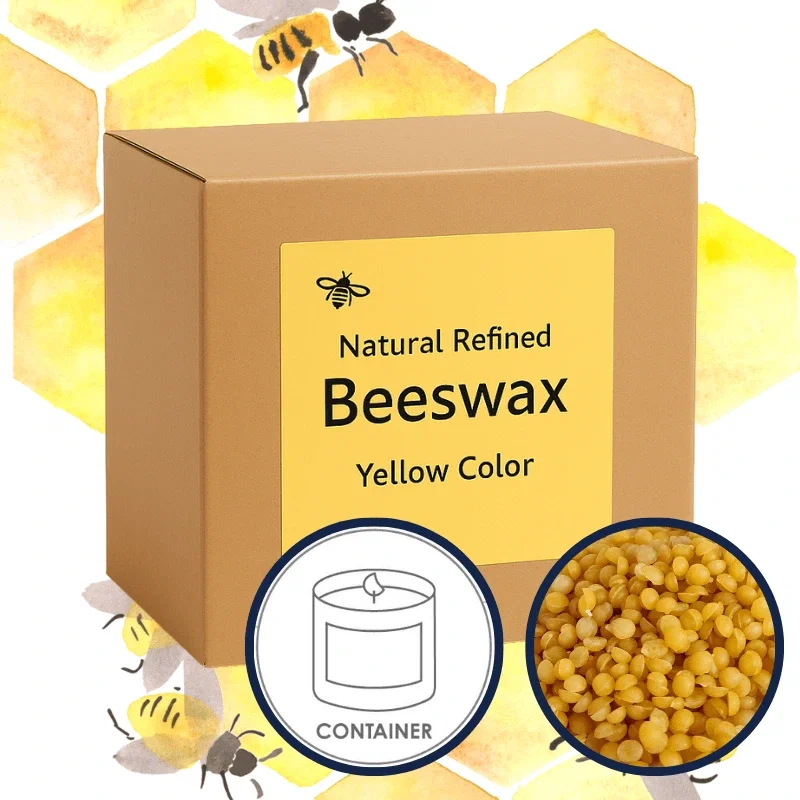
Beeswax is an animal wax. Cera Alba, CAS 8012-89-3, melting at 62–67°C. It’s the most “natural” thing in the warehouse and it isn’t vegan. The two words don’t mean the same thing, and they’re used as if they did.
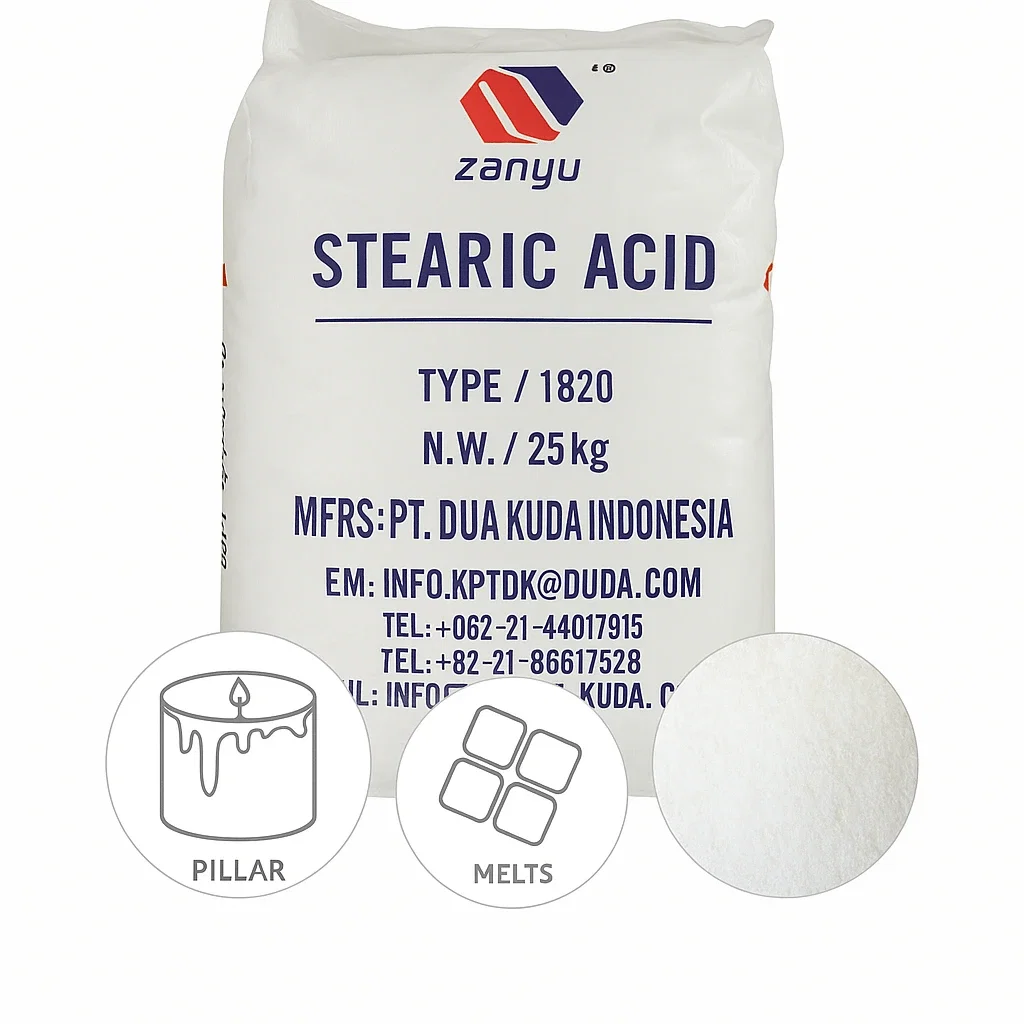
Paraffin is derived from petroleum, fully refined, and sits on the mould shelf next to the vegetable waxes. We sell it, we pour it and we write it on the page. On the event candles poured in our workshop, the composition is stated as it is: ultra-refined paraffin with stearin and palm wax, so that they hold their shape in the heat.
Palm is vegetable, but we have two that behave completely differently. One is refined, with very low acidity, and comes out smooth. The other has high acidity and crystallises as it cools: that crystal pattern isn’t a defect, it’s how it works. The same plant, two behaviours, two data sheets.
None of these things fits into the word “eco”. All of them fit into four pages of PDF.
Which documents to ask any supplier for, and what each one answers
Ask for all four. They’re free, and a supplier who has them sends them the same day.
With us, for some of the waxes you don’t even need to ask: the product page has a Download tab, with the manufacturer’s technical data sheet and safety data sheet, open without an account and before you put anything in the basket. On most pages the tab isn’t there yet, and then you ask us for them and we send them by email.
The technical data sheet and the safety data sheet
The technical data sheet (TDS) tells you what the wax is and how you work with it: the congealing point, the melting point, the viscosity, how much fragrance it takes, at what temperature you add colour, at what temperature you pour. It’s the document you open before your first batch, not after one has gone wrong.
The safety data sheet (SDS) tells you how the material is classified: whether it’s hazardous, what codes it has, how it’s stored, how it’s transported. On the soy waxes on our shelf it says “not classified as hazardous”, and that’s a verifiable fact, unlike “safe for your family”.
Whose document is it: the line I read first
Look at the header of the data sheet and see whose name is there. If it’s the distributor’s, not the manufacturer’s, what you’re holding is something other than what you asked for.
I’m not saying it’s illegal and I’m not accusing anyone. I’m saying it’s a difference in who can answer. The technical data sheet and the safety data sheet are built on the real composition and the classification of the material: data held by whoever produces it, not by whoever resells it. A document rewritten on someone else’s letterhead hides exactly the line you wanted to check: where the wax comes from.
What to ask for, so there’s no argument: the manufacturer’s data sheet, with its name, version and date on it. A PDF with no issuer, no version and no date isn’t a data sheet, it’s a brochure.
This test applies to me too. For EcoSoya Pillar, the technical data sheet I give you is the manufacturer’s, Kerax Ltd, version 3.0, and the safety data sheet is version 5.0, both with the revision date on them. If you ever get a data sheet from me with my letterhead instead of theirs, ask me why.
The batch certificate, the document nobody asks for
The certificate of analysis (CoA) for the batch is the only document that talks about the bag in front of you, not about the product in general.
The technical data sheet gives a range. The certificate gives the figure for your batch. For the mould soy wax, the data sheet says the congealing point is somewhere between 43 and 52 degrees, with a typical value of 47. The certificates of the real batches we’ve received give 49 and 50. How to read these lines to choose your wax (penetration, congealing point, pouring temperature) is another discussion, and I’ve written it up separately, in mould wax or container wax: how to choose.
Three degrees doesn’t sound like anything. It’s exactly the difference between a recipe that works and one that stops working with a new batch.
It’s the document the fewest people ask for, and the only one that explains why the same recipe behaves differently this month.
The IFRA certificate, for fragrance, and what no document tells you
The IFRA certificate tells you how much fragrance you’re allowed to use, for each application. For candles, category 12, often with no limit. For lip products and toys, zero: prohibited. Same fragrance, same bottle.
And here’s the trap: IFRA is a safety limit, not a performance recipe. “You’re allowed 100%” doesn’t mean your system can carry 100%. Vegetable waxes become unstable above 10–12%: they sweat oil, burn badly, compromise the wick. Safe doesn’t mean good.
Which brings us to what no document tells you, however many you collect: the paper says what the material is, not how it behaves in your recipe. It doesn’t tell you which wick to use for your diameter, it doesn’t tell you how that fragrance burns in that wax, it doesn’t tell you why one batch came out with spots and the other didn’t.
You find that out by pouring. That’s why we pour too before we sell, and why we write what we’ve seen, not what we’ve read.
The document is the boundary. You make the recipe, inside it.
Where to start
If you remember one thing: don’t ask whether the wax is eco. Ask for the technical data sheet and the batch certificate. The first question gets a polite yes from anyone. The second gets either a PDF or silence, and the silence is the answer.
With us, you ask for them on WhatsApp or by phone, at +40 726 162 810 (we answer in English). Tell us which wax you’re interested in and we’ll send you what we have from the manufacturer, including the certificate for the batch in stock.
The materials I’ve written about here:
- Container wax: the soy, coconut and olive waxes for pouring into glass.
- Pillar wax: vegetable blends, palm, ultra-refined paraffin, stearin.
- EcoSoya Pillar Blend soy wax: the wax the example above comes from, brand name and all.
- Fragrance oils for candles and soap: the fragrances with an IFRA certificate per batch.
If you want to follow one of the threads further:
- Candle-making terms: pillar, container, hot throw, frosting: if any word on the shelf sounded foreign to you, they’re all explained there, with what you look for with each one.
- Why white spots appear on soy wax candles: the article I quoted my mistake from. The mechanism is right; the positioning wording isn’t.
- IFRA fragrances for candles: how much you’re allowed to use vs how it really burns: the difference between the safety limit and what your system can carry.
- Why the same recipe stops working with a new batch of wax: what you do in practice when the batch certificate shows different figures.
I wrote the wrong word on my own blog and kept it there for six months. Nobody caught me; I caught myself, reading my own file.
A nice word on the shelf can’t be verified. A three-page PDF can. Ask for it from anyone who sells you wax, including me.