 EN
EN  Romana
 Magyar
Sometimes you can’t find it because you don’t yet know which word to search for.
Someone wrote to us: "it’s my first time, I want to make candles, but I don’t know what wax to ask for" (translated from Romanian). They were right not to know. Nobody is born knowing that the sack they need is called container, and that the other one, which looks identical on the shelf, is called pillar.
It isn’t that you’re no good at this. It’s that you can’t search for something you don’t know how to name. You type "candle wax" and you get a list of pages that all say more or less the same thing, so you take whatever seems right. The first decision isn’t even the wax, it’s the technique: poured means you melt and pour, rolled means you warm a sheet and wrap it, without melting anything. If you pour, you choose between pillar, a firm wax for moulds that stands on its own, and container, a soft wax for glasses that sticks to the walls. The rest of the words describe what happens afterwards.
I’m Sînziana. Thirteen words look like nothing at all. They are, in fact, the difference between searching and finding, and half the messages that reach us start right here.
Below is the full list: the words as we use them at the workbench, not data sheet definitions, plus what you actually look for with each one. You’ll find them all in the table at the end.
Why do candle-making terms hold you up before you even search?
Because the barrier at the start isn’t technical. It’s a language barrier. Someone who knows exactly what they want to get, but doesn’t know what it’s called, can’t put the search into words, and so they never reach the answer, however well it’s written somewhere.
We’ve seen this hundreds of times in the messages that reach us. People describe the result they want perfectly and don’t hit a single word from the catalogue.
Poured or rolled: what do you choose before the wax?
This is the first fork in the road, and it comes before the wax, not after.
Poured means you melt the wax, pour it into a form and leave it to cool. You need a melter, a thermometer, a mould or a glass, and patience until the next day.
Rolled means you take a sheet of wax, with us the honeycomb wax sheet, warm it for a few seconds until it softens and wrap it around the wick. You don’t melt anything. You don’t need a thermometer.
The difference that matters most is what happens when you get it wrong. When pouring, wax poured at the wrong temperature is dead wax: you remelt it, you lose the fragrance, you lose the batch. When rolling, you unroll the sheet back to where you went wrong and start again straight. The wax is all still there.
That’s why, if it’s your first attempt, rolling is the cheaper way to learn. Not because it comes out right first time. It doesn’t. Because it costs you nothing when it doesn’t.
The words used by people who write to us
Hardly anyone writes "polymorphism". People write "grainy", "curdled", "craters", "I can’t get it right", "it should look perfect" (translated from Romanian).
These words are correct. They describe exactly what you see. It’s just that they don’t match anything in the catalogue or anything written on the data sheets, so the person using them is left without an answer.
The left-hand column of the table at the end is exactly that: your words, set next to ours. Not to correct you. So that you find what you need.
Not sure which camp you’re in? Write to us on WhatsApp at +40 726 162 810 (we answer in English) and tell us what you want to make, in your own words. We’ll tell you whether it’s one to pour or one to roll, before you buy anything.
The words that decide which sack you buy
This is where most money is lost on a first order. Two waxes can be made from the same soy, by the same producer, with the same colour in the sack, and do opposite things.
What does pillar wax mean and when do you use it?
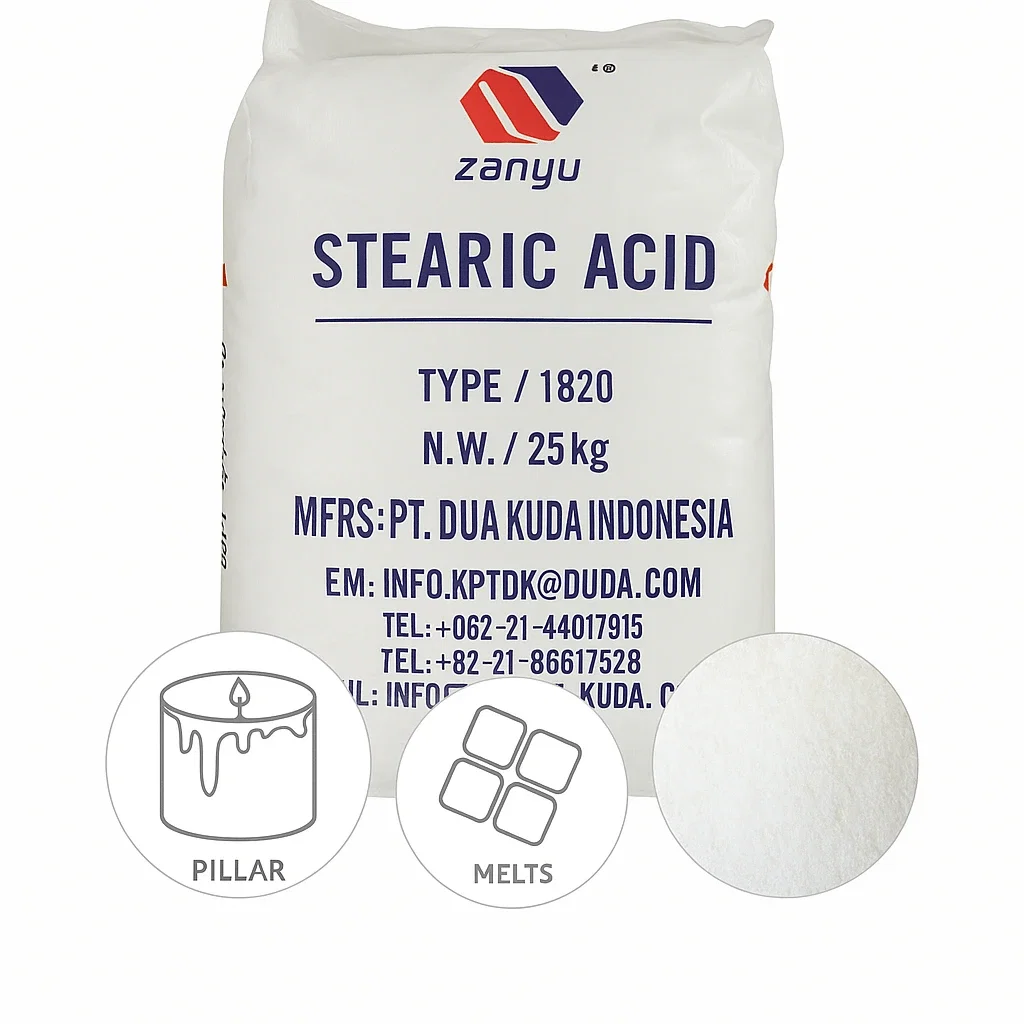
Pillar means mould wax. It’s the firm wax that makes a candle which stands on its own, without a glass: a cylinder, a cone, a figurine. The firmness isn’t an impression, it’s a number on the data sheet. It’s called penetration, and the higher the number, the softer the wax.
You look for: mould wax.
What does container mean, and why doesn’t it hold in a mould?
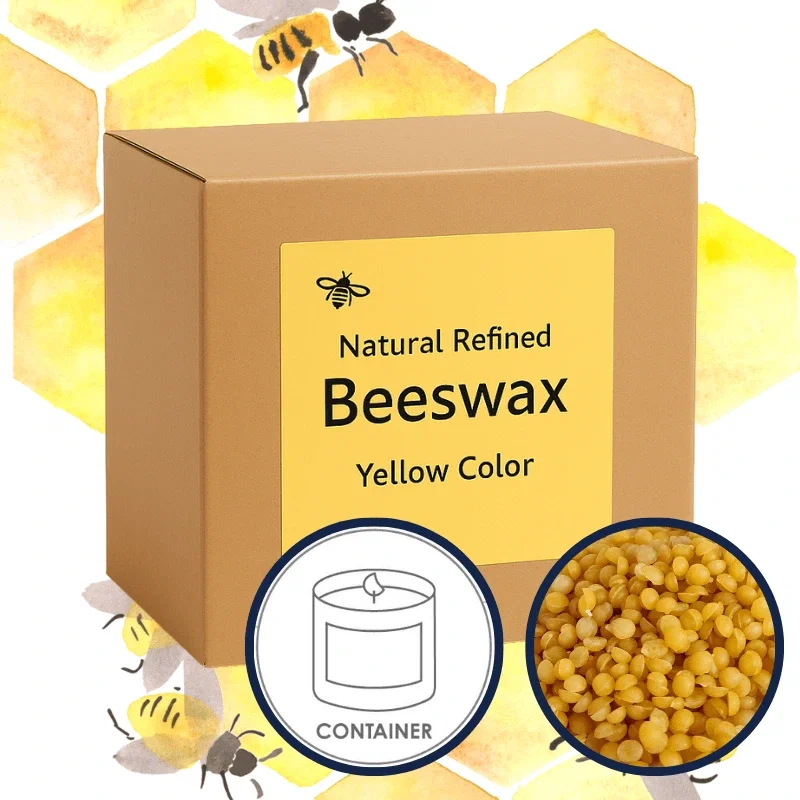
Container means wax for containers. It’s soft by design, because its job is to stick to the walls of the glass, not to support itself. Poured into a mould, it gives a candle that loses its shape on the first warm day. The word that goes with it is adhesion, and adhesion doesn’t come from the sack: a cold container plus wax that’s too hot loses it, a preheated container plus a low pour gains it.
You look for: container wax.
That’s all you need to name the shelves. Which of them suits what you want to pour, with the penetration of each wax in our range, is another subject and has its own article: first you choose the shape, then mould wax or container wax.
What a blend is, and why it comes up in our answers
A blend is a mix of two waxes, made to correct a limit that one of them has on its own.
It isn’t a trick and it isn’t a secret recipe. The example we can give you is our own: pure soy is soft, and with large pillar candles and figurines poured in silicone you can feel it. In the Servus workshop in Maramureș we use SM2000 palm wax as an additive, in a blend with KeraSoy 4120: a drier surface to the touch and cleaner demoulding than the same recipe without it.
Paraffin would also fix the firmness. Only it changes what’s in the candle, and we looked for the option that stays plant-based.
How much you put in: 30% at most, with a test on a small batch before you take it into the final recipe. SM2000 is an additive, not a base wax. On its own it doesn’t form a candle structure.
Whichever way you go, the word you’re looking for is blend. Without it, you search for "wax that doesn’t break" and find nothing, because nothing is sold under that name.
If you’re choosing now: mould wax when the piece has to stand on its own, container wax when you pour into a glass. If it’s still not clear which shelf you’re on, tell us the shape and the container. That’s all we need to answer you.
What words describe the wick, the fragrance and what you see on the cold candle?
These are the words that come up after you’ve bought. I’ve put them here because half of our support messages start with the description of something that already has a name.
What is matching the wick to the diameter called?
It’s called sizing, and it takes two steps, not one.
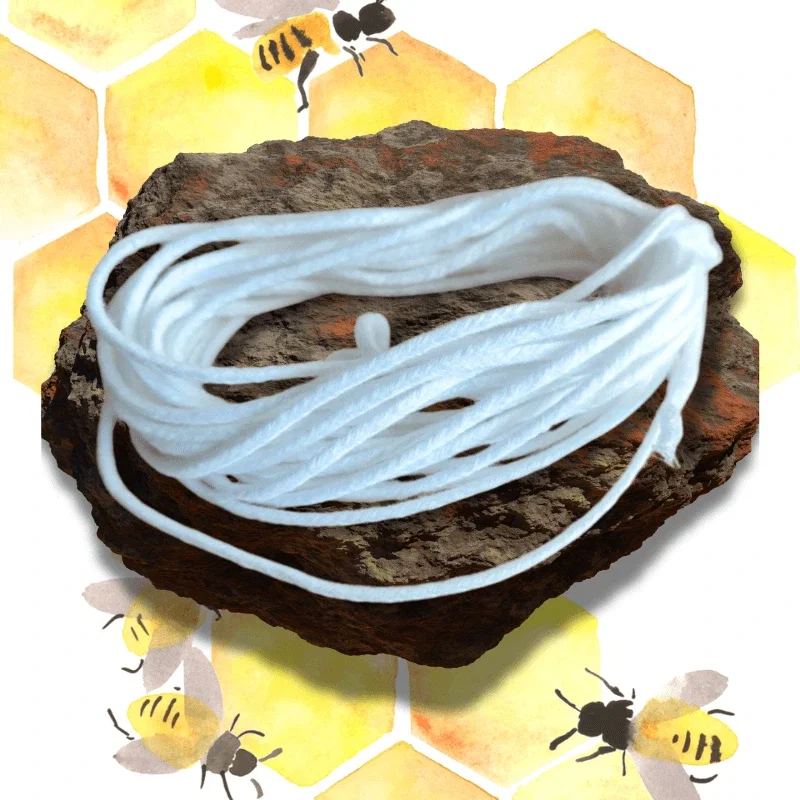
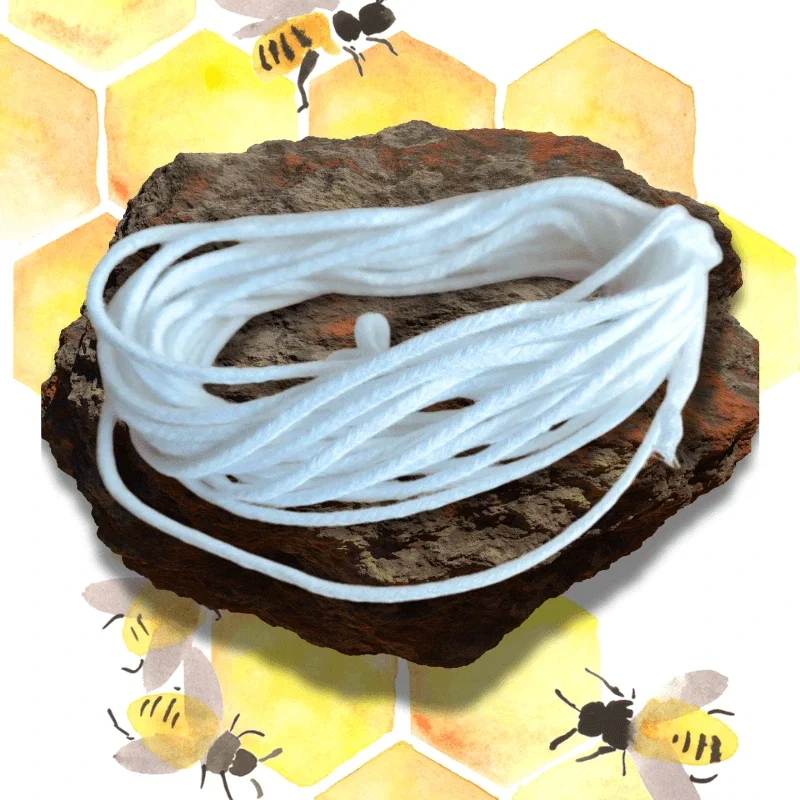
The first step is the choice, by the diameter of the candle and by the wax. The rule you need from the start: plant waxes need a larger wick than paraffin, at the same diameter. There is no universal wick.
These are the four wicks in our range and the diameters they carry:
| The wick | For which wax and which technique | Candle diameter |
|---|---|---|
| Special wick no. 5, round, unwaxed | beeswax, paraffin, blends with stearin or rapeseed; rolled candles from honeycomb wax sheets | 2–4 cm poured, 2.5–4.5 cm rolled |
| Special wick no. 7, round, unwaxed | the same waxes, at large diameters; wide rolled candles, from 4 sheets up | 5–8 cm poured, 5.5–7 cm rolled |
| Braided cotton wick, flat | pillars with stearin, up to 100%, and pillars of crystallised palm wax | 2–3 cm → 3x6, 3–5 cm → 3x8, 5–7 cm → 3x10, 7–9 cm → 3x12 |
| Waxed cotton wick with tab | container candles and tealights, in any wax | burn diameter ~3–10 cm, heights 3.5–17.5 cm |
Two things to read from the table. The ranges for no. 5 and no. 7 are two, not one: the figure for poured candles is the manufacturer’s, the one for rolled candles is ours, from the workshop. When rolling, air stays between the layers and the wax burns differently. And the container wick is waxed with paraffin; if your candle has to stay declared 100% natural, you choose no. 5 or no. 7, which are unwaxed, and you prime them yourself, in your own wax.
The second step only comes up with containers and is called calibration. Here the wick isn’t judged by the flame but by the melt pool, the liquid layer that forms around the wick as it burns. You look from the side, through the glass, and measure how deep it is.
- More than half a centimetre deep: the wick is too big. The glass overheats, and the fragrance burns instead of spreading.
- A small pool that doesn’t reach the walls: the wick is too small. The candle digs a tunnel and leaves the wax on the edges.
- Half a centimetre at most, with the wall reached evenly: that’s the balance we look for.
You do the test on the final recipe, 48 to 72 hours after pouring, and you read it in the second hour of burning. Not in the first few minutes.
You look for: wicks. How to choose the size from the start, step by step: our guide to wicks for container candles.
What does hot throw mean, and why does it matter more than the smell in the sack?
They’re two words, not one, and the difference between them is the most expensive misunderstanding in all of fragrance.
Cold throw is the scent when cold: how it smells in the bottle, or the unlit candle. Hot throw is the scent when it burns.
A fragrance can have a strong cold throw and zero hot throw. You smell it in the bottle, fall in love with it, pour the batch, light it and smell nothing. The cause isn’t the wax: it’s the structure of the fragrance. The light notes go first, and if the fragrance is built mostly from them, the scent disappears before the wax has a chance to spread it.
What you never do: add more fragrance to make up for it. It sweats and burns unsteadily. On the KeraSoy 4130 data sheet the limit is 10 to 12 per cent, and above it the fragrance comes out of the wax. Another sack, another number: you read the data sheet, you don’t apply a general rule.
You look for: fragrance oil. The whole mechanism and the drop test on a teaspoon: why your candle has no scent when it burns.
What is the thing you see on the cold candle called?
Four different things that people call by the same name, "it didn’t turn out". They have different names because they have different causes, and the cause tells you what to change.
Frosting: white patches, like frost flowers, on the walls or on the surface. It’s the natural crystallisation of plant wax, when the cooling was uneven. It isn’t mould, it isn’t spoiled wax, and it doesn’t affect the burn or the scent. It only appears on plant waxes; you never see it on paraffin. You keep it in check with a preheated glass and slow cooling, with the candles side by side. In full: why white spots appear on soy wax candles.
Sinkhole: the hollow next to the wick that appears after cooling, under a surface that looks perfect. The skin hardens first, the centre stays warm, and when it sets it shrinks and pulls material down. It’s the physics of shrinkage, not a material defect. It can choke the wick when it burns. With us it’s repaired with two holes next to the wick, not one: the second is a way out for the air, otherwise the air stays trapped and the hollow forms again. In full: why a hole forms next to the wick after cooling.
Wet spots: the areas where the wax has come away from the walls of the glass and shows through it as damp-looking patches. It isn’t a lack of adhesion in the sense of bad wax: it’s shrinkage, glass and wax don’t contract the same way. It most often comes from a cold container or a pour that’s too hot.
Cracking: the crack that runs from the centre to the edge, on mould candles. It comes from pouring too hot or from sudden cooling: the outside cools first, the inside stays warm, and the tension between them cracks the wax. Don’t rush the cooling. Above all, not in the fridge. In full: the candle that cracked.
The fifth word in this family is grainy, the way customers write it. Here it depends on which palm wax you poured, because they don’t all behave the same. There are six palm waxes on our shelf, and three of them are crystallised: they set into crystals as they cool and give a star-shaped crystal pattern, like ice. BWC07 and BWC09 for moulds, BWC16 for containers. Those are doing their job exactly when they look like that. The other three are refined and stay smooth.
So "grainy" is a defect only if you poured a refined wax and it still came out grainy. If you poured a crystallised one, that isn’t an accident, it’s the product.
Already poured the batch and something doesn’t look right? Send us a photo on WhatsApp at +40 726 162 810 (we answer in English) and tell us which wax and which wick you used. From the photo and those two, the cause can almost always be seen.
Where to start
A wrong word at the start isn’t paid for in the search. It’s paid for on the first order, when the sack that doesn’t do what you wanted arrives at your door.
What you look for with each word on this list
Thirteen rows. On the left, how it’s usually said. In the middle, what it’s called. On the right, what you look for with it.
| How you say it | What it’s called | What you look for with it |
|---|---|---|
| "I melt it and pour it" | poured | pillar or container wax, melter, thermometer |
| "I make it by hand, without melting" | rolled | honeycomb wax sheet and wick |
| "it should stand on its own, without a glass" | pillar | mould wax |
| "I pour it into a jar" | container | container wax |
| "wax that doesn’t break" | blend | two waxes mixed, not one product |
| "string", "thread" | wick | wick, chosen by diameter and wax |
| "the melted wax around the flame" | melt pool | the calibration criterion for containers |
| "smells in the sack, but not when it burns" | cold throw and hot throw | fragrance oil, chosen by how it behaves when hot |
| "white patches", "curdled" | frosting | slow cooling, preheated glass |
| "hole next to the wick", "crater" | sinkhole | the two-hole technique and the hot top-up |
| "it came away from the glass" | wet spots | preheated container, lower pour |
| "it cracked", "it split" | cracking | lower pour and slow cooling, not in the fridge |
| "grainy", "doesn’t look perfect" | crystallisation | crystallised palm wax if you want the pattern, refined palm wax if you want it smooth |
If you’re not sure about the technique, your first candle from honeycomb wax sheets is made without a melter and without a thermometer. If you want to go straight to pouring, your first soy wax candle works with a single recipe, taken all the way through. And if you don’t want to choose piece by piece, our kits already put together the things that go with each other.
If you get stuck, write to us on WhatsApp at +40 726 162 810 (we answer in English). Tell us what you want to make, in your own words, with a photo if you have one. We’ll translate.
You don’t need the vocabulary to start. You need it to search. And from the first sack bought right, these words aren’t ours any more. They’re yours.