 EN
EN  Romana
 Magyar
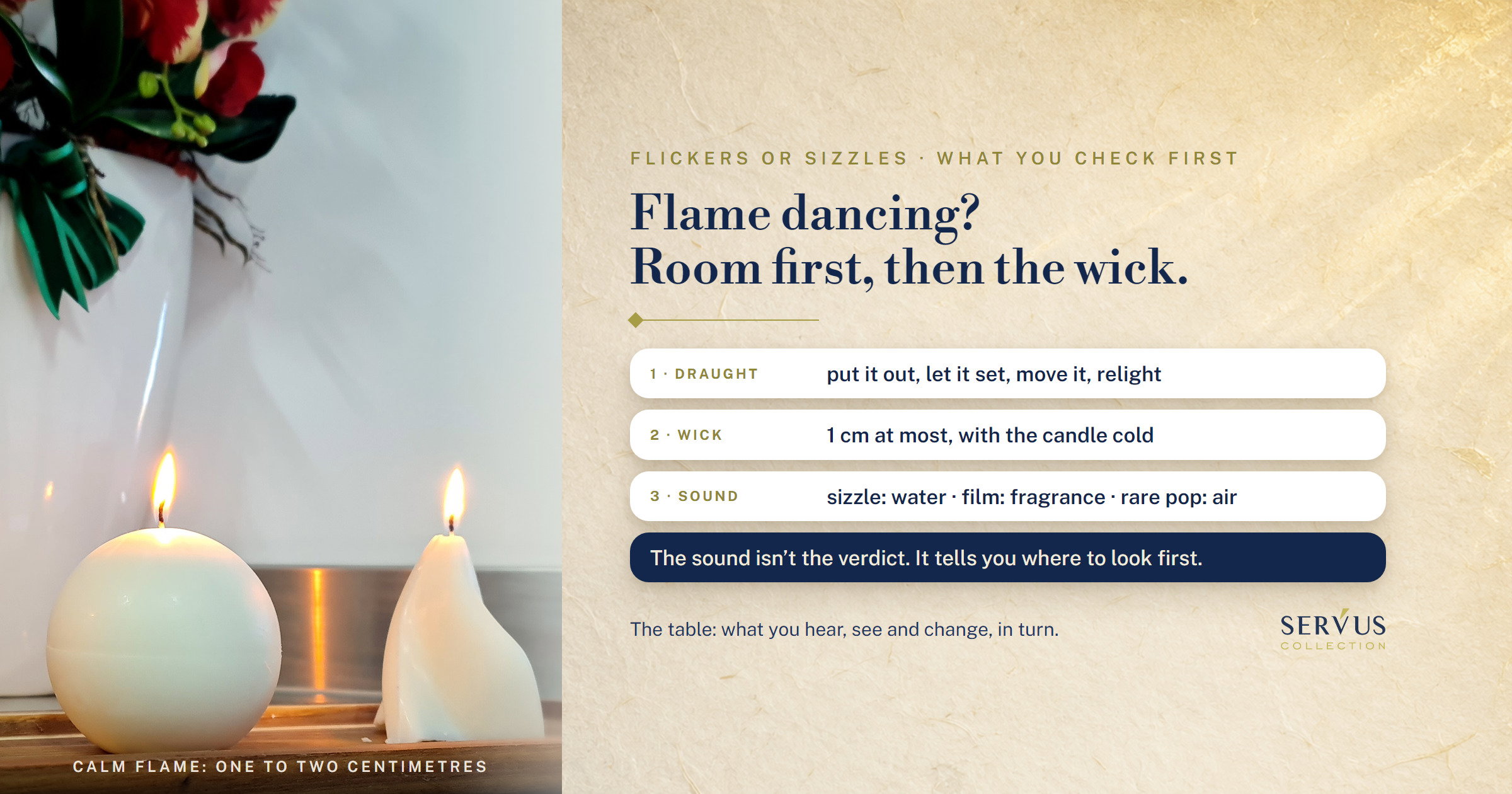
You’ve lit a candle and the flame won’t keep still. It sways, it stretches, it shrinks and grows again. Or you hear something: a faint sizzle, a pop now and then, as if there were water in it. If you bought it, you wonder whether it’s faulty. If you poured it yourself, you wonder what you got wrong in the recipe.
The short answer: a flame that dances most often has a cause in the room or at the tip of the wick, not in the wax. A sizzle usually comes from the wax: water, fragrance that didn’t fit in, air. No sign gives you the verdict on its own, but each one tells you what to check first, and the checks need no tools at all.
Below: what you check first when the flame dances; what each sound means; the table with what you hear, what you see and what you change first. About the candle that goes out altogether we’ve written separately, in the article on why the wick goes out; this one is about the candle that burns, but burns restlessly.
I’m Sînziana. In our workshop in Maramureș, Romania, we’ve been pouring candles since 2010, and we sell on the waxes, wicks and fragrances we work with. What you’ll find here comes from the manufacturers’ data sheets, from our pages and articles on wicks and from the burn tests we run on every batch; where we don’t have a test of our own, I tell you.
Why does my candle keep flickering?
Because the flame is getting air or fuel in uneven portions. The uneven air comes from the room: a draught. The uneven fuel comes from the wick: one that’s too long, too big for the candle, or a melt pool in which something other than wax has collected. The first thing you check isn’t the candle, but the place where it’s burning.
What you check first: the draught
You put it out, you leave it until the wax has set, and only then do you move it: a candle isn’t moved with the wax liquid, as the rules of the NCA, the US National Candle Association, say too (NCA, fire safety rules). You set it away from the window, the door and the radiator, relight it and watch it for a few minutes. If the flame settles in the new spot, the draught becomes the most likely explanation. If it dances just the same, the cause is more likely in the candle, and you move on.
The draught also has a sign you see after the candle has gone out: it pushes the flame to one side, and that side gets all the heat. The melt pool widens lopsidedly, the glass blackens on one side only, and on the other, unburnt wax is left behind. We wrote about this in the article on the first burn. The window left ajar, the door that opens often, the fan, the radiator under the window: any one of them is enough. The US National Candle Association puts the draught in the first line of its burning rules: not near open windows, fans or air vents (NCA, fire safety rules).
A case we lived through ourselves: outdoor wedding candles. The first minutes of any candle are the most fragile, because the flame lives off the wax it’s only just beginning to melt, and any breath of air lays it flat. What we learnt from that is in the article on outdoor wedding candles.
A wick that’s too long or too big: the flame that jumps
If it isn’t the draught, you look at the tip of the wick before you look at the wax. A wick left long after the previous burn, with its tip blackened and swollen, draws more wax than it can burn. The flame stretches, sways on its own and leaves a thread of smoke. It’s trimmed before every lighting: the pictogram on our boxes says 1 cm at most, the data sheet for KeraSoy 4130 soy wax asks for a quarter of an inch, about 6 mm, and on a wooden wick we keep it at half a centimetre. In our tests, a calm flame is between one and two centimetres tall. Above that, with smoke, it’s too much.
If the wick is trimmed correctly and the flame still jumps, dances or splits into two tips, you check how the wick matches the container and the recipe: most often it’s too big for that candle, but the soy wax data sheet says that with an unstable flame you also try a different type of wick, not just a different size. In the guide to wicks for container candles we wrote the signs at which we stop a test no matter what the clock says: smoke, a flame that flickers or jumps, a glass you can no longer hold in your hand, two flames on the same wick. On a candle you bought there’s nothing to change; on one you poured yourself, you go down one wick size at the next test. You put the diameter and the wax into the wick calculator and see the band it should come from.
There’s also a flicker that isn’t the big flame’s but the small one’s. A customer wrote to us, in a review from February 2026, about two candles rolled from honeycomb sheet, lit at a blessing in church: “a small flame flickering inside the candle, so that everyone was wondering whether they were still lit”. That isn’t a flame getting too much. It’s one getting too little. The hypothesis we check first on that description is the wick sunk into a tunnel, drowning in its own melt pool, the case from the article on why the wick goes out; the review describes what the customer saw, it doesn’t confirm the cause on its own. With rolled candles it’s all the more worth checking on a long burn, before the day that matters.
The lopsided melt pool and what fell into it
The third cause of flickering is under the flame, in the liquid. A matchstick end, the piece of wick you trimmed off and that fell into the wax, the dust on a candle left uncovered for months: all of them reach the wick at some point and burn differently from wax. The flame jolts, sometimes pops, then settles until the next piece. That’s why, among the ten tips on our candle pages, there’s also “keep the melt pool clear of matches and debris”: it’s a rule for a calm burn, not just for safety.
The candle standing crooked comes in here too. On a surface that isn’t level, the melt pool gathers on one side, the wick stands on one edge of it and gets wax at an uneven rate. You straighten it, and the flame straightens with it.
Why does my candle sizzle and pop?
Because something that isn’t wax is reaching the flame: water, fragrance that didn’t fit into the wax, or air. Wax burns quietly. Water, at the temperature of the flame, turns to steam all at once, and that steam is the sizzle you hear. Each of the three has a sign of its own, but the sound alone doesn’t say which it is; it only tells you where to look first.
Water in the wax or in the wick
Water is the first suspicion with a continuous, faint sizzle, sometimes with small sparks at the wick. The data sheets of our waxes give the moisture of each batch: for the palm wax we work with, for instance, the certificate for the current batch reads 0.12%. The figure on its own doesn’t explain a sizzle and doesn’t say where the water comes from; what it says is that the rest is looked for in the workshop. A pot washed and put on to melt while still wet. Steam from the melter condensing on the lid placed on top and dripping back in. Moulds brought from a cold store into a warm room, with dew on their walls, filled before they’ve dried. Wick kept in a damp room. We don’t have a batch measured with water in it, to give you a figure from which it can be heard; what we have is the list of places we look when we suspect it.
The test isn’t a sound, it’s a comparison. You pour two pieces from the same wax, with the same wick and the same recipe: one as until now, one with the pot, the mould and the wick dried completely beforehand, at the temperatures on the wax data sheet, not above them. If the second burns quietly and the first sizzles, you’ve narrowed the cause down to water and to the place you dried. If both sizzle, water comes off the list and you look at the fragrance. What you don’t do is heat the wax above the data sheet “to see whether it boils”: with KeraSoy 4130 soy wax, for instance, the data sheet asks for under 85 °C for prolonged heating and 90 °C at most temporarily, otherwise it discolours.
One thing you don’t do with the candle either: you never put it out with water. Water in hot wax spatters, as the NCA rules say too. A lid or a candle snuffer, that’s all.
Fragrance that didn’t fit into the wax
The second sign comes from the fragrance, and it’s a film, not a sound. Every wax holds a certain amount of fragrance and no more: the KeraSoy 4130 soy wax data sheet puts the ceiling at 10–12%, and the sheet says that above it the fragrance comes out of the wax, which it calls “bleeding”. The same sheet says that fragrances made for paraffin give poor results in vegetable wax, with separation and a poor burn. An oil sitting on top of the wax, instead of in it, reaches the wick differently from wax and can give an irregular flame; whether it sizzles as well, we don’t know from our tests, so we don’t write it. About the ceilings and about the greasy film on the surface we wrote in the article on fragrance oil for candles; there’s also our case on soy, with Ginger Cookie: added below 58 °C, it left oil on the surface, at an otherwise correct dose.
The sign to look for: you look at the surface of the cold candle, before you light it. If it shines, if it leaves a greasy mark on your finger or if droplets have gathered around the wick, the fragrance has separated from the wax. It isn’t something to listen for, it’s something to take out of the test. Before you repeat the test you check three things, in turn: the dose, against the ceiling on the data sheet; the compatibility, which wax the fragrance is made for; and how you added it, at what temperature, within the range on your wax’s data sheet (for our soy, 60–65 °C). You change one thing only, so you know what fixed it.
Air in the wax and the crackle of wood
The third sound is short and rare: a pop, the flame jolts, then quiet. Most likely it’s an air bubble trapped in the wax at pouring, which the flame has opened. On candles poured in a mould the bubbles sometimes show on the surface too, as small pits; this year we had a batch of white candles with a line of pits on one side only, and we looked for the cause in the new stearin and in the melter temperature, not in the wick. A single bubble doesn’t spoil a candle. A string of pops sends you to the pouring, not to the burn: speed, temperature, a cold mould are the first to check, and the test is again the one with two pieces.
And there’s one more sound that usually isn’t a fault. A wooden wick crackles: it’s its sound, like a fireplace. In the article on wooden wicks we wrote, following the manufacturer’s patent, that the sound comes from the pockets of gum and resin in the wood and that it depends on the species, the wax and the glass, so we can’t promise it. The crackle alone isn’t a sign to stop. If it comes together with sparks, smoke or a flame that won’t keep still, you put it out and check as with any other wick. If you have a candle with a cotton wick and it crackles, you have the sections above to read.
What you hear, what you see, what you change first
The table below puts the signs together. The middle column is the first hypothesis, not the verdict; the third is what you check to confirm it or take it off the list. You read it top to bottom: each row is checked before the one after it, from the cheapest to the dearest.
| What you hear or see | First hypothesis | What you check first |
|---|---|---|
| the flame sways, the glass blackens on one side | draught | put it out, let it set, move it; if it settles, the draught is likely |
| tall, stretched flame, a thread of smoke | wick left long | trim to 1 cm at most, with the candle cold, relight |
| the flame jumps, two tips, hot glass | wick not matched to the container or the recipe | put it out; on your own candle, one size down or another type of wick, at the next test |
| small, buried flame, “flickering inside” | wick drowned in a tunnel, or too small | article on why the wick goes out |
| dances and recovers at the first lighting, unwaxed wick | unprimed wick | soak it in melted wax before fitting, on the next piece |
| jolts and pops now and then | debris in the pool, candle standing crooked | clear the pool once it has set, stand it level |
| continuous sizzle, small sparks | water, from the pot, mould, wick or condensation | two pieces: one with everything dried beforehand, one as until now |
| greasy surface, droplets by the wick, irregular flame | fragrance separated from the wax | the dose against the data sheet, the compatibility, the temperature you added it at; one thing at a time |
| rare pop, the flame settles on its own | air bubble | nothing on the spot; on the next batch, pouring speed and temperature, the mould |
| continuous crackle, wide wooden wick | the sound of the wood | nothing, as long as there are no sparks, smoke or unstable flame |
For those who pour: one variable at a time
If the candle is yours, you have levers the buyer doesn’t: the wick, the dose and temperature of the fragrance, the way you pour. The rule from all our wick articles holds here too: you change one thing at a time and pour a test piece for it. If you cut the fragrance and go down a wick size in the same batch, the candle may burn well and you still don’t know why. How you keep the test going, evening after evening, with the line you write at each lighting, is in the article on the burn test.
One more small case, from unwaxed wicks: special wick no. 5 comes with no wax on it and is soaked beforehand in a thin layer of melted wax. Without priming, we write on its page, the first lighting is capricious: the flame dances, shrinks, recovers. It’s neither water nor draught; it’s a dry wick that hasn’t had time to draw.
For those who bought one: what you can do on the spot
Three things, in this order. You put it out and let it cool completely, until you can hold the glass in your hand and the wax has set. Only then do you stand it level, away from the window, the door and the radiator, clear from the pool whatever fell into it and trim the wick to the length on the candle, 1 cm at most. You relight it and watch it. If it burns calmly, you’ve found it. If the sizzle comes back, if sparks, smoke or a flame bigger than it should be appear, you put it out and don’t go on burning it to see what happens: the cause is in the candle and there’s no way for you to reach it. Then you write to whoever you bought it from, with two photos: one from above, with the pool and the wick, and one from the side. At our end, we answer that message with questions, not with an apology, because without them any explanation is a guess.
If the wax, the wick or the fragrance are from us and the test doesn’t work out, write to us on WhatsApp or call us at +40 726 162 810, where someone who speaks English answers, with the details from your notes: the wax and the batch, the wick with its series and size, the fragrance and the dose, the temperature you added it at, and what you heard, at which lighting.
The sizzle doesn’t say on its own what went wrong. It says you stop, note down what you heard and what you saw, and check the cause now, while the candle is still with you and not with a customer who won’t tell you anything.