 EN
EN  Romana
 Magyar
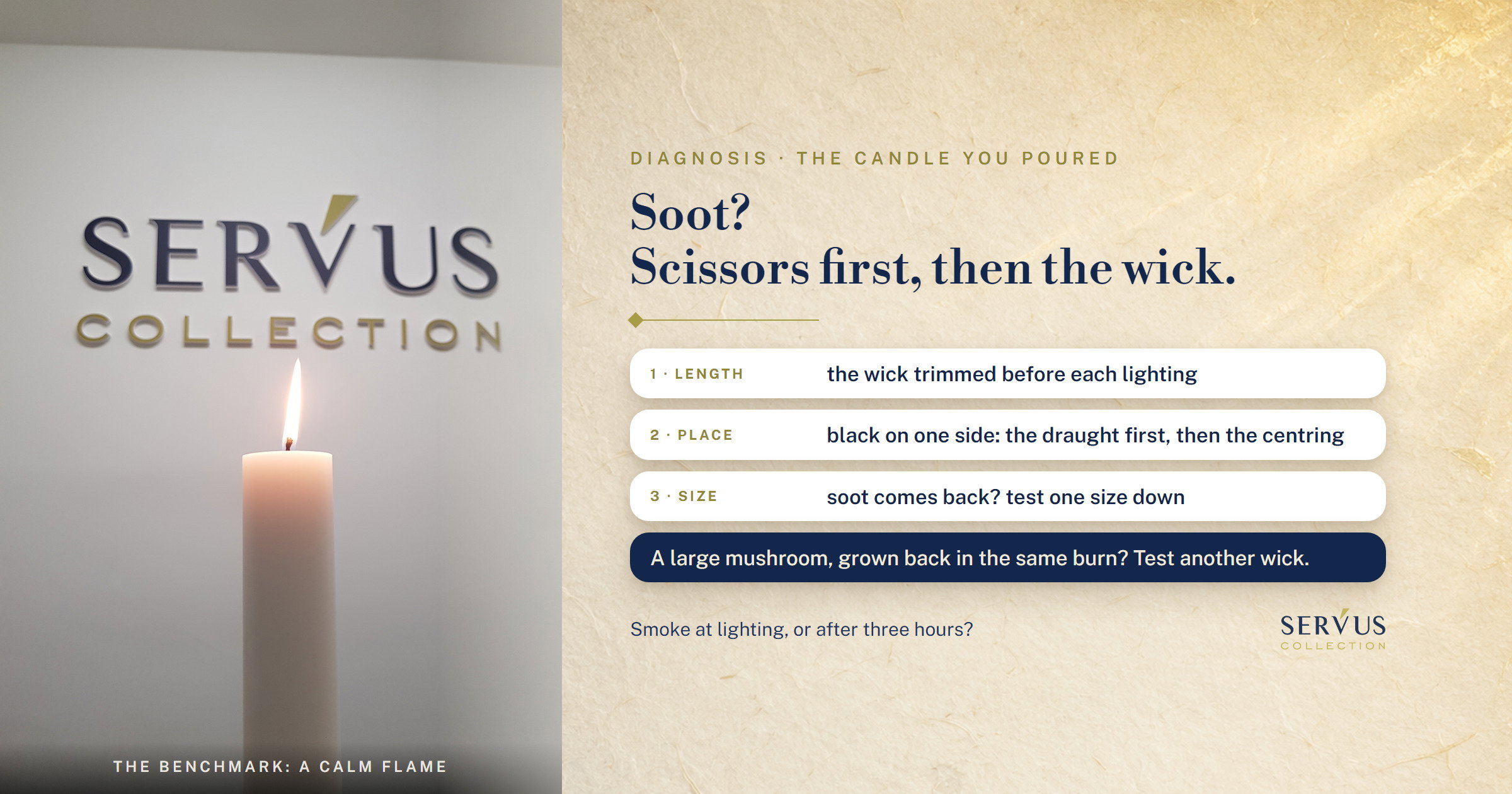
You lit your test candle and for the first hour it burned nicely. When you came back, the glass was grey above the flame, and a black knob had grown on the tip of the wick. Or someone who bought a candle from you has written, with a photo of the blackened glass, and wants to know why the candle produces soot.
When a candle produces soot, first check the wick length and the draught, which you can fix in a few minutes. If the soot comes back, test how well the wick matches the glass and the recipe: the wax data sheets say that a wick that’s too big can cause soot. If you’ve recently changed the fragrance or the dose, start the comparison there.
Below, in turn: what the data sheets say, what the mushroom is, how to read the moment and the place where the black appears, what to change first, with the size down for our wicks, and what to reply to the person who bought your candle. It’s written for whoever pours, whether at their first batches, with candles they already sell or at volume.
I’m Sînziana. In our workshop in Maramureș, Romania, we’ve been pouring candles since 2010, in moulds and in glasses, and we sell on the wicks and waxes we work with ourselves. What you find here comes from the manufacturers’ data sheets, from our wick pages and from the test burns we’ve already written about; where I don’t have a test of our own, I tell you so.
Why does a candle produce soot even when it’s made of soy wax?
A soy wax candle can produce soot too: with the wick left too long, in a draught or with a wick that’s too big for it. Soy wax has a reputation for burning cleanly, but the manufacturer’s data sheet for the soy wax we sell for glasses, KeraSoy Container 4130, says that a wick that’s too big can cause soot. The wax’s reputation doesn’t stand in for the right wick.
The wrong assumption is that once the wax is chosen, soot is no longer your concern. The data sheet says the opposite: every combination of container, wax, dye, fragrance and wick has to be burn-tested.
What does the wax data sheet say about a wick that’s too big?
The data sheets of the Kerax waxes we sell say that a wick that’s too big can cause soot, can speed up the burn and can make the melted wax run down one side of the candle. The sentence is the same, word for word, on the data sheets of the four Kerax waxes we reread for this article: KeraSoy Container 4130, EcoCoco and EcoOlive for glasses, KeraSoy Pillar 4120 for moulds.
Higher up, on the same data sheets, it also says where the mistake starts: "natural waxes" tend to need larger wicks than paraffin. Say you move from paraffin to soy, read this line and jump two sizes, to be safe. You’ve escaped the tunnel and ended up with soot. The data sheet gives you the direction, not the size. You find the size by testing, on your recipe, starting from the range of each wick, which we put in a single table in the article on tunnelling; how to choose a wick from scratch we wrote in the wick guide.
There are two more lines you’ll need further down, on the 4130 and 4120 data sheets. The wick is kept trimmed to a quarter of an inch, about 6 mm. And, if the flame is weak or unsteady, the data sheet sends you to try another type of wick, not just another size.
What is the mushroom on the wick, and when does it matter?
The mushroom is the build-up of carbon and other substances that collects on the end of the wick and interferes with its burn. That’s how the Kerax data sheets define it, and they also say it can cause soot and unpleasant smells. Which the other substances are, the data sheet doesn’t say, so I won’t guess either.
The mushroom matters when it comes back. One left over from yesterday’s burn, a blackened, swollen tip, is trimmed before lighting, like any wick left long; in the article on the first burn we wrote that this is the most common reason a flame smokes. But if you start with the wick trimmed, and the knob grows large again within the same burn and the flame smokes or smells, upkeep is no longer enough. The data sheet tells you what to do then: try other wicks until you get the melt pool you want, that is, the melted layer around the wick, and a "good clean flame".
We saw this first-hand when we chose the wick manufacturer we work with today. We poured six types of wick, from different manufacturers, in the same recipe: the same wax, the same fragrance percentage, the same temperature. One mushroomed "as if we’d put diesel in, not fragrance", and another burned steadily and cleanly. The recipe was the same for all six, so the mushroom came from the wick and from how it matched the recipe. The whole story is in the article on how we choose our raw materials.
What the person who buys your candle sees
The person who buys your candle doesn’t see the wick that’s too big. They see the blackened glass, the thread of smoke and, sometimes, they smell it. Smoke is visible and ends up in reviews; in August 2025, someone wrote to us about the products they’d ordered from us: "they don’t give off smoke" (translated from Romanian).
Of everything that causes soot, the buyer can only fix what has to do with burning: the wick length, the place, the hours and the way they put it out. They can trim the wick and move the candle out of the draught, and we wrote these gestures for them in the article on the first burn. The wick size they can no longer change, so a candle poured with a wick that’s too big leaves you with the soot built in. You only catch it in your own test, before the batch.
Where do you see the black, and what does it tell you?
The moment and the place where the black appears show you what to check first. Smoke at lighting sends you to the wick length. Sooting on one side only sends you to the draught and the centring of the wick. Soot that comes back after a few hours, with a deep pool and a hot glass, sends you to how well the wick matches the glass and the recipe. It isn’t a rule from the data sheet, it’s the order in which we check, built from the data sheets, our wick pages and our articles about burning.
| What you see | First hypothesis | First test |
|---|---|---|
| a tall flame and smoke from the first minutes | a wick left long or a mushroom left from last time (the article on the first burn; the wooden wick pages) | put it out, let it cool, trim the wick, relight |
| the flame sways, the glass is black on one side only | a draught or a wick that isn’t centred (the article on the first burn; the waxed wick page) | move the candle away from windows, doors, radiators; if it still soots on one side, check the centring in the next batch |
| a sooted glass after a few hours, with the pool deeper than our half-centimetre benchmark and the glass hot, even though the flame looks fine | a wick too big for the glass (4130 data sheet: the soot; waxed wick page: the pool and the glass) | put it out; the next test, one size down |
| the flame rises again or the mushroom grows large again within the same burn, although you started with the wick trimmed | the wick doesn’t suit the recipe (the Kerax data sheets) | another size or another type of wick |
| in moulds: an unsteady flame, wax running down one side | a wick that’s too strong (the mould wick page; the 4120 data sheet) | one size down |
| smoke only when you put it out | blowing it out (the article on the first burn) | a snuffer or the candle’s lid |
The table gives you the order in which to check, not the verdict. Read it from top to bottom: the first two rows are sorted out in a few minutes and don’t cost you a new candle. Only when the length and the place are right do the rows below become information about your recipe.
Black smoke at lighting, or after three hours?
Black smoke in the first minutes sends you first to the wick length, and soot that appears after a few hours, together with a deep pool and a hot glass, to its size. At lighting, the flame burns whatever it finds on the wick, and a wick left long makes it tall. The clearest example is our wedding candles: the wick comes long, about ten centimetres, so it can be decorated, and lit like that it makes a large flame and smoke from the first minute. Before the ceremony it’s trimmed to one centimetre; we wrote this in the article on the first burn.
After a few hours it’s another story. The wax data sheet lists soot among the effects of a wick that’s too big, and the page of the waxed wick for glasses tells you how to recognise it in a glass: with a burn diameter too large for the container, the flame stays nice, but the pool goes deeper than half a centimetre and the glass overheats. The half centimetre is the benchmark we calibrate our own candles in glasses by, not a figure from the manufacturer’s data sheet, and on its own it doesn’t decide: you read it together with the hot glass and the soot, on your glass and your recipe. In the guide to wicks for container candles we wrote that overheating sometimes only appears in the third or fourth hour, so a test that looks fine at the second hour doesn’t close the discussion.
When did you first see smoke on your test candle: at lighting or after the pool had deepened? The answer tells you where to start: with the scissors or with the test with a smaller wick.
Is the glass black on one side or all the way round?
Soot on one side of the glass only sends you first to the draught and the centring of the wick, and soot all the way round, to the wick: first to its length, then to its size. A draught pushes the flame to one side, and that side of the glass gets all the heat: the pool widens unevenly, the glass blackens on one side only, and on the other unburned wax remains. A window left ajar, a door that opens often, the radiator under the window can do this. If there was no draught, check where the wick sits: on the page of the waxed wick we write that it’s stuck in the centre of the glass, otherwise the burn migrates towards the wall.
Two candles from the same batch burn on the same table, one by the window. If only that one is sooted, and only on one side, you have a good hypothesis, which you check by moving it, without touching the recipe.
Even black, like a ring around the whole glass, has no direction. If it appears with the wick trimmed and away from draughts, move on to the signs in the next section.
The signs that the problem is in the recipe
Soot points to the recipe when it comes back after you’ve ruled out the length and the place: you’ve trimmed the wick, moved the candle away from draughts, lit it at least 48 hours after pouring, as the data sheets require, and you still see one of the signs below.
- the flame rises and flickers again, although you started with the wick trimmed;
- the mushroom grows large again within the same burn, and the flame smokes;
- in a glass, the glass soots up, the pool goes deeper than our half-centimetre benchmark, and the glass overheats;
- in moulds, the flame is unsteady or the melted wax runs down one side;
- the soot appeared along with a change in the recipe: another fragrance, another dose, another wax, another diameter.
A single sign, on a single candle, is a hypothesis. The same sign on two identical pieces from the same batch is already a direction, and from there you no longer buy a wick by guesswork: go down one size, on a new piece, with the rest of the recipe unchanged, or, if you’ve changed the fragrance, do the fragrance test below first.
What you don’t do is trim the wick shorter and shorter to hide a wick that’s too big. A wick trimmed below its length no longer tells you anything about the size, as we wrote in the article on the wick that goes out, and the candle goes to the buyer with the wick you poured, not the one you trimmed at your test.
What to change first, so you’re not guessing
With a candle that produces soot, first change what costs you nothing, the wick length and the place, then a single thing in the recipe. Put it out, let the candle cool, trim the wick and move it away from draughts; if the soot comes back, pour a new piece with the wick one size down, with the rest of the recipe unchanged. The one exception to this order is a recently changed fragrance: there you test the fragrance first.
The costly mistake is to change the wick and the fragrance in the same batch. If the candle then stops making soot, you don’t know which of them fixed it, and with the next batch you’re guessing again.
How short do you trim the wick before the test?
The wick is trimmed before each lighting, to the length written for your wick and wax, and the same on all the pieces you compare. The KeraSoy 4130 and 4120 data sheets ask for a quarter of an inch, about 6 mm. For the wooden wick, on its pages we write half a centimetre, because a wooden wick that’s too long gives a large flame and smoke. The pictogram on the pages of our candles sets the ceiling: one centimetre at most.
In the test, the length has to be both the correct one and the same on all the test candles. In the article on your first candle in a mould we trim the test wicks to the same length, about 6 mm, before lighting them. If one has a centimetre and another half, you’re comparing lengths, not wick sizes.
You burned the test candle yesterday, and today the wick has a black tip, a few millimetres too long. Trim it before you light it, while the wax is still set, otherwise today’s first half hour shows you soot that says nothing about the size. Don’t leave the trimmings in the wax: among the safety pictograms on candles is also a pool kept clear of matches and debris.
What is the size down for your wick?
The size down is the next weaker wick on its page, used on the same candle diameter: for cotton, the previous size in the same series; for wood, the shape or width with the smaller flame. On our wick pages, the rule mirrors tunnelling: for a tunnel you go up a size, and at the too-big-wick sign written on each wick’s page you go down one.
| The wick | The size down | What its page says |
|---|---|---|
| braided cotton SKS, for moulds: 3x6 · 3x8 · 3x10 · 3x12 | the previous size, for example from 3x10 to 3x8 | an unsteady flame means a wick that’s too strong |
| waxed with tab SHW, for glasses: codes 30 · 40 · 50 · 60 · 70 · 80 · 100 | the previous code, for example from 60 to 50, with the height by the depth of the glass | pool deeper than 0.5 cm or a hot glass: go down one diameter size |
| special no. 7 | special no. 5 | below its range, no. 7 is too big: a large flame, smoke, fast consumption |
| special no. 5 | it’s the thinner of the pair; below it, another type of wick | with smoke or a restless flame, go down |
| wood: cross, straight 14 mm, straight 10 mm | from cross to straight, from 14 mm to 10 mm, from two wicks to one | an unsteady flame that jumps: too much wick for that diameter; the cross in a small jar gives too big a flame |
Take a glass 5 cm across on the inside and 7.5 cm deep, with soy wax. You started from 60/7.5, because the waxed wick page says that on soft plant waxes you allow for one diameter size up. At the two-hour test, the pool goes past half a centimetre, the glass overheats and soot builds up on it: you put it out, and the next test is the same recipe with 50/7.5. You don’t change the height, because the depth of the glass is the same; you only check that the new code comes in the height you need, since not every code comes in every height. On the wick page, 50 comes in 7.5 and 10, and 60 in 7.5 and 12.5. You can also see the size down in the wick calculator: for this glass it gives you 60/7.5 as the starting point and 50/7.5 as the size down.
The wave and round wooden wicks aren’t in the table. For the wave wick, its page says that the width on the label isn’t the burn width, and for the round one we don’t yet have a measured range; for both, your test gives the size.
The size down is confirmed like any size: on the whole piece, burned in sessions down towards the end. If at the size down the pool no longer reaches the walls, and at the size up it produces soot, no size in this series suits your recipe, and the data sheet sends you to another type of wick.
What do you do if the soot appeared after a new fragrance?
When the soot appeared after a new fragrance, pour two pieces with the same wick, one with the previous fragrance and one with the new one, and burn them under the same conditions. If only the piece with the new fragrance produces soot, you’ve found the change, and only then do you choose between another dose, another fragrance or another wick for this fragrance.
The 4130 data sheet says why the test is worth doing: some fragrances react badly with the wax and can give, among other things, a weak flame, and the effect is greater with fragrances made for paraffin candles. It also recommends fragrances developed for "natural waxes" and gives the maximum dose, up to 10–12%. We wrote about dosing separately, in the guide to fragrance in candles.
Your autumn batch has the same wax and the same wick as the summer one, but a new seasonal fragrance, and it starts to blacken the glass. The first test is the summer recipe next to the autumn one, with the same wick, not a smaller wick.
What you don’t do is raise the fragrance when a candle that burns too hot smells weak. On the waxed wick page we write that, if the pool goes past half a centimetre, the problem is the wick, not the fragrance dose, and more fragrance in an overheated recipe makes the result worse.
Where to start
Start with the test candle, not the batch. Light it 48 hours after pouring, with the wick trimmed, away from draughts, and watch it for at least two hours: the flame, the wick tip, the glass. The first hours tell you whether to stop the test or change it. Pour the batch only once the test candle has burned well in sessions, down towards the end.
What do you reply to a buyer who sends you a blackened glass?
To a buyer who sends you a blackened glass, reply with questions and ask for two photos, before any explanation. The answers separate what they can fix from what you fix in the next batch.
- How much wick stood out of the wax when they lit it? A photo from above, with the wick and the pool, shows you whether the wick was left long or has a mushroom from the burn before.
- Where did it burn? By a window, in the path of a door, above a radiator. Glass that’s black on one side only points to a draught.
- How long did it burn in one go? On the pages of our candles we write 4 hours at most; if it burned for a whole evening, that’s the first thing to correct.
- How did they put it out? Blowing sends smoke into the room; a snuffer or the candle’s lid, much less.
- What does the glass look like from the side? The second photo shows you how deep the pool is and where the black has settled.
If the answers point to length, draught or too many hours, send them the article on the first burn, which has the gestures that are up to them. If everything was in order and the glass is sooted all the way round, with a deep pool, the too-big-wick hypothesis becomes the most likely. Then ask them not to light the candle again, agree with them what to do about the one they received, and check the batch separately, with the test at the size down.
If the wick is from us and, after the test, you still can’t tell, send us the test data and the two photos: the wax, the wick with its series and size, the fragrance and the dose, the diameter, how much wick stood out of the wax and how long it burned. Write to us on WhatsApp or call us on +40 726 162 810 (we answer in English).
What you write on the card that goes with the candle
On the card you write what the buyer can do alone against soot, with the figures from your test:
- trim the wick before each lighting, with the candle out and cold, to the length at which your test candle burned without soot;
- keep the candle away from draughts: an open window, a door, a radiator;
- don’t burn it for more than 4 hours in one go, as we also write on the pages of our candles, or less, if that’s what your test showed;
- put it out with a snuffer or its lid, not by blowing;
- if the flame rises and smokes, put it out, let it cool, trim the wick and only then relight it.
Write your figures, not ours: if your test candle burned without soot with the wick at half a centimetre, that’s the figure for the card. We also wrote about the card in the article on candles to give as gifts, where it also carries the figure from your burn test.
When a candle produces soot, the first move is the scissors, not a new wick. The second is the place. Only the third is the test: with the previous fragrance, if you changed it, or with the size down, with the rest of the recipe unchanged.