 EN
EN  Romana
 Magyar
You poured in the evening, and in the morning the candle looks different from how it should: grainy, cracked, with patches on the glass or with the wick gone out in a hollow. You take a close-up photo and write to us: "it’s not working, why does it look like this?". From the photo we see the fault. What caused it lies in your recipe, your thermometer and your glass, which we can’t see.
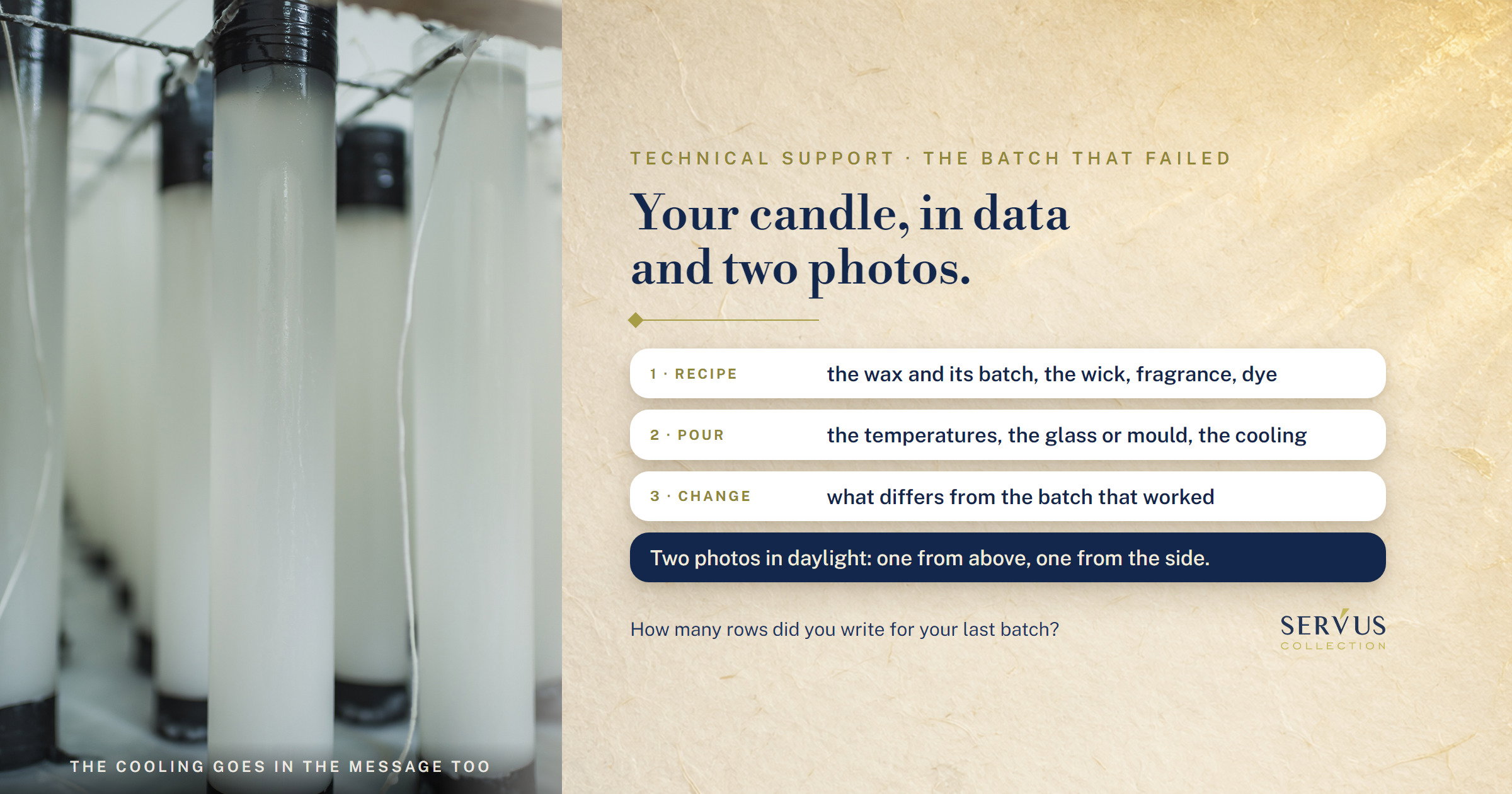
When you ask for candle-making technical support, send us in your first message the recipe with its batch numbers, the temperatures read on the thermometer, the container or mould with its inside diameter, what has changed since the batch that worked, and two photos in daylight, one from above and one from the side. With them we look for the cause on your candle.
Below you’ll find what to write to us when a batch doesn’t work out, what to add depending on what went wrong, what to tell us before you order, what we do with your message, and a message ready to copy. It’s written for anyone who writes to us: when you’re starting out, when you already sell or when you produce at volume.
I’m Sînziana. In our workshop in Maramureș, Romania, we’ve been pouring candles since 2010, and we sell on the waxes, wicks, fragrances and dyes we work with ourselves. On WhatsApp and on the phone, we answer in English. At the end of several articles we’ve written what to send us for the problem covered there. Here we’ve gathered them all, for when you don’t yet know what problem you have or want to ask before you buy.
How do you ask for candle-making technical support when a batch doesn’t work out?
When a batch doesn’t work out, you ask for technical support with three things in the same message: the recipe and pouring data, two photos in daylight, and what has changed since the last batch that worked. The data say what you poured, the photos show what came out, and the change tells us where to start.
If something’s missing, we’ll ask you afterwards, and the search takes one more exchange of messages. The same fault has several possible causes: wax pulling away from the glass can come from the pour, the glass, the cooling or the storage, as we wrote in the article on patches on the glass. Without data, we can only give general advice, which doesn’t tell you what to change in the next batch.
What do you tell us about the recipe and the pour?
From the recipe you give us the wax with the batch number from the bag, the wick, the fragrance, the dye and the additives with their doses, and from the pour the temperatures, the container or mould and the way the candle cooled. They’re the rows from your recipe notebook, if you keep one, so you copy them straight from there.
- The wax: the name or code and the batch number from the bag.
- The wick: the type, series and size, plus the batch, if you have it.
- The fragrance: the name and the percentage, or the grams added to the amount of wax.
- The dye: the name, the form, liquid or solid, and how much you added, in drops or in grams.
- The additives: what and how much, if you used any.
- The container or mould: the material, the inside diameter and the height; for a mould, the largest diameter and the thinnest section of the piece.
- The temperatures: at melting, at adding fragrance and at pouring, read on the thermometer, plus the temperature of the glass or mould when you poured.
- The cooling: the room, how warm it was and how many hours the candle stood before you took it out or lit it.
Each row answers a question we’d otherwise put back to you. The batch number tells us what figures your bag has: in the article on the candle that breaks when it comes out of the mould we wrote that two of our batches of 4120 differ by one degree in their congealing point. The inside diameter, together with the wax and the recipe, shows us which wick the test starts from, and the temperatures read on the thermometer show us whether the pour can explain the fault.
The recipe part of the message looks like this, for example: KeraSoy Container 4130 with the batch number from the bag, fragrance 5%, that is 25 g to 500 g of wax, no dye, SHW 50/7.5 wick, clear glass 5 cm across on the inside. What you didn’t note down, you say you didn’t note down. A guessed figure sends us looking for a cause that doesn’t exist. How many of these rows do you have written down for your last batch?
Which photos help us see what you see?
Two photos taken in daylight, without a filter, help us: one from above, with the surface and, if the candle has burned, with the melted wax around the wick, and one from the side, with the candle’s wall or, in a glass, with the place where the wax meets the glass. If the fault is in a single spot, add a third, close up, of that spot.
We read a lot from the photo from above. With grainy palm wax, from it we see the crystallisation, the shape and often the pot, before we ask you anything, as we wrote in the article on grainy palm wax. The side photo shows what can’t be seen from above: the depth of the melt pool in a glass, the wall in a mould, the patches between wax and glass.
Sometimes the most useful photo is the comparison. If you also have a good piece from the same batch, photograph it next to the problem one, in the same light. For a candle that broke coming out of the mould, send us a photo of the break and one of the mould, and for colour, the test drop on the worktop next to the cooled candle.
What to add depending on what went wrong
Depending on what went wrong, you add a few rows about your fault to the basic data: for a wick that goes out, how long it burned and after how long it went out; for a candle that broke coming out of the mould, how many hours it stood and how you took it out; for patches on the glass, when they appeared. The table below gathers them from the articles in which we wrote about each problem at length.
| What you see | What else to add to the message | The guide that can help you |
|---|---|---|
| the wick goes out or just glows | how much wick stood out of the wax, how long it burned each time and when it went out | why the wick goes out |
| the flame sinks into a hollow and leaves wax on the walls | the inside diameter of the glass and how long it burned the first time | candle tunnelling |
| soot on the glass, a smoking flame | how much wick stood out of the wax and how long it burned | why a candle produces soot |
| the candle breaks when it comes out of the mould | the mould temperature, how many hours it stood, how you took it out, a photo of the break and of the mould | the candle that breaks when it comes out |
| patches on the glass, wax pulling away from the glass | the batch of glassware, whether the glass was preheated, the cooling room and when you saw the patches | why wax pulls away from the glass |
| a grainy or "curdled" surface | the wax code, the pot and the temperature you poured at, with the photo from above | why palm wax turns grainy |
| the colour comes out differently from what you wanted | the dye and its form, the drops or grams, the temperature you added it at, the test drop on the worktop | liquid or solid dye |
| two technical data sheets that don’t match | a photo of the two rows, with their codes, and the batch number from the bag | how to read a wax technical data sheet |
| the burn test doesn’t pass | the test sheet and the log rows up to the evening with the problem | the burn test |
The guides in the last column help you check at home what can be checked before you buy other materials. If you’ve done the checks, send us their result too. If you don’t know where to start, or what you see isn’t in the table, write to us what you’ve noticed and send the photos.
How do you ask for help before you buy the wax and the wick?
Before you order, tell us three things: which technique you use, that is, pouring into glasses, pouring into moulds or rolling honeycomb wax sheets; which container or mould you work with, with its inside diameter; and what the candles are for. From the technique we choose the wax family, from the diameter the wick, and from the purpose what else you need to know before your first batch.
The question "which wax is best?" only has an answer after the technique. In a mould, the wax has to come away from the form; in a glass, it has to stay stuck. In the article on mould wax or container wax we wrote why the shrinkage that makes demoulding clean with 4120 is the main fault in a jar. The wax that’s best for your mould is a poor choice for your glass.
What are you making, what are you pouring into and who is it for?
Tell us whether you pour into glasses, pour into moulds or roll sheets, what inside diameter the container or mould has, and whether the candles are for you, to give as gifts or to sell. With these answers we tell you which wax to take, which wick to start from for your diameter and what test to do before the batch.
When you write that it’s your first time, we first ask how you want to work, by hand or by pouring. For a candle rolled by hand you need honeycomb wax sheets, and for one poured into a glass, container wax. If you want dried plants in the glass, we talk about them too: in the article on pouring safety we wrote what risk they bring next to the wick.
The purpose changes the list. If you’re starting out, what to buy first and what you can put off is in the article on what you need for candle making. If you sell, a burn test taken to the bottom comes before the batch. If you produce at volume, ask us about bulk cases too.
What you already have on the shelf, and from whom
Tell us what you already have on the shelf with the exact name, the code and the supplier: the wax in the opened bag, the wicks left over, the fragrances. We choose the wick on the wax and the diameter together, so a wick recommended without knowing your wax is a guess.
Say you have a bag of soy wax from another supplier and want only the wick from us. Then send us the technical data sheet of your wax too, with the manufacturer’s letterhead, and the inside diameter of the glass. From the data sheet we see what kind of wax it is and what it was designed for, that is, where the choice of wick starts; the confirmation still comes from your test.
If you no longer know the code, photograph the label on the bag. A photo of the label tells us more than a name remembered, especially when the same manufacturer has several waxes with similar names.
Why don’t we give you a percentage on the spot?
For a blend we haven’t poured, you find the percentage on a small test batch, because the blend changes the shrinkage, the adhesion and the pouring window all at once. A plausible figure, given on the spot, is more dangerous than none: it looks like a recipe and sends you straight to the batch.
Where we have poured the blend, we give you the figure and say what it came out on: on the page of the Kerawax 1150 additive we write that the blends tested in the workshop use 80–85% KeraSoy 4120 with 15–20% Kerawax 1150, for large pillars and complex shapes. For any other blend, tell us the exact products and what you want to achieve. If we haven’t poured it, we tell you so and agree what to compare on small batches: one thing changed per batch, with the same fragrance, the same wick and the same pot.
We keep the same rule with additives. Added as a precaution to a recipe that didn’t need it, an additive can take you from "it breaks when I take it out" to "it cracks as it cools", and you no longer find out why, because you changed two things at once. That’s why we don’t sell you an additive before we know whether the piece stayed in the mould long enough.
What support does with your message
When the recipe has worked before, candle-making technical support starts from what has changed since then; with a new recipe, from the wax and the vessel. Then we put your batch next to its documents, and if the material is from another supplier, we tell you what to ask them. We recommend a product to you when the data and the test show that changing it is the next step.
A new product is the answer only once we’ve checked what can be checked without it. For the candle that breaks when it comes out of the mould we wrote down the order in which we search, from what’s cheapest to change to what’s most expensive: the wax, the time, the mould, the temperature, the recipe. The time, the mould and the temperature you check without buying anything.
What has changed since the batch that worked?
What has changed since the batch that worked is the first question we ask when a recipe that used to work no longer does: the batch of wax, the wick, the fragrance or its dose, the glass, the temperature or the room it cooled in. The difference you find becomes the first variable to test.
Now, in autumn, the example is close at hand. The autumn batch has the same wax and the same wick as the summer one, but a new seasonal fragrance, and it starts to blacken the glass. The first test is the summer recipe next to the autumn one, with the same wick, burned under the same conditions, as we wrote in the article on soot. If only the piece with the new fragrance makes soot, you’ve found the variable.
The costly mistake is to change the wick and the fragrance in the same batch: if the candle then stops making soot, you don’t know which of them fixed it, and with the next batch you’re guessing again. When the recipe stops working after a new bag, the step-by-step check is in the article on the recipe that stops working with a new batch.
How we check the batch documents
We check the batch documents row by row: the batch’s certificate of analysis next to the wax’s technical data sheet and next to the certificate of the old batch. For the waxes for which we have the certificate of the batch in stock, we send it to you, and if your bag is from the same batch, you can make the same comparison yourself. The row that has moved from one batch to the next tells you what to test first; the test confirms the cause.
You read the certificate on the same row as the data sheet: the specification says what the manufacturer promises for any bag, the typical value what usually comes out, and the figure on the certificate what came out on that batch. How to read them, row by row, we wrote in the article on the wax technical data sheet. On a few wax pages, among them 4120 and EcoSoya Pillar, the manufacturer’s documents are under Download; for the others we send them to you by email, with the certificate of the batch in stock.
I’ll tell you up front that on our shelf there are waxes for which we only have the certificate, without the process data sheet. We know which they are and we’re asking for them. Until they arrive, the process figure you can rely on is the one from your own test.
What do we do when the material is from another supplier?
When the wax or the wick is from another supplier, we tell you what to ask them for: the manufacturer’s data sheet, with its letterhead, the method code next to each figure and the certificate of the batch you received. With them you can put the figures next to ours or next to those of your old batch.
The method code looks like a lab detail until you compare two waxes. On the certificates of two palm waxes on our shelf, the melting point appears as 56 on one and 60 on the other, and the second doesn’t have the method written. It looks like four degrees between two waxes; how much of the difference is material and how much is method, you can’t tell from the paper. So we ask the supplier which method the figure came from, and you can do the same.
Where to start
Start with a single message, written once, with the recipe, the pour, what has changed and the photos. Your question goes at the end, after you’ve written what you know.
The message to copy
The message to copy has seven lines. Fill in what you know and write "don’t know" where you didn’t take notes; you don’t need to have all the data to write to us.
- What I made: candle in a glass, in a mould or rolled; the material, inside diameter and height of the glass or mould; for me, to give as a gift or to sell.
- The recipe: the wax, the batch number from the bag and how much I melted; the wick, with its series and size; the fragrance, in grams to how many grams of wax; the dye, its form and how much I added; the additive and how much, if I used one.
- The pour: the temperature at melting, at adding fragrance and at pouring; the temperature of the glass or mould; the room it cooled in and how many hours it stood.
- What has changed since the batch that worked: or "it’s the first time".
- What I see and since when: what went wrong and when it appeared, the day after pouring, at the first burn or after a few days; if it has burned, how much wick stood out of the wax, how many hours each lighting lasted and at which one the problem appeared.
- The photos: one from above and one from the side, in daylight, plus a good piece next to it, if I have one.
- My question.
Line 4 shows us fastest where to look; if you don’t know what has changed, write that. The question goes last for a reason: once you’ve written the first six lines, you sometimes see for yourself what has changed and already have the test to do.
Where do you write to us, and when?
You ask for candle-making technical support on WhatsApp or by phone, at +40 726 162 810, Monday to Friday, between 08:00 and 16:30 (Romanian time). We answer in English, and on WhatsApp you send the photos straight from your phone, in the same conversation as the data.
The photo alone shows us the fault. The message with the data shows us your candle.